

How to Fix Grainy Photos: The Complete 2026 Guide to Clean, Sharp Images
July 4, 2026
Best Adobe Photoshop Alternatives 2026: Free & Paid Tools
July 8, 2026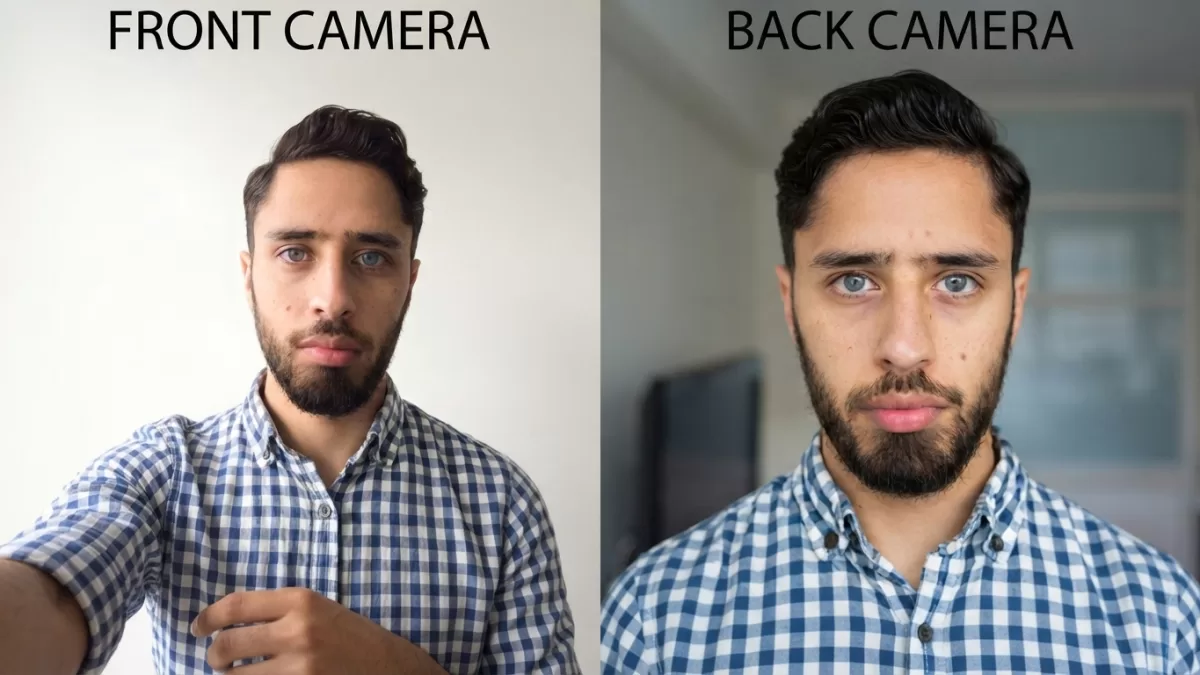
- TL;DR — The 30-Second Answer
- Introduction: Two Cameras, Two Very Different "You"s
- The Core Difference: What Front and Back Cameras Actually Do
- What Actually Distorts Your Face: Focal Length or Distance?
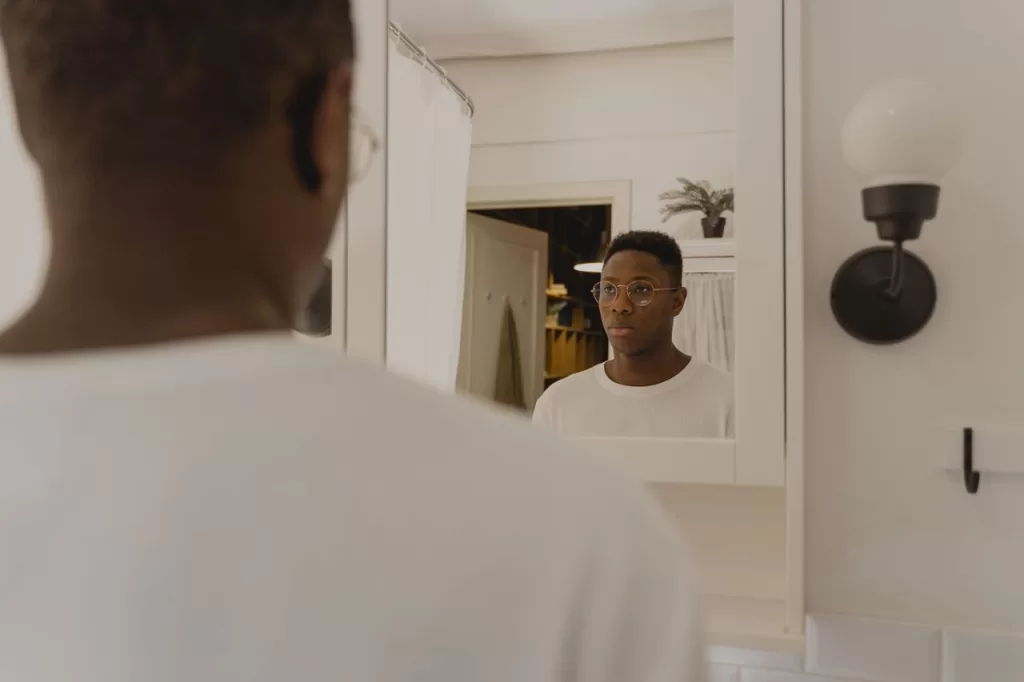
- The Mirror Question: Why Selfies “Feel Right” but Photos Don’t
- Hardware Deep Dive: Sensor, Lens, and Processing
- Computational Photography: The Silent Editor Inside Your Phone
- Side-by-Side: Front vs Back Camera at a Glance
- So Which One Is More Accurate? The Verdict
- Practical Tips: How to Get the Most Accurate Self-Photo
- Color Accuracy, Skin Tone, and White Balance
- What Professional Photographers Do Differently
- Front vs Back Camera for Different Use Cases
- Camera Angles That Change How “Real” You Look
- Common Myths About Front vs Back Cameras
- Pro Tips to Make Any Camera More Flattering (Without Lying)
- The Bigger Picture: Cameras Never Fully Capture Reality
- Quick-Reference Checklist for the Most Accurate Self-Photo
- FAQs: Front Camera vs Back Camera Accuracy
- Final Thoughts: Trust the Physics, Not the Filter
TL;DR — The 30-Second Answer
Which is more accurate, the front or the back camera?
The rear (back) camera produces a more optically accurate image of your face — because it uses a larger sensor, a sharper lens, and captures you un-mirrored, exactly the way other people see you. The front (selfie) camera feels more “like you” only because it mirrors the preview, matching the flipped reflection you’ve stared at your whole life.
Key takeaways at a glance:
- Back camera = closer to reality (how strangers, coworkers, and clients see you).
- Front camera = closer to your mirror self (what you’re used to seeing).
- Most “selfie distortion” is caused by shooting distance, not the lens itself. The Rutgers/Paskhover study published in JAMA Facial Plastic Surgery (2018) found that selfies taken 12 inches from the face make the nasal base appear 30% wider in men and 29% wider in women compared with a portrait shot from 5 feet away.
- For the truest photo of yourself: use the rear camera, hold it at arm’s length or farther, shoot from about 5 feet, and use soft, even light.
- Neither camera is “the real you” — reality lives somewhere between a flipped mirror reflection and an un-flipped rear-camera photo.
Struggling with dull, uneven selfies for your brand or e-commerce shots? Give every portrait a natural, magazine-ready finish with our professional photo retouching services.
Introduction: Two Cameras, Two Very Different “You”s
You snap a quick selfie with the front camera and think, “Yeah, that’s me.” Then a friend hands you their phone and shows a photo they just took of your face with the rear camera — and suddenly your nose looks different, your smile leans the other way, and you barely recognize yourself. Nothing about your face changed in those thirty seconds. So which camera is telling the truth?
The short answer surprises most people: the back camera almost always renders a more optically accurate image of your face, because it uses better hardware and does not flip the picture left-to-right. The front camera feels friendlier only because your brain has memorized your mirror reflection for years. This guide walks you through the optics, the psychology, and the practical photography tips that explain the gap — and helps you take images that look like the real you, whichever camera you choose.
The Core Difference: What Front and Back Cameras Actually Do
Two lenses built for two completely different jobs
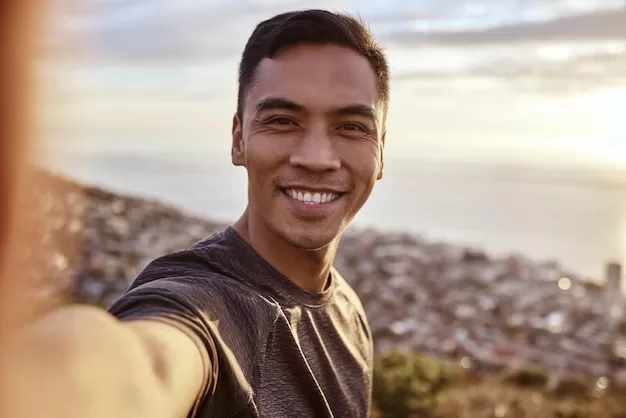
Smartphone makers design the front and back cameras for opposite goals. The front camera exists so you can frame a quick self-portrait or video call at arm’s length. The rear camera exists to photograph the world around you — landscapes, strangers, product shots — with the best hardware the phone can carry.
Here is what changes between the two:
- Sensor size: Rear sensors are physically much larger, so they gather more light and more detail.
- Lens quality: Rear lenses use more advanced optics and often multiple glass elements.
- Image processing: Rear cameras rely less on heavy noise reduction and skin smoothing.
- Field of view: Front cameras are usually wider to fit your face at close range.
- Focus system: Rear cameras use faster, more precise autofocus; many front cameras still use fixed focus.
Because of these choices, the rear camera preserves texture, color, and dimension that the front camera softens or blurs. The gap widens dramatically in low light, where the front camera’s smaller sensor smears detail and dulls skin tones.
Front camera: a mirror by design
Here is the twist most people miss: on nearly every phone, the front-camera preview is mirrored. That means the “you” you see on the screen is flipped horizontally — a scar on your right cheek appears on the left, your hair part swaps sides, and asymmetries you never noticed suddenly disappear. Some phones save the final image mirrored, some flip it back to un-mirrored at capture, and some let you toggle the behavior in settings (see the FAQ at the end for exact iPhone and Samsung paths). This flip is why so many people say the front camera “looks more like me.”
What Actually Distorts Your Face: Focal Length or Distance?
Photographers argue about this every day online, so let’s settle it with the science.
It’s the distance, not the “wide-angle lens” myth
Selfies get blamed for having “wide-angle” lenses that stretch faces. That is only half the story. As photographer-scientist Aaron Hertzmann explains in his write-up on perspective distortions, the effect comes from linear perspective mathematics, not a lens defect — and the driving variable is distance.
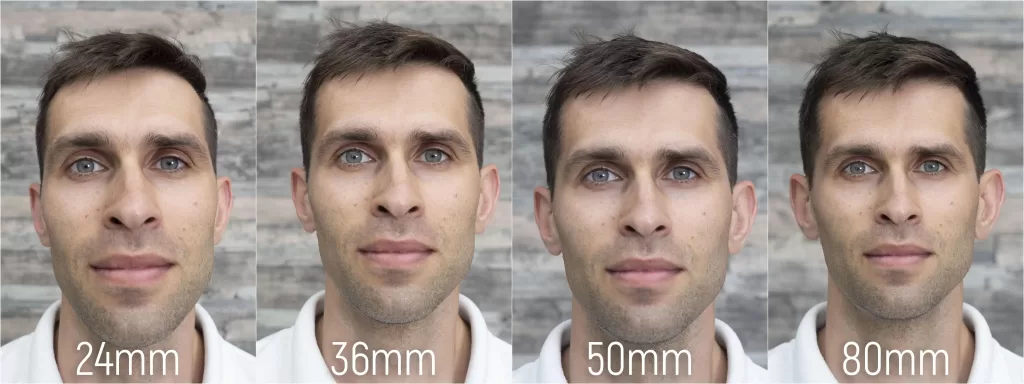
Research from portrait specialists at Ooh St. Lou Studios confirms it: when your face is 20–30 cm from any lens — wide-angle or not — the parts closest to the sensor bulge outward. Your nose is physically much closer to the sensor than your ears are, so the camera renders the closer object bigger. That is basic geometry, and it is why:
- Noses look wider and longer in close selfies
- Foreheads and chins bulge forward
- Ears shrink toward the back of the head
- Cheeks flatten and eyes appear farther apart
The focal-length reference ladder photographers use
- 22–26 mm equivalent (typical phone front camera): heavy perspective effect at close range
- 24–26 mm equivalent (typical phone rear main lens): noticeable at arm’s length; natural at 4+ feet
- 35–50 mm (“nifty fifty”): roughly matches human vision
- 85–135 mm (classic portrait range): compresses features flatteringly
- 200 mm+ (telephoto): flattens the face; ideal for editorial and fashion work
For context: Apple’s iPhone 16 Pro TrueDepth front camera uses a 23 mm equivalent f/1.9 lens, and the Samsung Galaxy S-series front cameras hover around 24 mm equivalent — both squarely in the “wide” zone. Traditional photographers consider 50–85 mm the sweet spot for portraits, because at that range facial features stay in natural proportion. Once you see the ladder, the front camera’s “distortion” reputation makes sense — its lens plus its close use-case is a recipe for exaggeration.
The 30% nose study
Plastic surgeons noticed a real-world consequence. The widely cited Rutgers University study led by Dr. Boris Paskhover, published in JAMA Facial Plastic Surgery in March 2018, modeled the geometry and found that a selfie taken 12 inches from the face makes the nasal base appear about 30% wider in men and 29% wider in women compared with a portrait shot from five feet away. The nasal tip alone appeared roughly 7% wider. Surgeons reported a spike in nose-job requests they nicknamed “Snapchat dysmorphia.”
Take the same person, back the camera up to five feet, and use a longer focal length — the nose returns to its true proportion.
The Google/MIT wide-angle correction breakthrough
A 2019 SIGGRAPH paper from Google and MIT researchers led by YiChang Shih confirmed that wider fields of view (up to 97°) stretch and twist faces near the edges of the frame — the reason group selfies push the outer people into “funhouse mirror” shapes. Google’s Pixel phones (starting with the Pixel 3 series and continuing today) ship with an on-device algorithm developed from that research that automatically detects faces near the edge of the frame and warps them back toward natural proportions. That software effort exists precisely because the raw wide-angle image is known to distort — a strong argument that the untouched front-camera photo is not “real life.”
Peer-reviewed follow-up research went further. In Derakhshan et al., “Quantifying Facial Distortion in Modern Digital Photography,” The Laryngoscope (2024), the authors measured midfacial distortion across smartphones and full-frame cameras and concluded that short “selfie” distances — not the camera brand or sensor format — drive most of the distortion effect.
If you want to understand how our eyes compare with any camera, this guide on human eye resolution puts megapixels and biological vision side by side.
The Mirror Question: Why Selfies “Feel Right” but Photos Don’t
Meet the mere-exposure effect
In 1968, psychologist Robert Zajonc published his landmark paper “Attitudinal Effects of Mere Exposure” in the Journal of Personality and Social Psychology, establishing the mere-exposure effect: simply put, the more we see something, the more we prefer it. You have seen your mirror image every morning of your life, so your brain has cast that flipped face as “correct.”
The specific research on mirror-versus-camera preference came almost a decade later, from the Mita, Dermer & Knight (1977) study “Reversed Facial Images and the Mere-Exposure Hypothesis” in the same journal. Participants preferred the mirror-reversed image of themselves at a roughly 2:1 ratio, while their friends and partners preferred the true (un-flipped) image. The finding has been replicated many times since, including in a 2024 study by Suchow and colleagues. In other words: you like your mirror-self; the world likes your camera-self.
So which one is “the real you”?
Both. And neither.
- The mirror shows accurate proportions but flips left and right.
- The rear camera shows accurate left–right orientation but can flatten depth.
- The front camera flips like a mirror and often distorts because of close-range wide-angle capture.
Your true face lives in a strange middle ground — a version friends, family, and cameras all agree on, but that your own brain rarely gets to see head-on. If you want to dig deeper into that overlap, our sister article on mirror vs camera accuracy walks through the topic from the reflection side.
Hardware Deep Dive: Sensor, Lens, and Processing
Rear camera specs almost always win
Open your phone’s official spec sheet and the imbalance jumps out. Flagship phones dedicate the vast majority of their camera engineering budget to the rear array. Premium 2026 flagships from Xiaomi, Vivo, and Sony now pair a 1-inch (or near-1-inch) main sensor on the back with a 1/3.4-inch to 1/3.6-inch sensor on the front — a size gap of several times, which translates directly to light-gathering ability. Even phones that stop short of a 1-inch main sensor, like the iPhone 16 Pro and Samsung Galaxy S25 Ultra, still carry noticeably larger rear sensors than their selfie counterparts.
- Rear camera (flagship): Larger sensor, optical image stabilization, multi-lens computational stacking, RAW support, wider aperture (often f/1.6–f/1.8), fast phase-detect autofocus.
- Front camera (flagship): Smaller sensor (Apple’s iPhone 16 Pro uses a 12 MP, 1/3.6-inch TrueDepth sensor at f/1.9), sometimes fixed focus, narrower aperture (often f/1.9–f/2.4), heavy skin-smoothing beauty processing enabled by default on many Android phones.
More sensor area means more real-world detail. More detail means more accuracy — freckles, pore texture, fine hair, and true skin tone all survive the trip from face to file.
Beauty modes silently rewrite your face
Many phones sold in Asia — and increasingly worldwide — ship with beauty filters turned on by default for the front camera. These filters enlarge eyes, thin jawlines, smooth skin, and sometimes reshape noses, all before you even tap the shutter. If your selfies look prettier than a mirror check but different from friends’ photos, hidden beauty processing is often the reason. Turn it off in your camera settings for a raw, honest capture.
Selling on Amazon or Shopify? Deliver crisp, distortion-free product shots — our background removal service makes every image look retail-ready in hours.
Computational Photography: The Silent Editor Inside Your Phone
Modern smartphones no longer capture a photo — they compute one. Every time you tap the shutter, algorithms merge multiple exposures, denoise the shadows, sharpen edges, and often reshape faces.
What your phone secretly does
- HDR stacking blends multiple exposures for balanced highlights and shadows.
- Night mode stitches long exposures into a single low-noise frame.
- Beauty filters smooth skin, enlarge eyes, and slim jawlines — sometimes without asking.
- AI-based portrait relighting re-renders shadows on your face.
- Semantic segmentation separates you from the background before applying different treatments to each.
- Face-warp correction (on Pixel phones since the Pixel 3) undistorts faces near the edges of wide-angle group shots.
Why this matters for “accuracy”
If two phones photograph the same face at the same distance in the same light, they can still produce noticeably different images because their computational pipelines differ. iPhones apply a subtle facial smoothing that Apple engineers have publicly discussed. Samsung, Google, and Xiaomi each tune their processing differently. So the “real you” is filtered not just by physics but by proprietary code — which is why one friend’s photo of you can look flattering and another’s can look harsh, even from an identical angle.
If you’re weighing whether to touch up images after the fact, our list of the best AI photo editing software in 2026 is a good starting point.
Side-by-Side: Front vs Back Camera at a Glance
| Feature | Front (Selfie) Camera | Back (Rear) Camera |
|---|---|---|
| Sensor size (typical) | Smaller (~1/3.4–1/3.6 in) | Larger (up to ~1 in on flagships) |
| Resolution (typical) | 10–32 MP | 48–200 MP |
| Field of view | Ultra-wide (~85–95°) | Wide to standard (~70–80°) |
| Focal length equivalent | ~22–26 mm | ~24 mm wide / 50 mm main / 70–200 mm tele |
| Autofocus | Often fixed | Fast phase-detect / laser AF |
| Low-light performance | Weaker | Much stronger |
| Mirror flip | Yes (preview, sometimes final) | No |
| Beauty processing default | Frequently on | Usually off |
| Distortion at arm’s length | High | Moderate |
| Best for | Video calls, casual selfies | Portraits, product shots, real-life accuracy |
| Closer to real-life look | ✕ Less accurate | ✓ More accurate |
So Which One Is More Accurate? The Verdict
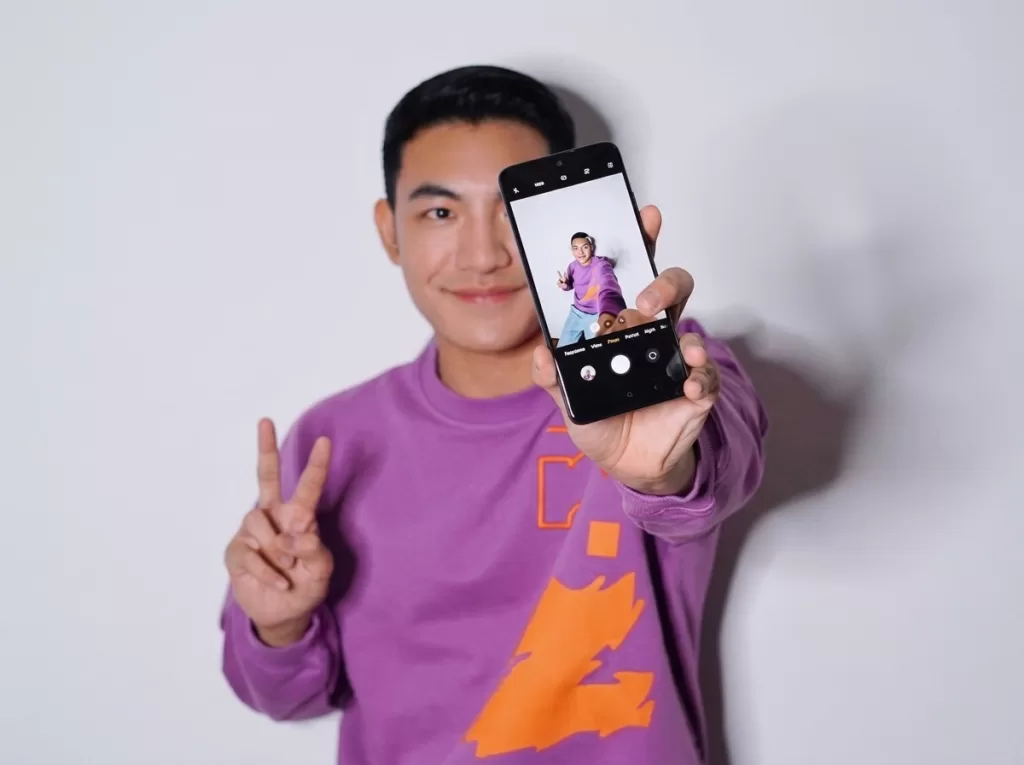
If accuracy means “the way other people actually see you,” the rear camera wins — because it captures your face un-mirrored, with better optics and more honest color. This is the version of your face the world moves through every day.
If accuracy means “the version I recognize as me,” the front camera wins — because it mirrors the preview and matches your lifelong mental self-image.
The truest, least-distorted photograph of your face happens under three conditions at once:
- Shot with the rear camera (ideally at 2x or 3x optical zoom to approximate a ~50 mm portrait focal length)
- From at least four to five feet away (use a friend, tripod, or shutter remote)
- Under soft, even, front-facing light
That combination gives you a portrait a professional photographer would recognize as accurate. Everything else is either a flipped mirror version or a close-range fisheye impression of it.
Practical Tips: How to Get the Most Accurate Self-Photo
For selfies with the front camera
- Hold the phone as far from your face as your arm allows, ideally with a small selfie stick or tripod.
- Turn off beauty filters in the camera app settings.
- Use soft daylight — north-facing window light beats overhead ceiling light every time.
- Tilt the phone slightly above eye level to slim the jawline naturally without exaggerated distortion.
- Do not zoom digitally; digital zoom on the front camera crushes detail.
For rear-camera portraits
- Ask a friend to shoot from five to seven feet away using the standard 1x lens, or use 2x or 3x optical telephoto to approximate a classic 50–85 mm portrait focal length.
- Use a tripod and self-timer or shutter remote if no photographer is available.
- Face a large window; keep your back to darker areas for natural three-point lighting.
- Position the camera at eye level, not tilted up (which enlarges the chin and nostrils).
- Shoot in burst mode and pick the frame where micro-expressions align.
- Check the final image on a calibrated screen — phone displays exaggerate saturation.
Pair this with a quick refresher on beginner photography tips and you will beat most selfies on the internet without buying new gear.
Need to isolate a subject cleanly from any background? Our expert clipping path service delivers hand-drawn precision on every edge.
Color Accuracy, Skin Tone, and White Balance
Even if geometry is perfect, color can still lie. Front cameras often push warmer, softer skin tones because they are optimized for pleasing selfies, not realism. Rear cameras generally produce cooler, more neutral color — closer to what a calibrated monitor would show.
Watch for these color traps:
- Auto white balance shifting under mixed indoor and outdoor light
- HDR modes blowing out highlights on cheeks or foreheads
- Beauty modes desaturating freckles, birthmarks, and skin texture
- AI scene detection artificially warming portraits it identifies as “faces”
For truest color, shoot in your phone’s Pro or Expert mode with white balance set manually, or better still capture in RAW and correct in software such as Adobe Lightroom, Capture One, or the free open-source alternative Darktable.
What Professional Photographers Do Differently
Professional portrait shooters solve this problem the same way every time — and every rule is possible to approximate on a smartphone:
- Stand eight to ten feet away from the subject.
- Use an 85 mm or 105 mm portrait lens (or the equivalent focal length on a zoom).
- Light the subject from slightly to the side and above, with a soft diffuser.
- Direct the subject to look above the lens, not straight at it, to widen the eyes naturally.
- Shoot many frames and pick the one where micro-expressions align.
Smartphone owners can approximate every rule. Use your rear telephoto, back up, use daylight, shoot in burst mode, and pick the best. The result will look startlingly close to a pro headshot — and far more accurate than any front-camera selfie.
Turning apparel photos into store-ready hero images? Our ghost mannequin editing service gives garments a clean, floating 3D look buyers trust.
Front vs Back Camera for Different Use Cases
For LinkedIn headshots and resumes
Always use the back camera at 4–6 feet distance with soft frontal light and eye-level framing. Recruiters will meet you at eye level, so your photo should mimic that geometry. The American Academy of Facial Plastic and Reconstructive Surgery has repeatedly warned against evaluating your own face from selfies — the same warning applies to headshots.
For dating apps
Mix both. Include at least two back-camera shots (one full-body, one mid-range portrait) so viewers see the “true you” rather than only the flattering selfie geometry. Save the front-camera shots for the candid, personality-driven images.
For online IDs and passports
Passport agencies require rear-camera-style undistorted portraits. That’s why booths use a longer focal length and a fixed distance — precisely to avoid the front-camera stretch.
For e-commerce product photos
The back camera is non-negotiable. Sensor size and detail matter, and any face-warping algorithm should stay far away from products. For advanced polish on jewelry, apparel, or reflective goods, professional post-production such as image masking unlocks details a smartphone alone cannot deliver.
Here the front camera earns its keep. It frames you instantly, works well at arm’s length, and matches the mirrored view most video apps display. For a five-second Story, a Zoom call, or a TikTok, hardware inferiority does not matter. Our roundup of the best vlogging cameras of 2026 covers dedicated tools for on-camera creators who want to level up.
For group shots, travel, and complex backgrounds
The rear camera wins any time more than one person is in the frame or the background matters. Its wider dynamic range holds shadows and highlights the front camera crushes. For sweeping landscapes and cityscapes behind your face, the rear camera keeps buildings straight and skies rich.
Camera Angles That Change How “Real” You Look
Angle matters as much as camera choice. Photographers use these general rules to render faces honestly:
- Slightly above eye level: Elongates the neck and slims the jaw — the most universally flattering angle.
- Straight-on at eye level: The most objectively accurate angle for portraits, headshots, and ID photos.
- Below eye level: Emphasizes the jaw and nostrils, often making faces look heavier or more dominant.
If you want a portrait that matches how people actually experience your face during conversation, shoot straight-on at eye level with the rear camera. If you want a friendlier social-media portrait, tilt slightly above. Neither is dishonest — they simply flatter different features.
You can also learn from long-form guides like our roundup on top camera brands to see how different sensor philosophies influence portrait rendering.
Common Myths About Front vs Back Cameras
Myth 1: “The front camera lies.”
It does not lie — it flips and softens, which is different from lying. It shows a genuine but mirrored version.
Myth 2: “Wide-angle lenses are the sole cause of distortion.”
The primary cause is distance to subject, not the lens itself. A 200 MP camera held 12 inches from your face still stretches your nose.
Myth 3: “Higher megapixels equal higher accuracy.”
Megapixels affect resolution and detail, not perspective. Sensor size, pixel size, and lens quality matter far more.
Myth 4: “The front camera adds weight to your face.”
Not exactly. The wide lens plus short distance widens the middle of your face at the expense of your ears — creating the illusion of a rounder face, not extra weight.
Myth 5: “Mirrors are 100% accurate.”
Mirrors flip left–right, and even minor tilt distorts the reflection. They are not the neutral referee people assume.
Myth 6: “Filters are the only reason selfies look edited.”
Even without a beauty filter, most phones apply base-level skin smoothing, tone-mapping, and edge sharpening automatically.
Myth 7: “The back camera can’t take selfies.”
Modern phones offer flip-to-selfie modes, remote shutter accessories, and AI-guided framing that lets you shoot self-portraits with the rear array. Try it — it will change how you photograph yourself.
Need a spotless background for a professional headshot or product page? Try our background removal service — clean cutouts in as little as a few hours.
Pro Tips to Make Any Camera More Flattering (Without Lying)
You don’t need studio gear to look like yourself at your best. A few habits close the gap between “front-camera weird” and “back-camera true.”
- Elongate your neck slightly and drop the shoulders — it defines the jaw naturally.
- Aim your chin slightly downward and forehead slightly forward.
- Blink right before the shutter to relax the eyes.
- Avoid overhead lighting — it casts unflattering shadows under the eyes and nose.
- Wear solid, mid-value colours so the camera exposes your face correctly.
- Take multiple frames, then pick — don’t rely on the first shot.
Advanced tip: understand the geometry
If you know that closer = bigger, you can use that to your advantage. Tilting the phone so your eyes are closest to the lens (instead of your nose) instantly creates a more balanced face. Many portrait pros call this “eye-forward framing,” and it costs nothing to try.
The Bigger Picture: Cameras Never Fully Capture Reality
No two-dimensional image can perfectly recreate a three-dimensional human face. Human eyes see in stereo, with two overlapping viewpoints that your brain fuses into depth. A single-lens camera collapses that depth into a flat rectangle, which is why every photograph — front, rear, or professional — includes some measure of interpretation. Even our own perception of ourselves in a mirror is filtered through familiarity bias, lighting, and posture.
The healthy takeaway: do not treat any single image as the final verdict on how you look. Reality lives in the composite — the way you appear across many photos, in many mirrors, on many days, to many people. If you want to explore how sensors chase that reality, our deep-dive into the evolution of photography traces the whole journey from pinhole to computational imaging.
Quick-Reference Checklist for the Most Accurate Self-Photo
- Use the rear camera, not the front.
- Shoot from at least arm’s length + tripod extension, or ideally 5+ feet.
- Zoom to 2x or 3x optical on multi-camera phones to approximate a 50 mm portrait focal length.
- Turn off beauty modes, filters, and heavy HDR.
- Light your face with soft, front-facing daylight.
- Aim the camera at eye level or slightly above.
- Shoot in burst mode; keep only the best frames.
- Review on a calibrated screen, not the phone’s saturation-boosted preview.
- Edit lightly — correct color and exposure, not proportions.
FAQs: Front Camera vs Back Camera Accuracy
1. Is the front camera or the back camera more accurate to real life?
The back camera is more optically accurate because it captures an un-mirrored image with a larger sensor and better lens. However, the front camera feels more familiar because it flips the preview to match your mirror reflection.
2. Why do I look different in the front camera than in the back camera?
Two reasons. First, the front camera usually mirrors the image while the rear does not, so left and right swap. Second, front cameras are wider and used at close range, which exaggerates features closest to the lens — especially the nose.
3. Does the front camera really make my nose look bigger?
Yes, when held at typical selfie distance. Dr. Boris Paskhover and colleagues at Rutgers found that a selfie taken 12 inches from the face makes the nasal base appear about 30% wider in men and 29% wider in women compared with a portrait shot from five feet away, with the nasal tip appearing about 7% wider. That’s geometry, not filter magic.
4. Do other people see me as I appear in the mirror or the camera?
Other people see the un-mirrored, rear-camera version of you. Your mirror image is horizontally flipped, so a rear-camera photo — however unfamiliar — is closer to how the world actually sees your face.
5. Why do I look better in the mirror than in photos?
The mere-exposure effect. The Mita, Dermer & Knight (1977) study showed people prefer their mirror image at roughly a 2:1 ratio, while their friends and partners prefer the true camera image. Familiarity, not accuracy, drives the preference.
6. Which camera is better for a professional headshot?
The rear camera, hands down. Combine it with a tripod, natural light, and a five- to seven-foot shooting distance for the closest thing to a studio portrait a smartphone can produce.
7. Can I make my front camera stop mirroring the photo?
On iPhone, go to Settings → Camera → Composition → Mirror Front Camera. Note that Apple’s toggle is a little counter-intuitive: turning it ON saves the mirrored (preview-matching) version, and turning it OFF saves the un-flipped “true” version. On many Samsung Galaxy phones, open the Camera app → Settings (gear icon) → “Save selfies as previewed” — toggle it ON to keep the mirrored preview version, OFF to save the un-flipped image. On stock Google Pixel phones, look for “Mirror selfies” in the Camera app’s settings.
8. Do all smartphones distort faces the same way?
No. Field of view varies (typically 70°–100° for the front camera), and computational processing differs by brand. Google’s Pixel line applies automatic face-warp correction on wide-angle group shots; other phones don’t.
9. Is a higher megapixel front camera automatically more accurate?
No. Sensor size, pixel size, lens quality, and image processing all outweigh raw megapixel count. A 12 MP camera with a bigger sensor typically produces a more accurate image than a 48 MP camera with a tiny sensor.
10. Should I edit my selfies to correct distortion?
For personal shots, only if you want to. For professional headshots, product listings, or IDs, yes — subtle geometry corrections align the photo with reality without altering your identity.
Ready to turn your best photos into scroll-stopping visuals? Explore the full range of professional editing solutions at Clipping Expert Asia and let our team polish every pixel.
Final Thoughts: Trust the Physics, Not the Filter
Neither camera is your enemy, and neither camera is the whole truth. The front camera flatters familiarity, mirrors your reflection, and prioritizes speed. The back camera delivers accuracy, sharpness, and the version of your face the rest of the world knows.
The front-versus-back debate isn’t really about which lens is honest — it’s about understanding how cameras translate three-dimensional humans into two-dimensional images. Once you know why each one behaves the way it does, you can use them both intentionally instead of blaming the lens for a bad angle.
If the goal is a photograph that shows you the way friends, family, and strangers experience you every day, reach for the rear camera, back up, breathe out, and let the sensor do its honest work. Your best portrait is not hidden behind a filter — it is waiting a few feet farther away than you think.