


How Big Is a 5×7 Photo | A Detailed Explanation
February 9, 2026
Best Photo Retouching Agencies in 2026
February 9, 2026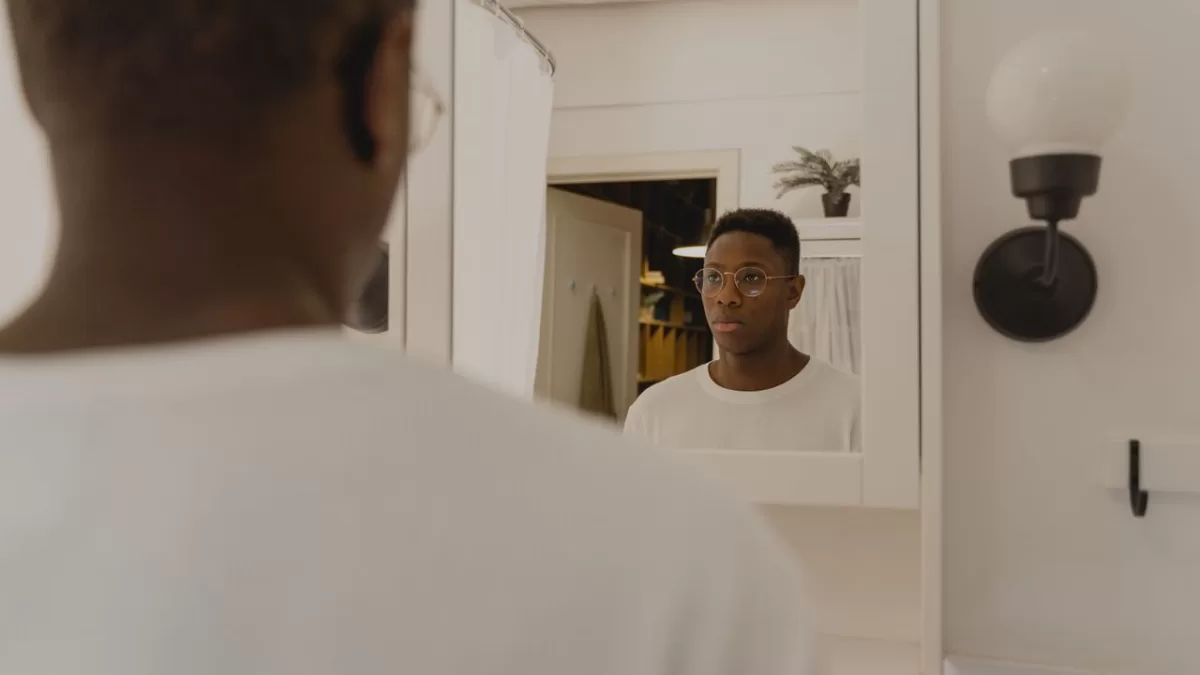
Ever glanced in the mirror feeling confident, then cringed at a photo taken seconds later? You are not alone — and the science behind it is genuinely fascinating.
Millions of people ask the same question every day: is a mirror more accurate than a camera, or does the camera show the “real” you? The honest answer sits between the two — and it involves optics, psychology, focal length, lateral inversion, and even how your brain hard-wires familiarity into what it calls “beauty.” This in-depth guide unpacks the science, busts common myths, and shows you exactly when to trust your reflection versus your photograph.
Want to boost your online sales with better product photography?
High-quality images increase conversions by up to 40%. Let us help you get there. See our editing services
- The Short Answer First: Mirror vs Camera Accuracy
- How Mirrors Work: The Physics of Reflection
- How Cameras Capture Your Image: The Optics of Photography
- Why Selfies Are the Worst Culprit for Distortion
- The Psychology: The Mere-Exposure Effect Explained
- Mirror vs Camera: Side-by-Side Accuracy Comparison
- Other Sources of Distortion Nobody Talks About
- So, Which One Should You Trust?
- For Product & Portrait Photographers: Getting Camera Accuracy Right
- Emerging Tech: Can AI Close the Gap?
- Common Myths, Busted
- Practical Tips: Look More Like Your True Self in Photos
- Cultural & Historical Context
- Final Verdict: Is a Mirror More Accurate Than a Camera?
- FAQs: Mirror vs Camera Accuracy
The Short Answer First: Mirror vs Camera Accuracy
Neither the mirror nor the camera shows the 100% “true” version of you — but each is accurate in a different way.
- A mirror is more accurate to how you see yourself every day, because it delivers a real-time, high-resolution, 3D, laterally-flipped reflection.
- A camera is more accurate to how others see you, because it captures a non-flipped, 2D image — closer to what other people’s eyes and brains actually register.
Most people instinctively prefer their mirrored reflection because they have seen it thousands of times. Photographs, on the other hand, feel unfamiliar even though they represent your outward appearance more objectively. So if you are wondering “is the mirror more accurate than the camera?” — the smarter framing is: accurate for whom?
How Mirrors Work: The Physics of Reflection
Lateral Inversion Explained Simply
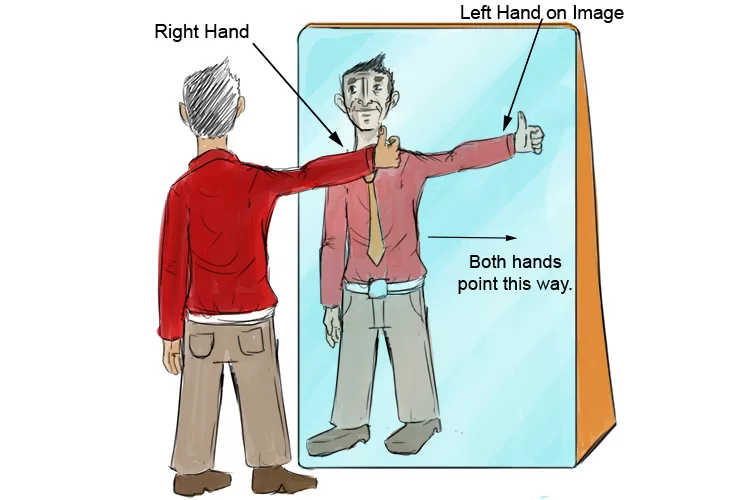
Mirrors follow one basic optical rule known as the law of reflection: the angle of incidence equals the angle of reflection. When light bounces off a smooth, silver-backed sheet of glass, it produces a virtual image — an image that appears behind the mirror but does not actually exist there.
The key property? Lateral inversion. Your left hand appears on the right side of your reflection, and vice versa. Physics educators at BYJU’S explain that this reversal is exactly why text held up to a mirror reads backwards.
Why Plane Mirrors Feel So Real
Bathroom mirrors, wardrobe doors, and vanity mirrors are almost always plane mirrors — perfectly flat sheets of glass with a reflective coating. They deliver:
- A 1:1 size ratio to your actual body
- Real-time motion feedback with zero shutter lag
- Full 3D depth, because both of your eyes still work together (binocular vision)
- True colors under whatever ambient light you happen to be standing in
That is why makeup artists, dentists, and stylists still trust mirrors for close-in work — no other tool matches that live, dimensional feedback.
The Distortion Problem: Not All Mirrors Are Equal
Not every mirror plays fair. Curved mirrors — convex or concave — bend your reflection dramatically. Convex mirrors (like store security domes) make you look smaller and wider. Concave mirrors can stretch you tall. Even a flat mirror can warp your image if the glass has ripples, waves, or manufacturing flaws.
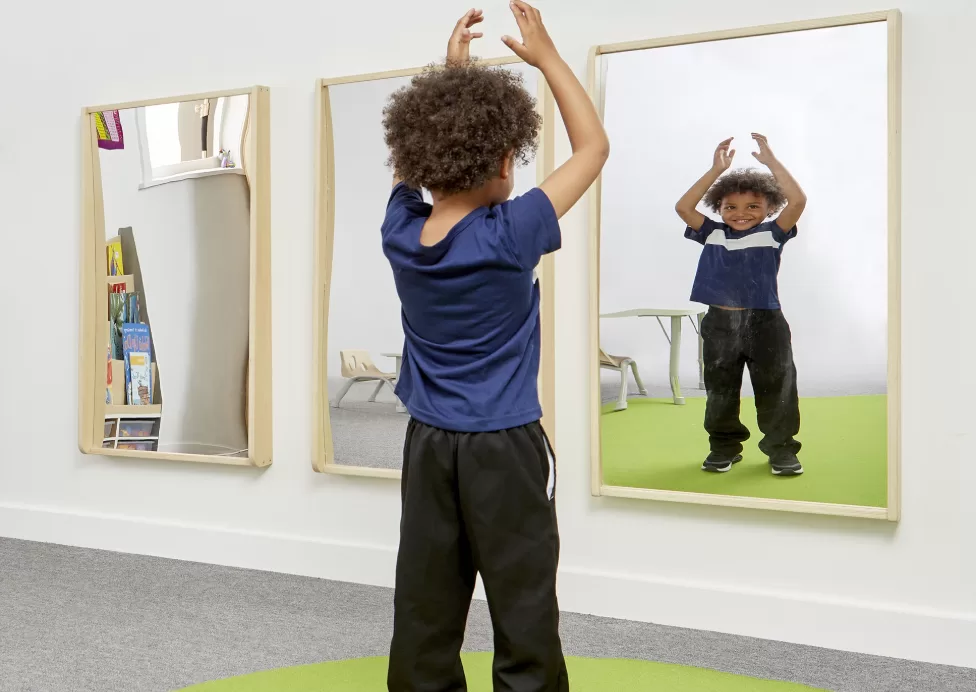
Retailers know this. Some fitting-room mirrors are subtly tilted or slightly convex to make shoppers look slimmer. That “amazing outfit mirror” you love? It might be lying to you — but pleasantly.
How Cameras Capture Your Image: The Optics of Photography
A camera does not reflect — it records. Light passes through a curved lens element, focuses onto a digital sensor (CMOS or CCD) or a piece of film, and gets converted into a two-dimensional image file.
The Flatness Problem
Your eyes gather visual information in stereo — each eye sees a slightly different angle, and your brain fuses them into a full 3D scene. A single camera lens cannot do that. It flattens depth into a plane, which:
- Compresses features
- Strips away the subtle contour information your brain uses to recognize you
- Freezes a single expression at roughly 1/60th of a second — sometimes at your worst blink
This flattening alone explains why a still image often feels “off” compared to real life. If you want to soften those flattened results afterwards, understanding your photo editing workflow becomes essential.
Focal Length: The Silent Face-Changer
Focal length hugely influences how accurate a photo of your face looks:
- Wide-angle lenses (14–35mm) — exaggerate whatever is closest to the lens. Your nose looks bigger, your forehead balloons, your chin recedes.
- Standard lenses (~50mm) — sit closest to natural human vision and produce the least distortion.
- Portrait lenses (85–135mm) — mildly flatten features, which most viewers find flattering.
- Telephoto lenses (200mm+) — compress facial features and background, sometimes too aggressively.
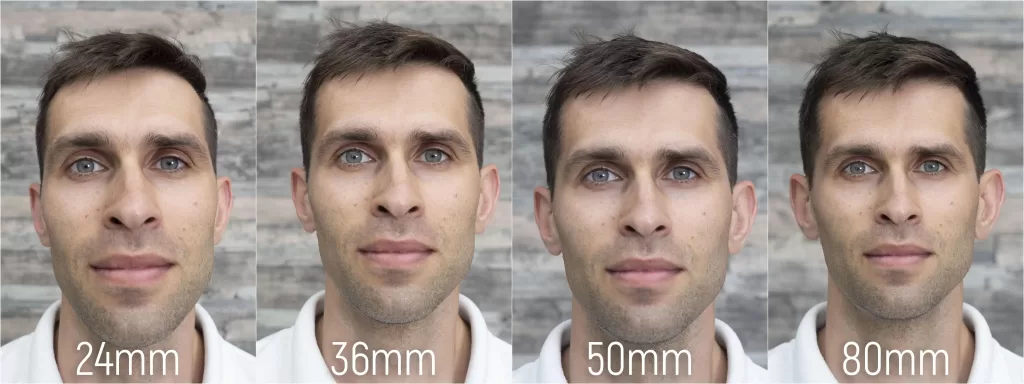
Portrait photographers overwhelmingly recommend 85–105mm for headshots — a rule of thumb reinforced by guides like Shotkit’s lens breakdown and echoed across the industry.
Want to enhance colors and contrast without losing realism?
Trust our experts to perfect your images with our Photo Retouching Service
Why Selfies Are the Worst Culprit for Distortion
The Front Camera Is Not Your Friend
Most smartphone front cameras use a 24–28mm full-frame equivalent focal length — clearly on the wide-angle side. Held at arm’s length (roughly 30–40 cm from your face), that wide field of view magnifies whatever features stick out — usually the nose and the closest cheek.
A peer-reviewed 2024 study titled “Quantifying Facial Distortion in Modern Digital Photography,” published in The Laryngoscope, quantified the effect precisely. Researchers found selfies taken 12 inches from the face produced a ~30% increase in the ratio of nasal breadth to bizygomatic (cheekbone) width, along with roughly 6.4% longer nasal length, compared to standard clinical portraits shot at proper distances. In short: the closer you hold the phone, the more your nose visually dominates your face.
Mirrored vs. Un-Mirrored Selfies
Smartphones add another layer of confusion. Most default to showing you a mirrored preview on-screen (so you feel oriented like a mirror), but many phones save the file un-flipped — matching what others see. Some Android phones let you choose in settings. iPhones added a “Mirror Front Camera” toggle in iOS 14 and later.
That explains the classic complaint: “The preview looked fine — why does the saved photo look weird?” Your brain briefly saw the familiar mirror-you, then the phone handed you the true un-flipped version. To your neurons, that flipped version is essentially a stranger’s face.
If you shoot a lot of selfies, it also helps to understand your camera’s default aspect ratio — the 4:3 aspect ratio still rules most phone front cameras and shapes how the frame crops your features.
The Psychology: The Mere-Exposure Effect Explained
Why You Prefer the Mirror
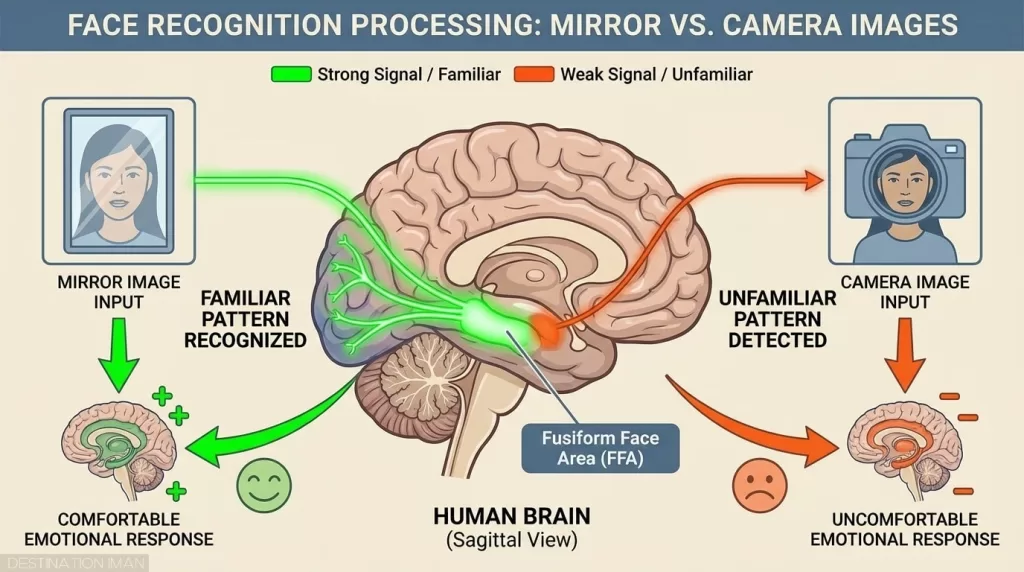
This is the single most important concept in the whole debate. In 1977, psychologists Theodore Mita, Marshall Dermer, and Jeffrey Knight published a landmark paper titled “Reversed Facial Images and the Mere-Exposure Hypothesis” in the Journal of Personality and Social Psychology (Vol. 35, No. 8). Their findings changed how researchers view self-perception:
- Subjects preferred a mirror-reversed photograph of themselves over their true photograph.
- Their close friends and partners preferred the un-reversed, true-view photograph — because that is the face they see every day.
The mechanism is simple: our brains equate familiarity with likability. Social psychologist Robert Zajonc first documented this bias — the mere-exposure effect — in the 1960s, and it has been replicated across dozens of contexts since.
Facial Asymmetry Amplifies the Shock
No human face is perfectly symmetrical. Your eyebrows sit at slightly different heights, one nostril flares wider, your smile pulls stronger on one side. In the mirror, you learn to love those asymmetries because you see them daily in one orientation. Flip them left-to-right in a photograph, and your brain instantly senses that something is off.
Nothing changed on your face. Only the orientation changed. The discomfort is neurological, not cosmetic.
Mirror vs Camera: Side-by-Side Accuracy Comparison
| Factor | Mirror | Camera |
|---|---|---|
| Image orientation | Flipped (lateral inversion) | Un-flipped (true) |
| Dimension | 3D depth via binocular vision | Flat 2D representation |
| Motion | Real-time, dynamic | Frozen single instant |
| Familiarity to self | Very high | Low |
| Familiarity to others | Low | Very high |
| Distortion sources | Curved glass, warps, tilt | Focal length, angle, sensor |
| Color accuracy | Depends on ambient light | Depends on white balance |
| Resolution | Effectively unlimited | Sensor-limited (megapixels) |
| Best for | Self-perception, grooming | Sharing, ID, others’ perception |
If color rendering matters for your specific use-case — checking foundation, wall paint, or product shots — brushing up on white balance settings will make a bigger difference than swapping mirrors ever will.
Other Sources of Distortion Nobody Talks About
Lighting Changes Everything
Even a perfect lens paired with a perfect mirror will lie if the light lies:
- Harsh overhead light casts shadows under eyes, nose, and chin — aging you ten years in a single frame.
- Warm yellow bulbs flatter skin tone; cool fluorescents drain color and highlight blemishes.
- Camera flash, fired straight-on, kills natural contour and enlarges pores.
- Golden hour sunlight softens skin and quietly hides asymmetry.
Angle and Distance
A mirror at chest height flatters you. Raise the camera six inches above your eyes and your jawline sharpens. Drop it six inches below and you get the dreaded double-chin look. Neither photo lies — they simply show different geometric projections of the same face.
Facial Expression Freezing
Your face rarely holds a still pose in real life. Mirrors show you a living stream of micro-expressions. A camera, however, captures a single 1/60th-of-a-second slice — sometimes mid-blink, mid-syllable, or mid-nostril-flare. That frozen frame becomes a snapshot your brain never had a chance to average out into the “you” it recognizes.
If you find yourself editing portraits after the fact, some of that frozen awkwardness can be softened — a well-executed color grading pass often does far more than filters ever will.
Want your images to look professionally edited, not over-processed?
Achieve natural, high-end perfection with our skilled Photo Retouching Service
So, Which One Should You Trust?
Here is a practical decision framework you can apply today:
Trust the mirror when you need to:
- Apply makeup or shave
- Check outfit fit
- Practice a speech, expression, or pose
- Judge how a new haircut feels to you
- Get real-time feedback on hair, teeth, or accessories
Trust the camera when you need to:
- Send an ID photo or passport picture
- Post on a dating profile or LinkedIn
- Understand how strangers, employers, and cameras will actually see you
- Shoot professional headshots
- Judge symmetry objectively
Trust both together when you need to:
- Prepare for a video call or interview (mirror to pose, camera to verify)
- Do professional photography of yourself or your products
For Product & Portrait Photographers: Getting Camera Accuracy Right
Amateur photographers often blame their gear when the real culprit is technique. Here is how professionals minimize the “camera lies” problem:
- Use focal lengths between 50mm and 135mm for face shots on a full-frame body
- Increase the subject-to-camera distance — six feet or more is a solid rule for portraits
- Diffuse the light — softboxes, umbrellas, or a large north-facing window beat direct flash every time
- Match white balance to the light source so sensor accuracy actually reflects the scene
- Shoot in RAW and correct residual lens distortion in post-production
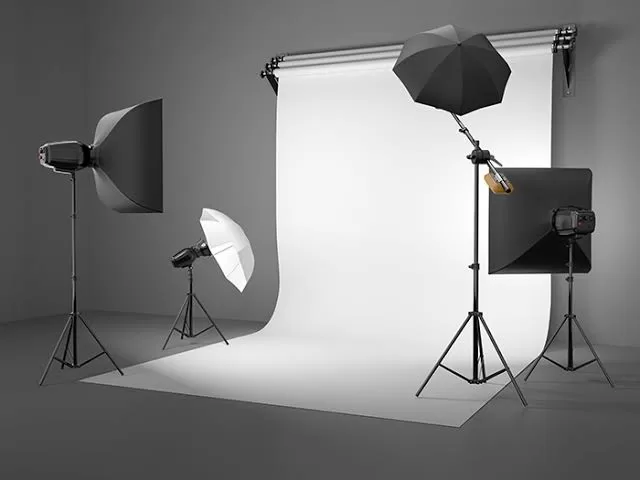
For E-commerce, apparel, and jewelry shoots — where visual accuracy converts directly into sales — post-production carries just as much weight as lens choice. A clean, un-distorted product shot only lands when the background is transparent or neutral, colors are precisely rendered, and edges are surgically defined.
Need an editing service that offers unlimited revisions?
Experience risk-free, perfect cutouts with our Clipping Path Service
Emerging Tech: Can AI Close the Gap?
Modern computational photography is quietly narrowing the distance between mirror and camera:
- Google Pixel and Apple iPhone apply real-time facial geometry correction to counter selfie distortion.
- AI portrait modes simulate proper focal-length compression using on-device depth mapping.
- Smart mirrors with embedded cameras now show you an un-flipped view — literally what others see.
- Neural retouching engines can reverse lens distortion after the shot is taken.
Photographers weighing whether to lean into these tools should read up on the best AI photo editing software available in 2026. The technology is catching up fast — but human judgment still matters more than any algorithm.
Common Myths, Busted
Myth 1: “The mirror shows the real you.”
Only partially. The mirror shows a reversed real-time version. Others never see that view.
Myth 2: “The camera adds ten pounds.”
Not the camera — the wide-angle lens combined with a close shooting distance does. Step back or zoom in and the “ten pounds” disappears.
Myth 3: “I’m ugly because my photos look bad.”
Photos capture single frames under specific lens, light, and angle conditions. Your face in motion — the face people fall in love with — is not what a still image shows.
Myth 4: “Front and back cameras show the same thing.”
False. Front cameras usually pair wider lenses with smaller sensors than the rear array. That is why the front camera vs back camera accuracy debate genuinely matters.
Myth 5: “Mirrors never distort.”
Wrong. Curved, warped, tilted, or dirty mirrors distort your reflection just like bad lenses do.
Practical Tips: Look More Like Your True Self in Photos
- Never shoot selfies at arm’s length with the front camera. Hand the phone to a friend and step back.
- Use the rear camera whenever possible — better sensor, less distortion, sharper detail.
- Aim for an 85mm-equivalent perspective for portrait shots.
- Soften harsh light with a window, sheer curtain, or reflector.
- Take multiple frames and pick the natural one — never trust a single click.
- Practice angles in a mirror first, then step in front of the camera.
- Flip the image horizontally in editing if you want to see the “mirror-you” your brain is used to.
Cultural & Historical Context
Humans lived without accurate self-imagery for most of history. Ancient bronze and obsidian mirrors were dim, murky, and distorted. Silver-backed glass mirrors — the modern kind — only became widely accessible in the 19th century. Cameras arrived even later.
For thousands of years, most people had no reliable way to know exactly what they looked like. The gap between mirror-self and camera-self is therefore a genuinely modern anxiety — amplified further by front-camera phones and social media. If you enjoy that history, the evolution of photography makes for a great deep-dive.
Final Verdict: Is a Mirror More Accurate Than a Camera?
A mirror is more accurate for self-perception. A camera is more accurate for outside perception. Neither is a lie. Both are partial truths filtered through physics, optics, and neurology.
If accuracy genuinely matters — for product photography, professional headshots, ID documents, or eCommerce listings — the right combination of lens, distance, light, and post-production trumps whether you started with a mirror or a camera.
The most important takeaway: stop hating photos of yourself. Your friends, family, and partner see that face every single day, and they love it. The person who is “wrong” about your appearance is not the camera. It is the mere-exposure effect quietly running in your brain.
FAQs: Mirror vs Camera Accuracy
Is the mirror or camera more accurate?
A mirror is more accurate for your own perception because it provides a live, three-dimensional, high-resolution reflection. A camera is more accurate for how other people see you because it captures an unflipped image.
Why do I look worse in photos than in the mirror?
Most people notice this because of three factors:
- Lens distortion, especially from smartphone selfie cameras.
- Lateral inversion, since mirrors flip your reflection while photos do not.
- The mere-exposure effect, where your familiar mirror image feels more attractive simply because you see it every day.
Do phone selfies distort my face?
Yes. Most smartphone front cameras use wide-angle lenses (around 24–28mm equivalent) at close distances, which can make your nose appear larger and facial proportions less natural. Research has found that close-range selfies can increase the apparent nasal-to-cheekbone ratio by around 30%.
Which focal length gives the most accurate-looking face?
A 50mm lens on a full-frame camera closely matches natural human perspective. For flattering portraits with minimal distortion, photographers typically prefer 85–135mm lenses.
Are mirrors always accurate?
No. Mirrors can create distortions if they are curved, warped, tilted, or damaged. Some dressing-room and retail mirrors are intentionally designed to make people appear slimmer or taller.
Why do I look different in the front camera than in the back camera?
The rear camera usually has a larger sensor, better optics, and a longer effective focal length, producing a more natural-looking image. Front cameras are designed for convenience and wider framing, which can introduce more facial distortion.
Which shows the real me: a mirror or a photo?
Neither shows the complete picture. A mirror displays a reversed version of you that you’re used to seeing, while a photo shows the unreversed version others recognize. In reality, people experience you in motion, in three dimensions, and under constantly changing lighting.
How can I look better in photos?
To create more flattering photos:
- Use a longer focal length when possible.
- Step farther away from the camera and zoom in slightly.
- Shoot in soft, natural, directional light.
- Experiment with your head angle and posture.
- Take multiple shots to capture natural expressions.
- Apply subtle post-processing or retouching to enhance the final image without making it look artificial.
Ready to elevate your brand’s visual presence?
Partner with Clipping Expert Asia for fast, secure, and premium image editing starting at just 25¢. Explore all our services