


AI Background Remover Explained: Object Detection vs Manual
June 26, 2026
Video Editing Tips & Techniques: Pro Guide for 2026
July 1, 2026
The wearable tech revolution finally fits your face. After years of clunky prototypes and false starts, camera glasses and video recording smart spectacles crossed a meaningful threshold in 2026. They now look like normal sunglasses, capture genuinely shareable footage, and pack AI assistants that actually help in real life. Meta’s partnerships with Ray-Ban and Oakley triggered an arms race, while challengers like Solos, Chamelo, and RayNeo push into specialized niches. The result is a category that finally delivers on a promise the original Google Glass made over a decade ago.
This guide cuts through the marketing noise with an honest, no-fluff breakdown of the best smart camera glasses you can actually buy right now — what they shoot, how long they last, what they cost, and who they suit best. Whether you create content full-time, ski steep lines on weekends, or simply want a hands-free way to capture your kids before they grow up, the right pair is in here.
Capturing product shots from your new camera glasses? Let our experts turn raw POV stills into clean, marketplace-ready visuals with our professional background removal service.
- What Are Camera Glasses? A 60-Second Primer
- The Best Camera Glasses of 2026: Quick Comparison
- 1. Ray-Ban Meta (Gen 2) — Best Camera Glasses Overall
- 2. Oakley Meta HSTN — Best for Athletes and Sharper Photos
- 3. Oakley Meta Vanguard — Best for Cyclists and Extreme Sports
- 4. Meta Ray-Ban Display — Best Future-Forward Camera Glasses
- 5. Ray-Ban Meta (Gen 1) — Best Budget Pick from Meta
- 6. Solos AirGo Vision — Best AI-First Camera Glasses
- 7. Chamelo Music Shield — Best Style-First Audio Glasses (No Camera)
- 8. RayNeo X3 Pro — Best Bleeding-Edge AR (With Camera Support)
- Key Features to Evaluate Before You Buy
- Use Cases: Who Should Buy Camera Glasses in 2026?
- Privacy: The Conversation You Have to Have
- How to Get the Best Photos and Videos from Your Camera Glasses
- Smart Camera Glasses vs. Action Cameras vs. Smartphones
- What’s Coming Next: Late 2026 and Beyond
- Frequently Asked Questions (FAQ)
- Final Verdict: Which Smart Camera Glasses Should You Buy?
What Are Camera Glasses? A 60-Second Primer
Camera glasses — sometimes called video recording smart spectacles or POV glasses — are wearable eyewear with a built-in lens, microphone array, open-ear speakers, and a small chip that records photos, video, and audio from your point of view. Most pair with a smartphone app over Wi-Fi or Bluetooth for transfer, editing, and live streaming.
The category exploded in 2025 and 2026. Meta launched second-generation hardware, Oakley joined the Meta partnership, and the first true display-equipped pair shipped to consumers. Today’s smart camera glasses cluster into three useful buckets:
- AI camera glasses — wireless, all-day frames with a 12MP shooter and an onboard assistant (Ray-Ban Meta, Oakley Meta HSTN, Oakley Meta Vanguard).
- Display + camera glasses — frames that add a tiny in-lens screen for notifications, captions, and navigation (Meta Ray-Ban Display).
- Specialty recording glasses — sport, action, or stealth models tuned for one job, like cycling POV or live translation (RayNeo, Solos AirGo Vision).
WIRED explained the category shift bluntly in its 2026 guide: the popularity of the Ray-Ban Meta lineup “clarified the answer” — these are basically “Bluetooth headsets that make you look fabulous at the same time,” and they now record very capable video too.
Why people are buying them in 2026
- Smartphone fatigue — fewer interruptions, more presence in the moment.
- Truly hands-free vertical content for TikTok, Reels, and YouTube Shorts.
- AI assistants that can describe, translate, or identify what you see.
- Prescription-ready frames from real eyewear brands you already trust.
- Genuine athletic utility — Garmin integration, Strava connectivity, and IP67 ratings finally make these glasses credible action-cam alternatives.
The Best Camera Glasses of 2026: Quick Comparison
| Model | Camera | Video | Battery (glasses) | Price (starting) | Best for |
|---|---|---|---|---|---|
| Ray-Ban Meta (Gen 2) | 12MP ultra-wide | 3K (2256×3008) @ 30 fps, vertical | Up to 8 hrs typical | $379 | Best overall |
| Oakley Meta HSTN | 12MP ultra-wide | 3K (2203×2938) @ 30 fps, portrait | Up to 8 hrs typical | $399 ($499 LE) | Sport + sharper video |
| Oakley Meta Vanguard | 12MP, 122° FOV | 3K @ 30 fps, 1080p @ 60 fps | Up to 9 hrs | $499 | Cyclists & extreme sports |
| Meta Ray-Ban Display | 12MP | 3K, vertical | ~6 hrs mixed (1.5–3 hrs heavy) | $799 | Future-forward + HUD |
| Ray-Ban Meta (Gen 1) | 12MP | 1080p (1440×1920) | ~4 hrs | From ~$239 sale | Best budget Meta |
| Solos AirGo Vision | Camera + GPT-4o | Photo + AI describe | All-day audio | From $249 | ChatGPT-style AI |
| Chamelo Music Shield | None (audio only) | N/A | ~12 hrs audio | ~$239 | Style + tunable tint |
| RayNeo X3 Pro | Auxiliary capture | Display-led AR | ~3–4 hrs active | $1,000+ | Bleeding-edge AR |
Prices reflect U.S. MSRP at time of writing and vary by frame, lens option, and retailer.
1. Ray-Ban Meta (Gen 2) — Best Camera Glasses Overall
The second-generation Ray-Ban Meta is the rare gadget that consensus actually agrees on. Reviewers across the spectrum land in the same place: this is the smart camera pair to beat in 2026. The Wayfarer silhouette looks like a normal pair of Ray-Bans, hides the tech beautifully, and now shoots 3K (2256×3008) video at 30 fps with stabilization. Meta launched them on September 18, 2025, at a starting price of $379, and they have remained the default recommendation for nearly every reviewer since.

Specs that matter:
- 12MP ultra-wide camera with improved sensor over Gen 1
- 3K video at 30 fps (default 60-second clips, expandable up to 3 minutes), vertical orientation
- 32GB onboard storage
- Wi-Fi 6, Bluetooth 5.3
- Five-mic array and open-ear speakers
- Up to 8 hours typical use, roughly twice the Gen 1
- Up to 48 hours total runtime with the included charging case
- Prescription, Transitions, and polarized lens options
What sets the Gen 2 apart is the invisible tech. The capture LED on the front blinks brightly, making the privacy story honest. The hyperlapse and slow-mo modes added in late 2025 expand creative range. The original Ray-Ban Stories jumped from 5MP and 780p video to 12MP and 1440×1920 with Gen 1, and Gen 2 builds on that foundation with sharper stabilization, richer color science, and an enormous storage bump (32GB versus 4GB on Stories). CNET called them “the best ones you can buy for their price and features.”
Pros:
- They look like regular Ray-Bans, not tech bait.
- Excellent open-ear audio for calls, music, and Meta AI replies.
- Best-in-class capture indicator for bystander awareness.
- Heritage and frame selection from one of the most popular camera brands in the eyewear world.
- 2x battery life over Gen 1.
Cons:
- 3-minute per-clip cap on video.
- Vertical-only recording — no native landscape mode.
- No optical zoom, and the ultra-wide pulls subjects further from frame.
Verdict: If you want one pair to do everything — capture, listen, call, and ask AI — start here.
2. Oakley Meta HSTN — Best for Athletes and Sharper Photos
The Oakley Meta HSTN takes the same Meta brain and squeezes it into a wraparound sport-style frame. The headline upgrade is photo resolution: HSTN records 3K (2203×2938) video at 30 fps in portrait orientation and is marketed as offering a 50% pixel-count bump over the original Ray-Ban Meta. The real-world difference between HSTN and Ray-Ban Meta Gen 2, according to detailed comparison testing from Android Central, is “subtle in most situations.”
Specs that matter:
- 12MP camera with 100° field of view
- 3K video (2203×2938) at 30 fps, portrait-only
- Up to 8 hours typical use; 5 hours continuous audio; 19 hours standby
- +48 hours of additional charging from the case (six full charges)
- 50% charge in just 20 minutes
- Prizm lens options including 24K Polar (Limited Edition)
- Standard HSTN frames from $399; 50-year Limited Edition at $499
- 32GB storage; 500+ photos or 100+ 30-second clips
A skier review from Powder emphasized that the HSTN stays put during hard physical movement and replaces both headphones and a small action cam in one device. The case-bonus structure means you can leave home for a long weekend without worrying about plugging in.

Selling sports apparel or outdoor gear? Crisp shadows make products look real and clickable — try our shadow creation service for catalog-grade depth.
Pros:
- Higher peak resolution on photos than Ray-Ban Meta.
- Built for movement, with secure grip and sweat resistance.
- Prizm color science improves outdoor scene contrast.
- Same charging case bonus (+48 hours) keeps you going for days.
Cons:
- Bold Oakley look is not subtle — these read as “tech glasses.”
- Heavier than the Ray-Ban Meta Wayfarer.
- Portrait-only video remains a limitation for traditional 16:9 editing.
3. Oakley Meta Vanguard — Best for Cyclists and Extreme Sports
Where the HSTN is “sport-styled,” the Oakley Meta Vanguard is sport-engineered from the ground up. The wrap-around Prizm lenses block sun across a wide arc, the centered 12MP camera has an ultra-wide 122° field of view (the widest in the entire Meta lineup), and the frame carries an IP67 sweat, dust, and water-resistance rating. The Vanguard also delivers up to 9 hours of typical use on a single charge, with another 36 hours via the charging case, according to Meta’s product page.
The Vanguard is the first Meta-branded smart glasses that genuinely competes with low-end action cams. Garmin and Strava integration are the standout differentiators — your glasses now talk to your bike computer and your watch, surfacing live speed, heart rate, and route data through the open-ear speakers.
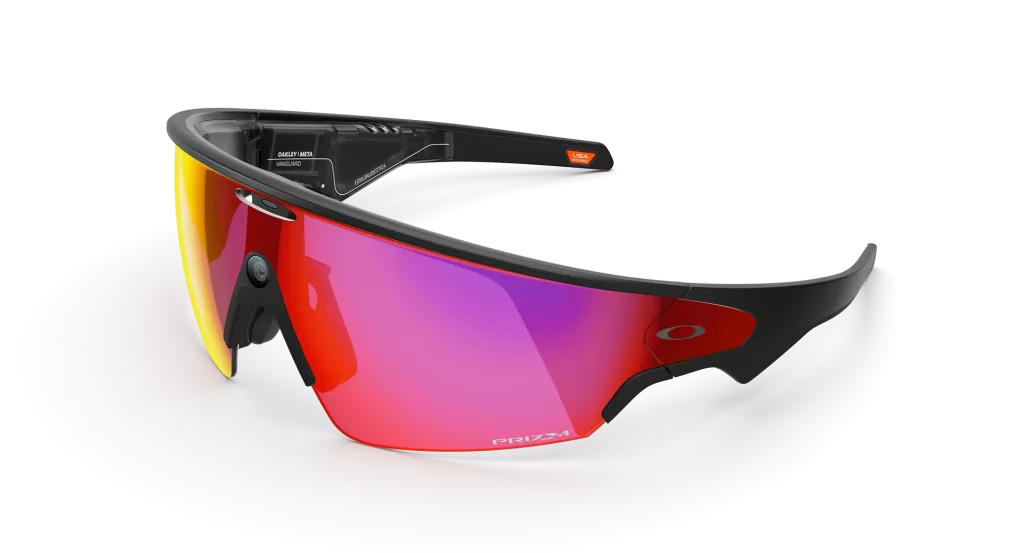
Specs and pricing:
- $499 MSRP, launched October 21, 2025
- 122° ultra-wide 12MP camera (centered on the nose bridge)
- 3K video at 30 fps, plus 1080p at 60 fps for smoother action footage
- Slow-motion and hyperlapse modes
- IP67 water, sweat, and dust resistance
- Garmin device sync and Strava integration
- Customizable physical action button
- Wi-Fi 6e and Bluetooth 5.3
- Compatible with cycling helmets and prescription inserts
Pros:
- Widest field of view of any Meta camera glasses — perfect for cycling, skiing, and running.
- Best battery life among camera-equipped Meta glasses.
- Fully IP67 rated for rain, sweat, and dust.
- Garmin and Strava integration brings real-time data into your earpieces.
- 1080p at 60 fps unlocks smoother action footage.
Cons:
- Bold wrap-around design draws attention off the bike.
- $499 price tag puts pressure against entry-level action cams.
- Portrait-only video for 3K (1080p supports landscape).
If you already shoot first-person sports content, compare the Vanguard directly to the best budget action cameras — the gap closed dramatically in 2026.
4. Meta Ray-Ban Display — Best Future-Forward Camera Glasses
The Meta Ray-Ban Display is where camera glasses graduate into an entirely new category. Priced at $799 (which includes the Neural Band), these glasses add a 600 × 600-pixel hi-res full-color monocular display projected onto the right lens. They are controlled by the Meta Neural Band, an EMG wristband that reads tiny muscle signals so a pinch of your fingers becomes a click. The pair shipped on September 30, 2025, and remains the only major consumer smart glasses with both a camera and a heads-up display.
A hands-on review from PCMag called the display “sharp and colorful” but flagged that battery life is “not quite a full day” — a recurring theme in real-world testing.
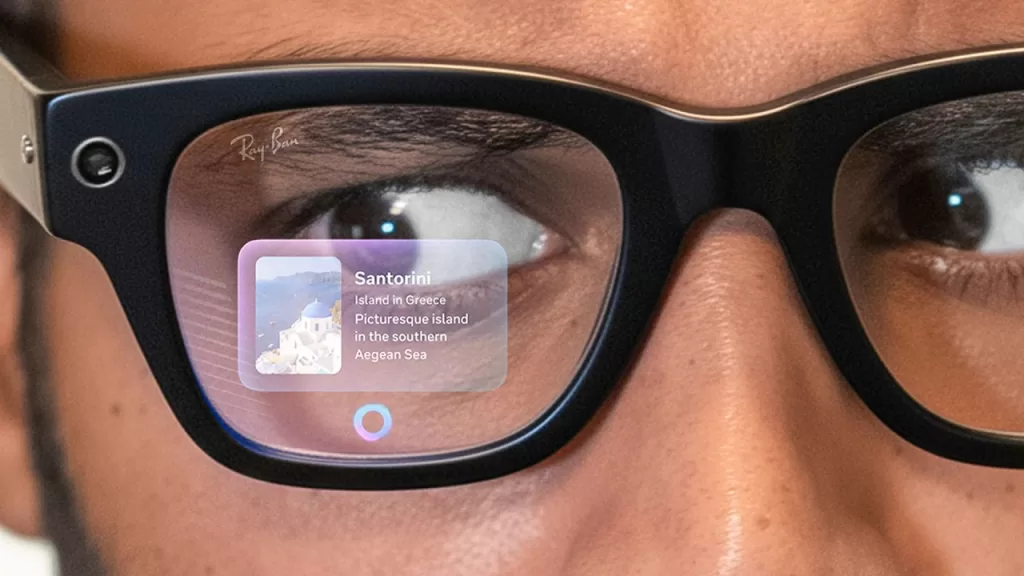
Specs:
- 12MP camera with 3K video capture
- 600×600 hi-res full-color in-lens display, right eye only
- 6-mic array, open-ear stereo speakers
- 32GB onboard storage with Wi-Fi 6 sync
- Meta’s official rating: up to 6 hours mixed use
- Real-world: 1.5–3 hours under heavy display use (independent battery tests regularly report under two hours when the display is in continuous use)
- Includes the Meta Neural Band wristband
- Transitions lenses standard
The display unlocks live captions, message previews from WhatsApp, Messenger, and Instagram, walking directions, video call viewfinders, and discreet AI replies — all without touching your phone. For users with hearing loss, live captioning has emerged as a quiet hero feature that materially improves daily life.
Pros:
- See your shot before, during, and after capture.
- Read messages discreetly; reply with subtle hand gestures via the Neural Band.
- Live captioning is a genuine accessibility win.
- Transitions lenses included as standard.
Cons:
- $799 starting price is the highest mainstream entry.
- Real-world battery under heavy display use is significantly shorter than the marketed six hours.
- No Netflix or general video playback yet.
- Display is monocular (right eye only), which takes adjustment.
For storage planning, our 32GB card breakdown is a useful frame of reference — these glasses ship with exactly that amount of internal storage.
Need flawless product cutouts for your e-commerce store? Our pixel-perfect clipping path service delivers hand-drawn precision at scale.
5. Ray-Ban Meta (Gen 1) — Best Budget Pick from Meta
You do not need the Gen 2 to enjoy great camera glasses. The original Ray-Ban Meta still records 1080p video, takes 12MP photos, supports Meta AI, and routinely drops to the sub-$240 range during sales. Digital Camera World actually lists the original Wayfarer first in its 2026 ranking because of unbeatable price-to-value.
Specs:
- 12MP camera, 1080p (1440×1920) video
- 32GB storage
- Wi-Fi 6 / Bluetooth 5.3
- ~4 hours active use; charging case adds ~32 more hours
- Same prescription, Transitions, and polarized options as Gen 2
Pros:
- Significant discount versus Gen 2 — often half the price during promotions.
- Same software ecosystem and full Meta AI access.
- Wider second-hand availability in major markets.
- All-Wayfarer style options still available.
Cons:
- Older sensor, no hyperlapse or slow-mo modes.
- Shorter battery on the glasses themselves (4 hrs vs 8 hrs).
- 1080p video lacks the dynamic range of 3K capture.
6. Solos AirGo Vision — Best AI-First Camera Glasses
If your interest in camera glasses leans more toward AI vision than cinema-quality video, Solos AirGo Vision deserves a hard look. Solos integrates GPT-4o directly, so when you ask “what am I looking at?”, the glasses describe the scene, read menus, and translate signs in near-real-time. The platform also supports Google Gemini alongside GPT-4o, giving buyers a genuine choice of AI engines — something Meta’s walled garden does not offer. Pricing starts at $249 for the base smart-glasses unit, with additional swappable frame fronts from $89.
Why pick Solos:
- GPT-4o and Gemini integration is more flexible than Meta AI.
- Swappable frame fronts let you change style without buying new electronics.
- Strong real-time translation via SolosTranslate.
- Far cheaper entry point than Meta Ray-Ban Display.
Trade-offs:
- Camera resolution and stabilization trail Meta in raw performance.
- Smaller third-party ecosystem and slower app polish.
- Limited retail availability outside online channels.
For creators editing AI-described scenes into reels, our roundup of the best photo editing apps is a handy companion read.
7. Chamelo Music Shield — Best Style-First Audio Glasses (No Camera)
Worth a quick mention because shoppers often conflate “smart glasses” with “camera glasses.” The Chamelo Music Shield has no camera — instead, it nails Bluetooth audio plus a clever electrochromic tint that you change manually in 0.1 seconds, perfect for cycling between sun and shade. If you want headphones-on-your-face plus tunable shades and do not care about recording, Chamelo lands around $239 and represents real value for the audio-first crowd.
8. RayNeo X3 Pro — Best Bleeding-Edge AR (With Camera Support)
The RayNeo X3 Pro represents a fundamentally different ambition: real AR rather than a small notification window. Dual-eye Micro-LED waveguides reach roughly 2,500–6,000 nits of brightness, support real-time translation overlays, a built-in teleprompter, and SLAM-based spatial anchoring. The camera here is auxiliary — used mainly for environmental awareness and capture — but the headline is the display technology, which leapfrogs Meta’s monocular approach.
Best for: developers, AR enthusiasts, and creators experimenting with what comes after the smartphone. Casual buyers should likely wait one more generation.
Editing reels recorded on your smart glasses? Save hours with our high-volume photo retouching for flawless thumbnails and brand-ready frames.
Key Features to Evaluate Before You Buy
Buying smart camera glasses is not just a spec race. Use this checklist before you tap “add to cart”:
- Video orientation: Most current models record vertical-only at 3K. The Oakley Meta Vanguard now supports landscape at 1080p/60fps — a meaningful exception.
- Clip length cap: Ray-Ban Meta caps clips at 3 minutes (default 60 seconds). Vanguard pushes longer for sports modes.
- Storage: 32GB is the new baseline; offload regularly to your phone or cloud.
- Battery split: Look at glasses-only runtime and total case runtime — the case bonus is often the difference-maker.
- Prescription support: Confirm your Rx range; high-index lenses may carry extra cost ($80–$300 depending on lens type).
- Privacy LED: A visible capture indicator protects you legally and socially.
- App compatibility: iOS 15.1+ and Android 10+ are typical minimums.
- Fit: Frames come in multiple sizes. Heads vary — try them on at a LensCrafters, Sunglass Hut, or Best Buy if you can.
For deeper context on how human vision compares to camera sensors, see our explainer on human eye resolution — it puts megapixel debates into useful perspective.
Use Cases: Who Should Buy Camera Glasses in 2026?
Travel and Vlog Creators
Hands-free vertical 3K video is a game-changer in markets, on trails, and during conversations with locals. A travel review from Good Housekeeping called Ray-Ban Meta “a game-changer for travel” because you capture moments without breaking eye contact. The Ray-Ban Meta Gen 2 with Transitions lenses is the strongest single-pair travel companion you can buy.
Parents
Kids will not look natural when a smartphone appears. Glasses fade into the background and produce candid clips you would have missed otherwise. The 32GB storage typically holds an entire weekend of family video before sync.
Athletes and Outdoor Enthusiasts
Oakley Vanguard and HSTN compete head-to-head with low-end action cams. The 122° lens on the Vanguard especially captures context cyclists love, while the IP67 rating means you do not worry about rain or sweat. If you accidentally lose footage along the way, our guide to recently deleted photos walks you through recovery steps that work on most mobile devices.
Accessibility Users
Live captioning on the Meta Ray-Ban Display has emerged as a quiet hero feature for users with hearing loss. Real-time transcription of conversations directly into your field of view is genuinely life-improving technology.
Business Travelers
Real-time translation, hands-free calls, and discreet notifications via Display models compress airport friction and bridge language gaps in international meetings.
Privacy: The Conversation You Have to Have
We cannot review camera glasses without flagging the elephant on your face. Privacy advocates have raised serious concerns. The Electronic Frontier Foundation urges buyers to think twice about how facial-recognition adjacent features could escalate, and legal scholars warn that wiretap statutes have not caught up with the technology.
Practical guidance for responsible buyers:
- Know your jurisdiction. Recording laws vary widely; California’s pending Wearable Device Privacy Protection Act would tighten rules significantly.
- Respect the LED. When the capture light is on, treat it like a visible recording sign.
- Disclose, do not surprise. Tell people you are recording if you intend to publish.
- Avoid private settings. Bathrooms, locker rooms, schools, and medical facilities are off-limits and may be illegal.
- Mind two-party consent states. Audio recording laws in California, Florida, Illinois, Massachusetts, and others require all parties to consent.
Running an apparel brand? Showcase clothing on invisible models with our award-winning ghost mannequin service — designed for catalogs and Shopify.
How to Get the Best Photos and Videos from Your Camera Glasses
Even the best video recording smart spectacles need a few habits to shine:
- Light it up. All three Meta models lean on their ultra-wide sensor, which loves daylight. Indoor low light remains the weakest scenario across the category.
- Hold a beat. Look toward your subject and stay still for half a second before tapping. Stabilization helps, but a deliberate moment helps more.
- Mind the framing. Subjects sit closer than they appear in the ultra-wide image. Lean in or take a step forward.
- Use voice triggers. “Hey Meta, take a video” frees both hands and feels natural after a few tries.
- Offload nightly. Wi-Fi 6 sync is fast, but you do not want to lose a clip to a forgotten battery.
- Pair with a phone for editing. The companion app trims and exports — for heavier work, jump into desktop tools.
If you want a deeper editing workflow, our guide to the best photo editing software covers desktop and mobile suites that pair beautifully with glasses footage.
Smart Camera Glasses vs. Action Cameras vs. Smartphones
A fair comparison, in plain English:
- Smartphones still win on raw quality, optical zoom, and editing flexibility — but they pull you out of the moment and require both hands.
- Action cameras (GoPro Hero 13, DJI Osmo Action 5 Pro) still beat glasses on stabilization, mounting versatility, and 4K/120fps rates, but they require setup and look conspicuous.
- Camera glasses sit between the two: invisible, hands-free, and surprisingly competent at 3K vertical. For social-first creators, the math has tipped meaningfully in favor of glasses.
For a hybrid setup, many vloggers now pair smart glasses with a pocket gimbal — see our DJI Osmo Pocket 4 review for one of the best pocket cinema cameras of the year.
What’s Coming Next: Late 2026 and Beyond
The category is sprinting forward:
- Google’s Android XR partners (Samsung, Xreal) are expected to ship competing AI-display glasses by late 2026.
- Apple’s smart glasses remain rumored for 2026–2027 launch windows.
- Battery densities are improving roughly 15–20% year over year, finally pushing all-day use within reach.
- Open-ear audio is approaching bone-conduction quality for music playback.
- On-device LLMs will reduce cloud dependency and improve privacy.
- Ray-Ban Meta Gen 3 is rumored to launch around Meta Connect 2026 with potential landscape video support.
The smartest move for some buyers is simply patience — the next twelve months will reshape the category again.
Frequently Asked Questions (FAQ)
1. What are the best camera glasses to buy right now?
For most people, the Ray-Ban Meta (Gen 2) at $379 is the best overall camera glasses you can buy in 2026. Athletes should look at Oakley Meta HSTN ($399) or Oakley Meta Vanguard ($499), while early adopters who want a heads-up display will gravitate to the Meta Ray-Ban Display ($799).
2. Can camera glasses record 4K video?
Not natively yet. The top mainstream models top out at 3K (around 2,256 × 3,008 on Ray-Ban Meta Gen 2, or 2,203 × 2,938 on Oakley Meta HSTN) at 30 fps. Some Amazon listings advertise “4K,” but real-world resolution and bitrate often fall short of true 4K UHD standards.
3. How long does the battery last on smart camera glasses?
- Ray-Ban Meta Gen 2: up to 8 hours typical use, up to 48 hours total with case
- Oakley Meta HSTN: up to 8 hours typical use (5 hours continuous audio), +48 hours with case
- Oakley Meta Vanguard: up to 9 hours typical use, +36 hours with case
- Meta Ray-Ban Display: ~6 hours mixed use; significantly less under heavy display use
4. Are camera glasses legal to wear in public?
Owning and wearing them is legal in most regions, but recording is where things get murky. Two-party consent states and many countries restrict audio capture. Public photography is generally permissible; bathrooms, schools, locker rooms, and private events are not. Check local laws before traveling.
5. Do they work with prescription lenses?
Yes. All major Meta-branded glasses, plus Solos, support prescription inserts or direct Rx lenses, usually at extra cost ($80–$300 depending on lens type). Prescription range is typically -6.00 to +4.00 on Meta-branded glasses.
6. Can I live-stream from smart camera glasses?
Yes — Ray-Ban Meta and Oakley Meta lineups support live streaming to Facebook and Instagram, and several Solos models support direct streams via app. Stream quality depends on your phone’s data link and signal strength.
7. How much storage do camera glasses have?
Most current camera glasses include 32GB of onboard storage, which roughly equates to 500+ photos and 100+ 30-second video clips before you need to offload. Sync happens automatically when you charge or plug in.
8. Are camera glasses better than a GoPro?
For social-first vertical content and casual capture, mainstream picks like Ray-Ban Meta Gen 2 and Oakley Meta Vanguard now compete strongly. For high-end stabilization, 4K/120fps capture, underwater use, and helmet mounting, a dedicated GoPro Hero 13 or DJI Osmo Action 5 Pro still wins on pure performance.
Final Verdict: Which Smart Camera Glasses Should You Buy?
The honest answer in 2026:
- Buy the Ray-Ban Meta (Gen 2) if you want the best overall blend of style, audio, AI, and 3K capture for under $400.
- Buy the Oakley Meta HSTN if you train, ski, or hike and want a tougher frame with comparable 3K video.
- Buy the Oakley Meta Vanguard if you cycle, run, or shoot ultra-wide POV — this is the GoPro alternative for casual athletes thanks to 122° FOV and IP67.
- Buy the Meta Ray-Ban Display if you are an early adopter who wants to live a year ahead of everyone else and can live with shorter display-heavy battery life.
- Buy the Solos AirGo Vision if real-time GPT-4o or Gemini assistance matters more than cinema-quality video.
For most readers, the Ray-Ban Meta Gen 2 is the right answer. It is the gadget you actually wear, which is the only kind that matters.
Ready to publish flawless content from your new glasses? Get sharper subjects and cleaner edges with our expert image masking service — perfect for hair, fur, and tricky details.