


Photo Retouching Services 2026: Types, Costs & Outsourcing
August 22, 2026
The Complete Portrait Retouching Guide 2026: 13 Techniques Every Photographer Needs
August 29, 2026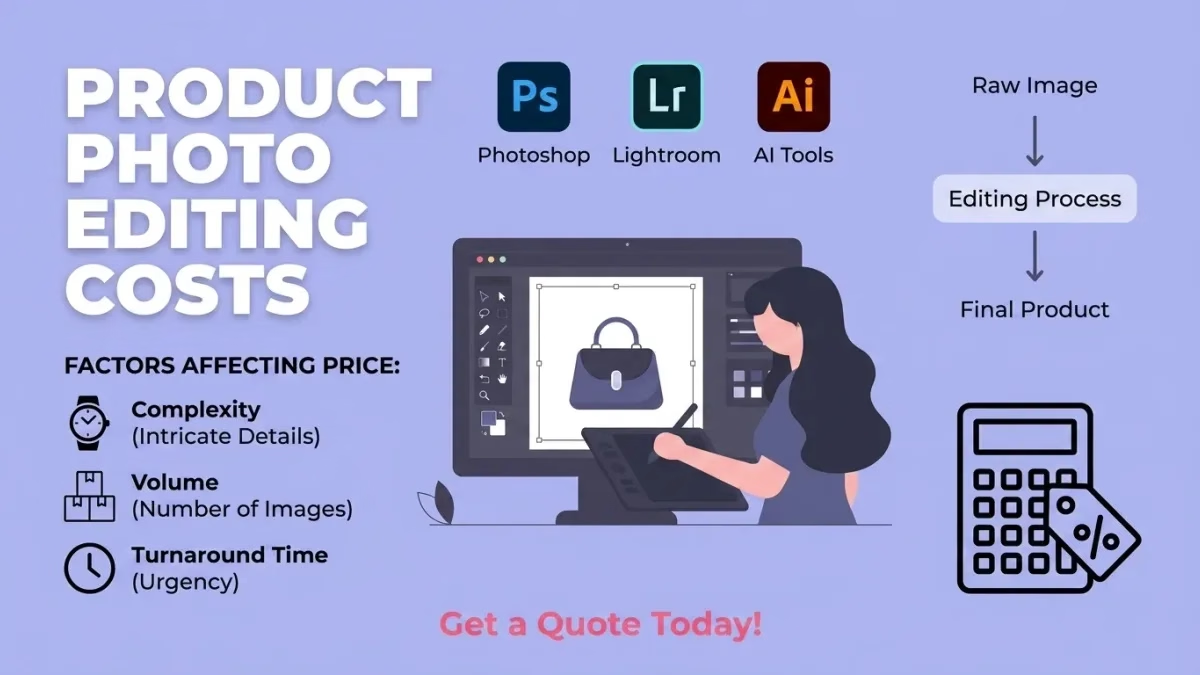
- TL;DR — Photo Editing Costs in 2026 at a Glance
- Who Should Read This Guide
- Quick-Reference Cost Table
- What “Per-Image Cost” Actually Means in 2026
- The 2026 Pricing Spectrum: 4 Tiers Explained
- Per-Image Rates by Service Category (Deep Dive)
- Regional Pricing: Where Your Editing Comes From Matters
- Freelancer vs Studio vs In-House: The 2026 Price Comparison
- The 5 Cost Drivers That Actually Move Your Quote
- Seasonal Pricing: When Editing Gets Expensive (and When It Doesn’t)
- The Contract Terms No One Talks About (But Should)
- Data Security: The Hidden Cost of Cheap Vendors
- Hidden Costs to Watch For
- Category-Specific Starter Budgets
- In-House vs Outsourced: The Real Cost Math
- AI vs Manual Editing: The Real Cost Tradeoff
- 6 Pricing Traps With Real Dollar Examples
- How to Get an Accurate Quote: The 7-Point RFP Framework
- Free Trial Standards: What “Good” Looks Like
- Cost per Image by Product Category (Detailed Reference)
- When Outsourcing Pays Off (And When It Doesn’t)
- How to Negotiate a Better Rate
- Frequently Asked Questions (FAQs)
- Final Thoughts on Editing Budgets in 2026
TL;DR — Photo Editing Costs in 2026 at a Glance
Skip to the section you need — but if you have 30 seconds, here’s the whole market condensed:
- Outsourced manual editing runs $0.25 to $50+ per image in 2026. Most e-commerce catalogs land between $0.25 and $2.50.
- AI-only editing has crashed the price floor to $0.05–$0.10 per image, but still fumbles hair, glass, and reflective products.
- Offshore studios in Bangladesh, India, the Philippines, and Vietnam charge 60–90% less than U.S. providers for equivalent manual work.
- Volume discounts are standard: 10% off at 50+ images, 20% at 100+, 30% at 500+, 40% at 1,000+.
- In-house editing costs U.S. brands $0.83 to $12.25 per image once salary, software, and hardware are counted — almost always more expensive than outsourcing above 50 SKUs per month.
- The professional 2026 default is hybrid: AI on 80% of the catalog, human editors on the 20% of hero images and complex products that matter for revenue.
Who Should Read This Guide
This guide is written for people spending real money on editing, not curious browsers:
- Amazon, Shopify, Etsy, Walmart, and TikTok Shop sellers costing out a full-catalog edit.
- DTC brand owners deciding between hiring an in-house editor and signing with a studio.
- Product photographers and creative agencies benchmarking their own margins.
- Wedding, real estate, and portrait photographers pricing culling and retouching plans.
- Studio managers comparing offshore vendors against U.S. providers before signing a Master Services Agreement.
Every rate below has been cross-verified against multiple 2026 industry sources, real published rate cards, freelance marketplace medians, and one specific studio’s live per-image pricing so you can benchmark honestly instead of guessing.
Quick-Reference Cost Table
The single most useful table in this article, up front for the impatient. Use it when you need a fast sanity-check on a quote:
| Service | Basic | Mid-Complexity | Advanced / Premium |
|---|---|---|---|
| Clipping path | $0.25 – $0.50 | $0.99 – $1.99 | $2.49 – $10.00 |
| Background removal | $0.25 – $0.50 | $0.99 – $1.99 | $2.00 – $5.00 |
| Image masking (hair/fur/glass) | $0.99 – $1.39 | $1.99 – $3.99 | $4.99 – $9.99 |
| Multi-clipping path | $1.19 – $2.49 | $2.49 – $4.99 | $4.99 – $9.99 |
| Ghost mannequin | $0.79 – $1.50 | $1.50 – $3.00 | $3.00 – $8.00 |
| Photo retouching | $0.79 – $3.00 | $3.00 – $5.00 | $5.00 – $10.00+ |
| Beauty retouching | $1.29 – $3.00 | $3.00 – $6.99 | $25.00 – $150.00+ |
| Shadow creation | $0.25 – $0.50 | $0.75 – $1.50 | $1.50 – $3.00 |
| Color change / variants | $0.69 – $1.50 | $1.50 – $2.50 | $2.50 – $6.00 |
| Jewelry retouching | $0.99 – $2.00 | $2.00 – $5.00 | $5.00 – $75.00+ |
| Real estate editing (HDR/sky) | $0.60 – $1.50 | $1.50 – $3.00 | $3.00 – $30.00 |
| Wedding photo editing | $0.05 – $0.25 | $0.25 – $1.00 | $1.00 – $8.00 |
Prices are 2026 industry medians pulled from published rate cards, freelance marketplaces, and one live studio’s transparent pricing page. Every category is unpacked in detail further down.
What “Per-Image Cost” Actually Means in 2026
Per-image pricing looks simple — one dollar figure per photo. In practice, that single number bundles four separate variables, and any one of them can move the total by 5–10x on the same job.
A basic clipping path on a smartphone photo sells for $0.30. A super-complex jewelry retouch with focus stacking, dodge-and-burn, and gemstone color correction sells for $6.99. Same studio. Same “per-image” label. Two entirely different jobs.
Every quote hides four levers:
- Complexity — how many edges, curves, and reflections the editor must handle by hand.
- Volume — total images ordered in a single job or retainer.
- Turnaround — standard 24-hour vs same-day vs 6-hour rush.
- Delivery format — flat JPEG vs layered PSD vs marketplace-compliant multi-format bundle.
Read every quote with those four levers in mind. A “cheap” quote that skips revisions, hides format fees, or takes five business days to deliver is not cheap once the invoices land.
The 2026 Pricing Spectrum: 4 Tiers Explained
Industry pricing sorts cleanly into four tiers. Match your product category and margin to the right tier — buy below your product’s tier and quality collapses; buy above it and you’re burning cash.
| Tier | Price / Image | Included Work | Best For |
|---|---|---|---|
| Tier 1 — AI-First | $0.05 – $0.10 | Automated color, exposure, background removal, culling | Weddings, sports, portraits, high-volume events, drafts |
| Tier 2 — Standard Offshore Manual | $0.20 – $0.50 | Basic clipping path, background removal, batch color correction with human QC | Amazon-ready cutouts, marketplace bulk, straightforward products |
| Tier 3 — E-Commerce & Product | $0.70 – $2.50 | Ghost mannequin, shadow creation, image masking, color matching, retouching | Apparel, cosmetics, footwear, mid-complexity catalogs |
| Tier 4 — Premium & Boutique | $5.00 – $50.00+ | Editorial retouching, high-end beauty, composites, luxury jewelry, campaign hero shots | Campaign heroes, fashion editorial, luxury e-commerce |
The gap between Tier 1 and Tier 4 is a full 100x. That’s not accidental. The labor in a boutique retouch is genuinely a hundred times more skilled and time-consuming than an AI batch process.
Per-Image Rates by Service Category (Deep Dive)
Here’s the money section — verified 2026 rates by editing service, benchmarked from multiple pricing pages and one live per-service rate card (Clipping Expert Asia).
1. Clipping Path Cost
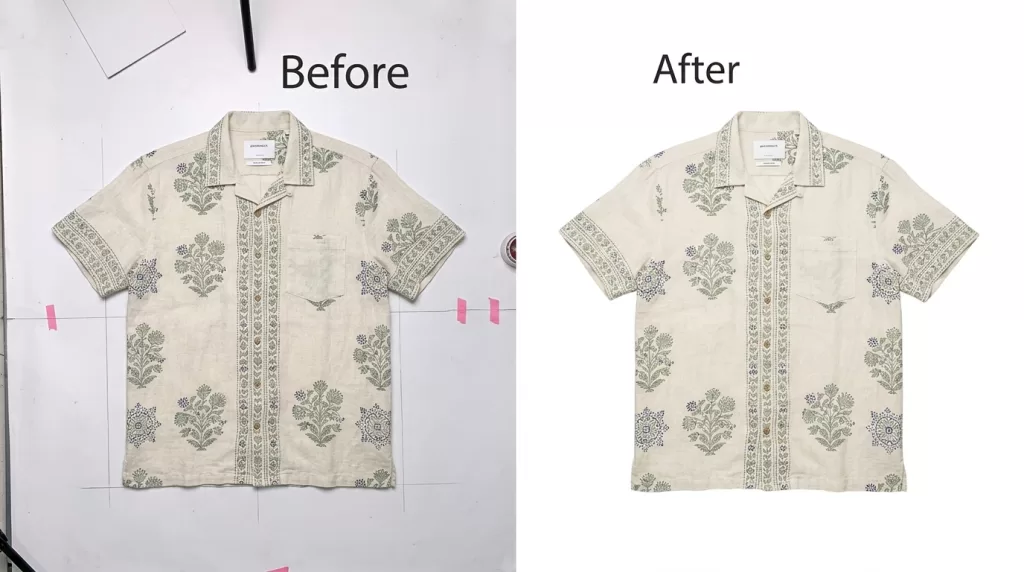
A clipping path is a hand-drawn vector outline in Photoshop that cuts the subject out of its background. Rates scale by how many curves the editor must trace:
- Basic (boxes, phones, mugs, simple electronics): $0.25 – $0.50
- Simple (sneakers, watches, headphones, bottles): $0.49 – $0.99
- Medium (jewelry, bicycles, eyewear): $0.99 – $1.99
- Complex (intricate chains, flying hair, lace): $2.49 – $3.99
- Super complex (group jewelry sets, messy hair, reflective glass): $4.99 – $10.00+
Clipping path is the workhorse of e-commerce editing. If you’re running Amazon or Shopify at any scale, this is where 60–70% of your editing budget lives.
Want to keep your image editing costs low without sacrificing quality?
Enjoy premium, hand-drawn Clipping Path services starting at just 30¢ per image.
2. Background Removal Cost
Background removal produces a transparent PNG, a marketplace-compliant pure white background, or a custom scene. Manual work starts at $0.25–$0.50 per image for straightforward products and rises to $2.00–$5.00 for hair, transparency, or fringe-heavy subjects. Pure AI drops as low as $0.05, but the color contamination and edge fringing usually force a manual pass anyway.
3. Image Masking Cost
Image masking handles hair, fur, glass, veils, and semi-transparent subjects using alpha channels, layer masks, and refine-edge. Rates:
- Basic (soft edges, plastic bottles): $0.99 – $1.39
- Simple (feather dusters, tasseled bags): $1.39 – $1.99
- Medium (glassware, gemstones, eyewear): $1.99 – $2.49
- Complex (flying hair, pet fur, foliage): $3.99 – $4.99
- Super complex (group shots, dense bridal veils): $5.99 – $9.99
4. Multi-Clipping Path Cost
A multi-clipping path draws several separate vector paths inside a single image, so each element becomes independently editable. That’s what makes SKU multiplication possible — one shoot, twenty colorways, no reshoot.
- Basic (2–3 elements): $1.19 – $2.49
- Medium (4–6 elements): $2.49 – $4.99
- Complex (7+ elements or fine components): $4.99 – $9.99
5. Ghost Mannequin Cost
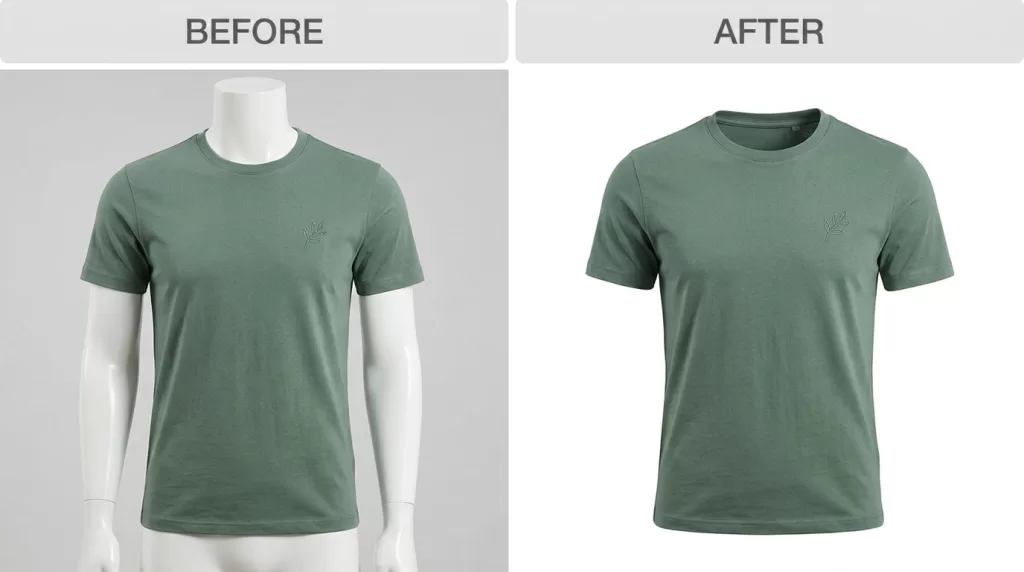
Ghost mannequin editing removes the mannequin from apparel shots while rebuilding the inner neckline, sleeves, or hem. 2026 pricing:
- Neck joint only (t-shirts, simple shirts): $0.79 – $1.50
- Neck + sleeve joint (jackets, blazers): $1.50 – $3.00
- Full 3D composite with bottom joint: $3.00 – $8.00
- Editorial-grade boutique work: $15.00 – $50.00
6. Photo Retouching Cost
Retouching prices spread wildly because “retouching” means everything from a 30-second cleanup to hours of frequency separation and dodge-and-burn:
- Basic retouching (blemish removal, teeth whitening, minor color): $0.79 – $3.00
- Pro retouching (body shaping, wrinkle reduction, stray hair): $3.00 – $5.00
- High-end retouching (frequency separation, 3D dodge-and-burn, HDR): $5.00 – $7.00
- Advanced editing (background replacement, head/body swaps, composites): $7.00 – $10.00
- Editorial / commercial retouching: $15.00 – $150.00+ per image
Want your images to look professionally edited, not over-processed?
Achieve natural, high-end perfection with our skilled Photo Retouching Service
7. Beauty Retouching Cost
Beauty retouching for editorial-quality skin, eyes, and lips runs $1.29 – $6.99 per image at scaled offshore studios and $25 – $150+ at U.S. boutique retouchers who work at hourly rates of $80 – $200.
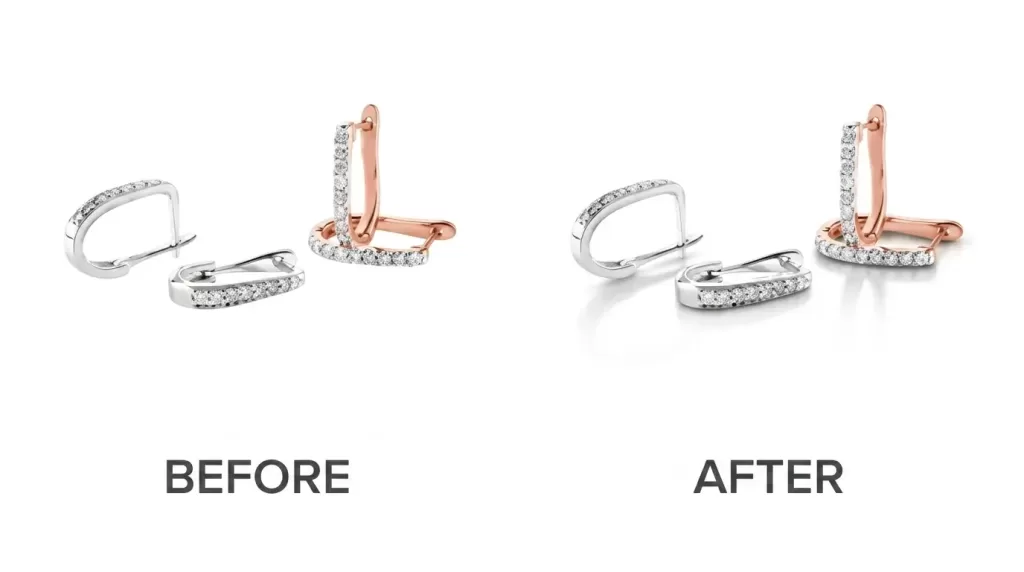
8. Shadow Creation Cost
Shadow creation is the highest-ROI add-on in e-commerce editing — usually the cheapest per-image line item, and the one that visibly lifts perceived product value:
- Drop shadow: $0.25 – $0.50
- Natural shadow: $0.50 – $1.25
- Reflection shadow (mirror finish): $0.75 – $1.50
- Complex cast or floating shadow: $1.50 – $3.00
9. Color Change and Variant Cost
Product recoloring turns one master shoot into unlimited SKU variants:
- Solid color swap: $0.69 – $1.50
- Multi-part or textured recoloring (denim, leather, silk, patterns): $2.50 – $6.00
- Pantone / brand-exact color matching: $1.50 – $3.50
10. Jewelry Retouching Cost
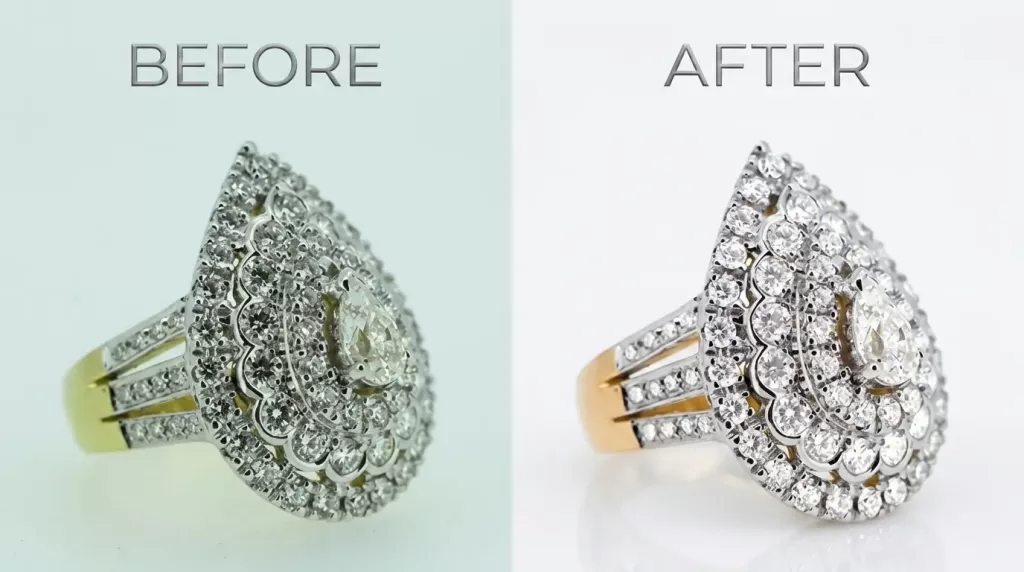
Jewelry retouching is one of the highest-margin niches because the work demands 400% zoom, focus stacking, and Pantone metal matching:
- Basic jewelry retouching (background + dust): $0.99 – $2.00
- Standard (color correction + sparkle enhancement): $2.00 – $5.00
- High-end (focus stacking, symmetry, gemstone work): $5.00 – $10.00
- Luxury editorial jewelry retouching: $15.00 – $75.00+
Do your product images fail to show off intricate details?
Highlight every facet and texture with our precise Jewelry Photo Editing Service
11. Real Estate Photo Editing Cost
Real estate carries higher rates because HDR blending, sky replacement, and virtual staging demand compositing skill:
- Basic exposure / color correction: $0.30 – $0.80
- HDR blending: $0.60 – $2.00
- Sky replacement: $1.00 – $3.00
- Object removal / clutter cleanup: $1.00 – $2.50
- Virtual staging: $10.00 – $30.00 per room
- Complete package (HDR + sky + object removal): $2.00 – $10.00
12. Wedding Photo Editing Cost
Wedding editing has been reshaped by AI more than any other category — traditional outsourcing at $0.25/image is now competing with AI tools that hit $0.05:
- Culling only: $0.03 – $0.05 per image
- Basic color / exposure correction: $0.12 – $0.25
- Full wedding edit with gallery prep: $0.50 – $1.50
- High-end editorial wedding retouching: $3.00 – $8.00+
Regional Pricing: Where Your Editing Comes From Matters
Geography is the single biggest lever on photo editing cost. Offshore studios operate at 60–90% lower cost than U.S. providers for equivalent manual output.
| Region | Basic Editing | Mid-Complexity | Advanced Retouching | Hourly Studio Rate |
|---|---|---|---|---|
| USA | $0.50 – $6.75 | $2.00 – $10.00 | $20.00 – $150.00+ | $50 – $200/hr |
| Bangladesh | $0.25 – $1.00 | $0.79 – $2.50 | $2.50 – $10.00 | $8 – $20/hr |
| India | $0.20 – $0.80 | $1.00 – $3.00 | $5.00 – $15.00 | $8 – $25/hr |
| Philippines | $0.50 – $1.00 | $1.00 – $5.00 | $8.00 – $20.00 | $12 – $30/hr |
| Vietnam | $0.20 – $1.00 | $1.00 – $3.00 | $5.00 – $15.00 | $10 – $25/hr |
Bangladesh dominates high-volume manual editing because Photoshop-trained labor is deep, English is workable, and living costs stay low. India competes on price but sometimes stretches turnaround. The Philippines and Vietnam are strong for real estate and wedding niches. The USA remains the premium tier for editorial and campaign work.
The right question is not “what is the cheapest country?” It’s “which studio in the country that fits my budget delivers consistent quality at my volume?” Cheap plus inconsistent equals expensive.
Freelancer vs Studio vs In-House: The 2026 Price Comparison
Where you buy editing matters as much as the per-image rate. Three sourcing models, three cost profiles:
| Model | Price / Image | Strengths | Weaknesses |
|---|---|---|---|
| Freelancer (Fiverr / Upwork) | $0.50 – $5.00 (or Upwork median $18–$35/hr) | Cheapest entry point, direct communication, flexible scope | Inconsistent when scaling, single-point-of-failure, quality varies wildly per gig |
| Studio (offshore or U.S.) | $0.25 – $10.00 depending on tier | Consistent output, QC layer, SLA, revision policies, dedicated managers | Higher entry pricing, minimum order fees, less negotiable at low volumes |
| In-house editor (U.S.) | $0.83 – $12.25 all-in | Full control, immediate feedback, on-brand consistency | Fixed cost regardless of volume, hiring risk, PTO/coverage gaps, hardware overhead |
Fiverr and Upwork context. Fiverr gigs advertise editing from $5 per job (often 3–5 images), while Upwork’s own data shows photo editors on the platform charge a median hourly rate of $25, typically ranging $18–$35/hour. Marketplaces are great for one-off projects. They’re brittle for high-volume catalog work.
Studio math. Studios add process — quality-control passes, versioned deliveries, revision workflows, SLAs — for a small premium over solo freelancers. That process is exactly what disappears when you go pure freelance.
In-house math. ZipRecruiter’s August 2026 data puts the average U.S. photo editor at $22.10/hour, or a $41,300/year median. Add Adobe Creative Cloud (roughly $19.99–$69.99/month depending on plan tier), hardware amortization, benefits, and PTO coverage, and effective per-image cost lands at $0.83 for basic work and up to $12.25 for complex retouching.
The tipping point sits at roughly 50 images per month. Below that, in-house wins on control. Above it, outsourcing wins on both cost and consistency — often by 5x or more.
The 5 Cost Drivers That Actually Move Your Quote
1. Image Complexity
Complexity is the top price driver. A geometric box on white ships at basic rates. A wedding ring with 47 diamond facets, a flying-hair headshot, or a translucent perfume bottle triggers premium tiers because every anchor point, mask edge, and reflection has to be handled by hand. Expect a 5–10x spread between the same studio’s basic and super-complex rates.
2. Volume
Bulk orders unlock steep discounts. The standard offshore ladder:
- 50+ images: 10% off
- 100+ images: 20% off
- 500+ images: 30% off
- 1,000+ images: 40% off (often with a dedicated account manager and SLA)
- 5,000+ images/month: Custom retainer pricing, often 15–25% below the public rate card
3. Turnaround Time
Standard turnaround runs 24 hours. Faster delivery costs more:
- Standard 24-hour: base rate
- 12-hour: +15–25%
- 6-hour: +25–50%
- Same-day / rush: +30–100% or a flat $100–$200 surcharge on smaller batches
Wedding and real estate photographers routinely pay rush fees during peak season. E-commerce brands rarely need rush unless launching campaigns.
4. Revisions and Quality Control
Reputable studios include unlimited free revisions in the per-image price. Cheaper vendors quote low but charge per revision — and if your first pass needs three tweaks, the “cheap” quote just tripled. Ask upfront:
- Are revisions unlimited or capped?
- Is there a revision fee after a certain number of rounds?
- Is there a QC pass before delivery, or is the first delivery raw output?
Studios with an internal QC step deliver fewer revisions in the first place, which lowers your true cost even when the per-image number looks higher.
5. Delivery Format and File Prep
File prep adds real cost when done properly:
- Flat JPEG only: base rate
- JPEG + PSD (layered): usually included at professional studios
- Multi-format bundle (JPEG + PSD + WebP + TIFF for print): +$0.10–$0.30
- Marketplace-compliant packaging (Amazon/Shopify/Etsy specs pre-sized): +$0.15–$0.50
For sellers who need marketplace-ready files, that markup pays for itself. Reshoots and re-uploads because of size or color-profile errors cost far more.
Seasonal Pricing: When Editing Gets Expensive (and When It Doesn’t)
Photo editing carries genuine seasonality that most guides ignore. Three peak periods reliably push rates up:
- Q4 e-commerce peak (October–December) — Amazon FBA sellers, DTC brands, and gift retailers flood studios with catalog refreshes and Black Friday campaign assets. Rush surcharges of 25–50% become common, and standard turnaround stretches from 24 to 48 hours at busier studios.
- Wedding season (May–September) — Wedding photographers overwhelm human-editor pipelines and drive AI adoption. Traditional outsourcing quotes climb 20–30% during peak, while AI-based tools stay flat.
- Real estate spring rush (March–June) — Sky replacement, HDR blending, and virtual staging demand peaks alongside home-selling season.
Two ways to protect your budget through peak season:
- Lock in a retainer before peak. Pre-negotiate a fixed per-image rate that survives the rush surge.
- Bank your files early. Send catalog images 3–4 weeks before deadline so you don’t get quoted rush rates.
The Contract Terms No One Talks About (But Should)
Beyond per-image rate, five contract terms quietly determine what you actually pay:
- Payment terms — Net-30 is the U.S. business standard for larger accounts. Studios often prefer 50/50 (50% deposit, 50% on delivery) or 30/70 splits for new clients. Wire fees and currency conversion can add 1–3% on international payments.
- Minimum order fees — Some studios charge flat $10–$25 minimums under a threshold image count. Rarely disclosed unless asked.
- Cancellation and dispute policy — Ask what happens if quality misses your brief. Reputable studios offer full re-edits at no charge; weaker ones argue.
- Ownership and license — All rights to the edited files should transfer to you on payment. Confirm this in writing.
- Data security and NDA — Especially critical for pre-launch products. Reputable studios sign NDAs on request and describe their file-handling policies transparently.
For brands processing customer-facing images or personal data, GDPR compliance rules apply the moment identifiable people appear in the shots. Confirm your editing partner’s data-handling process before uploading anything sensitive.
Data Security: The Hidden Cost of Cheap Vendors
Low-cost editing vendors often skip data-security investments that legitimate studios treat as non-negotiable. Skipping them is fine — until pre-launch product photos leak, or personal images from a wedding gallery appear on a random web forum.
Ask every vendor these five questions:
- Do you sign an NDA before we upload files?
- Where are files stored and for how long after delivery?
- Is transfer encrypted (SFTP or HTTPS at minimum)?
- Who has access to my files internally?
- Are files deleted from your servers after project completion?
Studios that hedge on these questions are not the ones you want touching pre-launch inventory.
Hidden Costs to Watch For
The published per-image rate rarely equals the total invoice. Seven hidden costs quietly inflate quotes:
- Rush surcharges — often disclosed only after upload.
- Per-revision fees — cheap-front pricing that recovers margin through paid changes.
- File conversion fees — extra charges for RAW → JPEG, sRGB conversion, or multi-format delivery.
- Storage or transfer fees — some vendors charge for delivery over a set gigabyte limit.
- Currency conversion and wire fees — 1–3% on international payments unless you use a low-cost transfer service.
- NDA / IP handoff fees — enterprise-only fees that only appear at contract signing.
- Minimum order fees — flat $10–$25 charges applied under a set image count.
Ask for a written all-in quote for a representative batch before committing. A studio that publishes transparent per-service pricing (Clipping Expert Asia lists rates from $0.25 for shadow creation up to $1.29 for beauty retouching) makes budgeting predictable.
Category-Specific Starter Budgets
Three real-world scenarios so you can plug your own numbers in:
Scenario A — Amazon FBA seller with 100 SKUs (quarterly refresh)
- 100 images × $0.30 clipping path + $0.50 shadow creation = $80 base
- Volume discount (100+): 20% → Final: $64/quarter, ~$256/year
- Fits comfortably inside the ~$50/month image budget most FBA guides recommend.
Scenario B — Shopify apparel brand with 500 SKUs (ghost mannequin, quarterly)
- 500 images × $0.79 ghost mannequin = $395 base
- Volume discount (500+): 30% → Final: $276.50/quarter, ~$1,106/year
- Compare to hiring one U.S. in-house editor at $41,300/year + software + hardware ($46K+ loaded).
- Net savings by outsourcing: roughly $45,000/year.
Scenario C — Wedding photographer shooting 30 weddings/year (2,500 images each)
- 75,000 images × $0.05 AI baseline = $3,750/year with AI-only tools
- Or 75,000 × $0.25 traditional outsourcing = $18,750/year
- The AI-first path saves $15,000/year but requires a manual QC pass on gallery hero shots.
Ready to transform your raw photos into professional assets?
Get a custom, no-obligation quote tailored to your specific volume and needs. Explore Clipping Expert Asia
In-House vs Outsourced: The Real Cost Math
Doing editing in-house feels controllable. The math tells a very different story.
In-house cost per image (U.S.-based, 2026):
- Editor salary: $22.10/hour verified median from ZipRecruiter’s photo editor salary data, loaded to ~$28–$32/hour with benefits and payroll tax.
- Software subscription (Adobe Creative Cloud Photography Plan starts at ~$14.99/mo, Photoshop plan $19.99/mo, full Creative Cloud Pro $69.99/mo).
- Hardware amortization: $50–$150/month per workstation.
- Average edit time per e-commerce image: 3–15 minutes for standard work, 20–30 minutes for complex retouching.
- Effective per-image cost: $0.83 – $12.25, depending on complexity and speed.
Outsourced cost per image (offshore manual):
- $0.25 – $2.50 for most e-commerce work
- Zero fixed overhead — you pay only for what you use.
- Scales instantly for seasonal peaks without hiring or firing.
Below 50 images per month, in-house wins on control. Above it, outsourcing wins on both cost and consistency — often by 5x or more. Above 500 images per month, outsourcing is functionally the only sane option.
AI vs Manual Editing: The Real Cost Tradeoff
AI editing tools have crashed the price floor. Understanding AI vs manual trade-offs prevents both under-buying and over-paying.
| Method | Cost / Image | Strengths | Weaknesses |
|---|---|---|---|
| AI-only (Remove.bg, Photoroom, Imagen) | $0.05 – $0.22 | Seconds per image, unlimited scale, near-free at high volume | Fails on hair, glass, reflection, transparent objects; leaves fringing |
| Manual only | $0.25 – $10.00+ | Pixel-perfect, marketplace-safe, handles complex products | Slower per image, higher unit cost |
| Hybrid (AI + human QC) | $0.30 – $1.50 | Combines AI speed with manual quality control on hero images | Requires workflow discipline and a review step |
The professional 2026 default is hybrid. AI processes 80% of the catalog at $0.05–$0.15 per image. A manual editor handles the 20% of hero shots and complex products AI mishandles. Blended cost lands at $0.30–$0.60 per image — dramatically cheaper than manual-only and dramatically higher quality than AI-only.
6 Pricing Traps With Real Dollar Examples
Cheap quotes hide expensive mistakes. Six traps to spot before signing:
- Trap 1: The “$0.10 clipping path” quote. Usually pure AI marketed as manual. Fails Amazon zoom inspection at 1,000+ px, forcing a manual redo at $0.30–$0.50 each. True cost per image: $0.40–$0.60.
- Trap 2: The “unlimited revisions” that aren’t. Cap of 2 revisions, then $2 per additional. A batch of 500 images with 3 revisions on 100 = $200 hidden fee.
- Trap 3: The “24-hour turnaround” that becomes 4 business days. No SLA in the contract means no enforcement.
- Trap 4: The undisclosed minimum order fee. $15 minimum on a $9 job = 66% surcharge on small tests.
- Trap 5: The multi-format upcharge. Base quote for JPEG only; PSD delivery adds $0.20/image after signing.
- Trap 6: The “free trial” bait. Free trial edited by senior lead editor; production batch handed to trainees at 50% the quality.
Ethical studios welcome all six questions and answer them in writing before invoicing.
How to Get an Accurate Quote: The 7-Point RFP Framework
Send this exact framework to any studio before signing. Studios that answer all seven questions clearly are ones worth hiring.
- What is your all-in per-image rate for [describe your specific product type and complexity]?
- Are revisions unlimited or capped? If capped, what is the per-revision fee?
- What is your standard turnaround SLA and what surcharges apply for 12-hour, 6-hour, or same-day rush?
- What delivery formats are included in the base rate (JPEG, PSD, WebP, TIFF, marketplace-sized bundle)?
- What is your volume discount schedule (10/20/30/40% breakpoints or custom)?
- What are your payment terms (Net-30, 50/50 deposit, milestone billing)?
- What is your data security policy (NDA, encryption, file retention, deletion after delivery)?
Most vendors quote within 24 hours. Compare three quotes minimum. Our full outsourcing checklist covers the extended 12-point vetting process.
Want to test our quality before committing to a large order?
Try our Image Background Removal Services risk-free with a free trial.
Free Trial Standards: What “Good” Looks Like
Reputable photo editing studios offer free trials on 2–5 images with no credit-card requirement and unlimited revisions during the trial. The industry standard has settled at:
- 2–3 sample images for basic services (clipping path, background removal, shadow creation).
- 1–2 sample images for complex services (jewelry retouching, ghost mannequin, high-end beauty).
- 24-hour delivery for trials — the same SLA the studio promises for paid work.
- Same editor on the trial as on the production batch (a common bait-and-switch trap).
Any studio that refuses a free trial or asks for credit-card details upfront is signaling process problems that will surface later.
Cost per Image by Product Category (Detailed Reference)
Use this granular table when scoping a new project or vetting a quote:
| Product Type | Typical Cost / Image (Standard Quality) |
|---|---|
| Simple electronics, boxes, packaging | $0.25 – $0.50 |
| Sneakers, watches, small accessories | $0.50 – $1.25 |
| Jewelry editing (rings, necklaces, gemstones) | $0.99 – $6.99 |
| Apparel with ghost mannequin | $0.79 – $3.00 |
| Cosmetics and beauty products | $1.29 – $4.00 |
| Furniture and home decor | $1.00 – $3.50 |
| Real estate exteriors with sky replacement | $1.50 – $5.00 |
| Real estate virtual staging | $10.00 – $30.00 per room |
| Fashion editorial retouching | $5.00 – $50.00+ |
| Luxury / campaign hero images | $15.00 – $150.00+ |
When Outsourcing Pays Off (And When It Doesn’t)
Outsourcing wins clearly when:
- Monthly image volume exceeds 50.
- Your team’s time is worth more shooting or selling than editing.
- Catalog consistency matters more than creative control on every frame.
- Marketplace deadlines force fast turnaround.
- You want to scale up during peak seasons without hiring or firing.
In-house wins when:
- Volume stays under 30–50 images per month.
- Every image demands unique creative direction (art photography, editorial campaigns).
- Data sensitivity blocks third-party sharing entirely.
- You already have a full-time editor on payroll for other work.
How to Negotiate a Better Rate
Studios rarely lead with their best number. Five levers actually move the price:
- Commit to volume. A 12-month retainer at 500 images/month typically unlocks 15–25% below the public rate card.
- Batch by complexity, not by SKU. Sorting your files into basic / medium / complex buckets before quoting stops you from paying complex-tier rates for basic work.
- Offer flexible turnaround. If you can wait 48–72 hours instead of 24, most studios discount 10–20%.
- Ask about beta or new-service discounts. Studios launching new categories (for example, AI hybrid pipelines) often offer promotional rates to build case studies.
- Test 2–3 vendors quarterly. Even if you stay with your current provider, competing quotes give you real negotiation leverage.
Frequently Asked Questions (FAQs)
What is the average cost to outsource photo editing per image in 2026?
The 2026 industry median for outsourced manual photo editing lands between $0.25 and $2.50 per image for standard e-commerce work. AI-first tools drop the floor to $0.05, and premium editorial retouching reaches $50+ per image. Most brands blend AI and manual and land at a blended cost near $0.50 per image.
Is it cheaper to hire an in-house editor or outsource?
Outsourcing is almost always cheaper above 50 images per month. In-house editing carries fixed costs — salary, software, hardware, benefits — that push effective per-image cost to $0.83 – $12.25 for U.S.-based teams. Offshore outsourced editing costs $0.25 – $2.50 per image with zero fixed overhead.
Why do offshore studios charge so much less than U.S. providers?
Offshore studios in Bangladesh, India, the Philippines, and Vietnam operate at 60–90% lower labor and overhead costs. Photoshop training is deep, workflows are highly specialized, and studios routinely process 1,000+ images per day per team. Quality is not the trade-off — process discipline is.
What causes photo editing prices to vary so much between vendors?
Five factors drive price variance: complexity of the image, volume ordered, turnaround time, revision policy, and delivery format. A “cheap” $0.15 quote with per-revision fees and 5-day turnaround often costs more than a $0.30 quote with unlimited revisions and 24-hour delivery.
How much should I pay for jewelry retouching per image?
Standard jewelry retouching runs $0.99 – $5.00 per image at reputable offshore studios. High-end jewelry work with focus stacking, symmetry correction, and Pantone metal matching costs $5 – $15. Luxury editorial jewelry retouching for campaigns can exceed $75 per image.
Do photo editing services offer volume discounts?
Yes. The standard structure is 10% off at 50+ images, 20% at 100+, 30% at 500+, and 40% at 1,000+. Enterprise clients above 5,000 images per month often negotiate retainer pricing that beats the public discount ladder by an additional 15–25%.
Common hidden fees include rush surcharges (30–100% above base), per-revision fees, file-conversion charges, minimum-order fees, currency conversion, and multi-format delivery upcharges. Always ask for an all-in written quote that itemizes revisions, delivery format, turnaround, and minimums before signing.
Can AI editing replace human editors in 2026?
Not for revenue-critical images. AI handles bulk color, exposure, and simple background removal at $0.05–$0.22 per image but consistently fails on hair, glass, jewelry, and reflection edges. The professional 2026 default is hybrid — AI on bulk, human editors on hero shots and complex products.
How long does it take to edit one product photo?
Simple product edits take 3–5 minutes per image for a trained editor. Standard e-commerce work runs 5–15 minutes. Complex retouching (jewelry, composites, editorial beauty) can take 20 minutes to an hour or more. Batch processing and templates reduce these times significantly at scale.
What’s the biggest reason to outsource photo editing in 2026?
Time reallocation. Every hour spent editing is an hour not spent shooting, marketing, or selling. Outsourcing removes editing bottlenecks so photographers deliver faster, brands launch listings quicker, and studios take on higher-margin creative work instead of billable production hours.
Final Thoughts on Editing Budgets in 2026
Photo editing costs are more transparent in 2026 than at any point in the industry’s history — and yet plenty of buyers still overpay because they buy on headline price alone. The right per-image number for your brand depends on category, volume, turnaround, complexity, and how much revision noise you can tolerate.
Three rules make budgeting reliable:
- Ask for all-in quotes with revisions, format, and turnaround included in writing.
- Match your product complexity to the right tier — under-buying kills quality, over-buying wastes cash.
- Test on 2–5 real images through a free trial before committing to a bulk contract. It’s the cheapest quality-control step you’ll ever run.
The brands that treat editing as strategic infrastructure — not a cosmetic afterthought — are the ones whose listings load fast, look consistent, and convert at rates their competitors envy. Budget accordingly.
Ready to transform your raw photos into professional assets?
Get a custom, no-obligation quote tailored to your specific volume and needs. Explore Clipping Expert Asia