


Remove.bg vs PhotoRoom vs Canva vs Manual Editing: The Honest 2026 Comparison
August 17, 2026
Shopify Image Size Guide 2026: Dimensions, Formats, Tips
August 19, 2026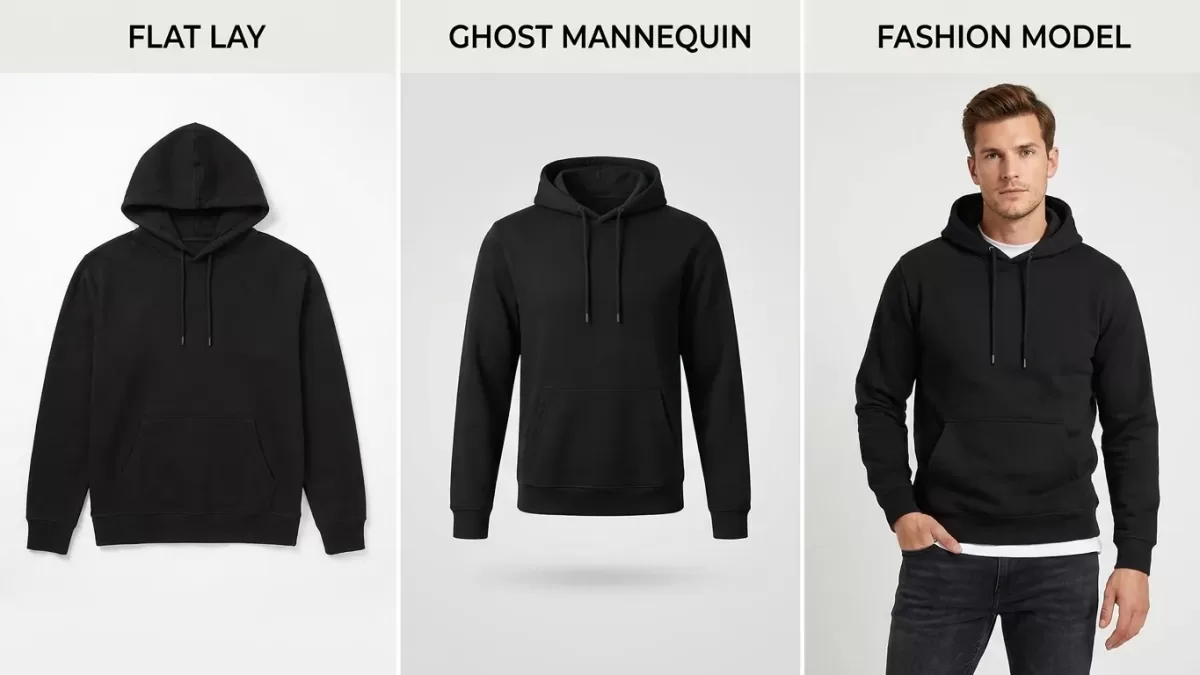
- TL;DR — The Quick Answer
- At a Glance — Which Format Should You Pick Right Now?
- Definitions — Quick Reference
- The Core Question Every Apparel Brand Faces
- What Is Ghost Mannequin Photography?
- What Is Flat Lay Photography?
- What Is On-Model Photography?
- How Each Format Communicates Fit
- Head-to-Head: Cost, Speed, and Production Reality
- Which Format Actually Converts Better?
- Format-by-Format Pros and Cons
- Which Format Wins by Garment Type?
- Which Format Wins by Fabric Type?
- Which Format Wins by Customer Segment?
- The 4-Image Apparel PDP Formula
- Marketplace Requirements: What Each Platform Actually Allows
- Return Rates: The Data Nobody Talks About Enough
- How to Choose the Right Format for Your Business
- The Photography Brief Template That Prevents Wasted Shoots
- Format-Specific Mistakes That Kill Apparel Photo ROI
- The Rise of AI Ghost Mannequin — Should You Care in 2026?
- A/B Testing Your Photography Formats
- Real Example: A 300-SKU Dress Brand’s Format Mix
- Seasonal and Campaign Format Switching
- Production Tips That Save Money on Every Shoot
- FAQ — People Also Ask
- Final Thoughts
TL;DR — The Quick Answer
- On-model photography wins for storytelling, emotional appeal, and hero images — but it costs the most and is slowest to produce at scale.
- Ghost mannequin wins on product detail pages because it shows fit, drape, and structure without a live model.
- Flat lay wins for social media, catalog thumbnails, and soft basics — it is fastest and cheapest but hides fit.
- The highest-performing apparel brands blend all three formats across the customer journey rather than picking one.
- Industry data suggests ghost mannequin can lift add-to-cart rates by roughly 22% over flat lay on structured garments like jackets and dresses.
At a Glance — Which Format Should You Pick Right Now?
- If you sell structured, tailored, or premium apparel → lead with ghost mannequin on your PDP.
- If you sell fashion, activewear, swimwear, or lifestyle brands → lead with on-model and support with ghost mannequin secondaries.
- If you sell tees, basics, accessories, or handmade Etsy pieces → flat lay is enough for most SKUs.
That is the decision in three lines. The rest of this guide explains why, when to break the rule, and how to mix formats for the biggest revenue lift.
Definitions — Quick Reference
- Ghost mannequin photography — a compositing technique where the garment is shot on a mannequin and the mannequin is digitally removed in post, leaving a 3D “invisible body” image that shows shape, drape, and interior details.
- Flat lay photography — the garment is laid flat on a surface and photographed from directly overhead at a 90-degree angle. Also called lay flat.
- On-model photography — a real human model wears the garment in a studio or lifestyle setting.
- Packshot — a clean, catalog-style image showing the product against a plain background (often white). Ghost mannequin is a form of packshot.
- Neck joint / sleeve joint / bottom joint — three ghost mannequin techniques that reconstruct the interior of the collar, sleeve, or hem after mannequin removal.
- PDP — Product Detail Page, the page on a store where a shopper decides to buy.
The Core Question Every Apparel Brand Faces
Apparel is the most-returned category in e-commerce. Return rates for clothing sit between 20% and 40% globally in 2026, with some fashion segments pushing 50%. The single largest cause? Shoppers picking the wrong size, colour, or fit because the photos misled them.
That fact makes photography style a business decision, not an aesthetic one. The right format shows the garment truthfully, cuts returns, and lifts conversion. The wrong one costs you sales — and margin on the sales you keep.
Three formats dominate the market in 2026: ghost mannequin, flat lay, and on-model. This guide compares all three on cost, speed, conversion power, and category fit — and shows exactly which combination works for your product mix.
What Is Ghost Mannequin Photography?
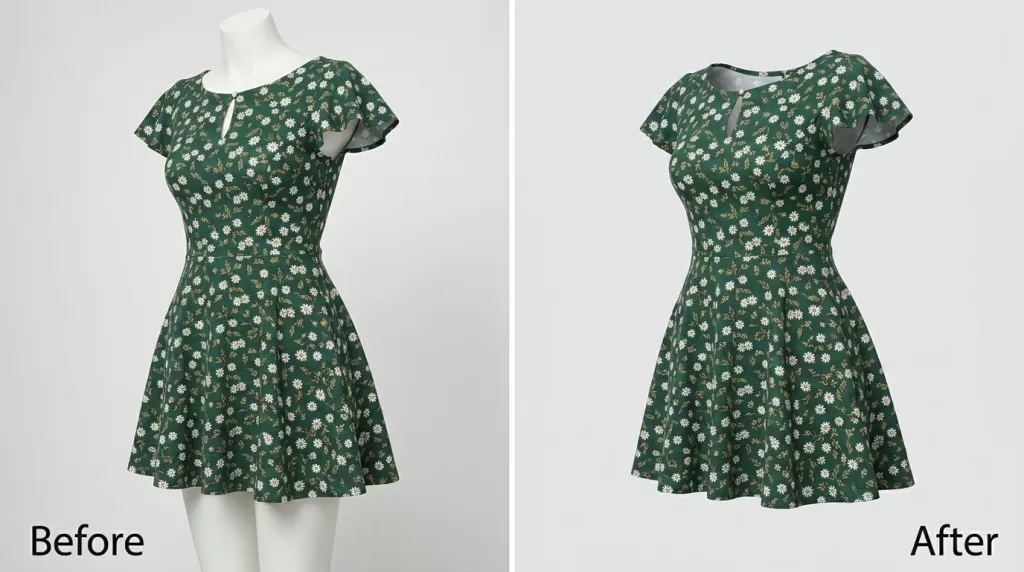
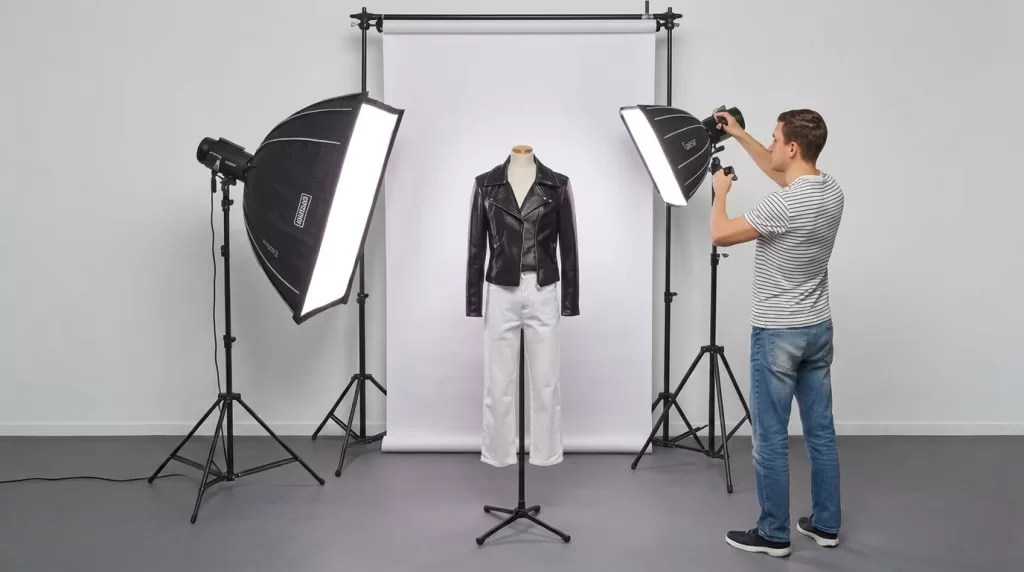
Ghost mannequin photography (also called invisible mannequin or 3D hollow-man photography) is a two-shot compositing technique. Editors photograph the garment on a mannequin, capture a separate interior shot, and digitally remove the mannequin while preserving inside details of the collar, cuffs, hem, and lining. The finished image looks as if an invisible body is wearing the garment.
The technique retains the three-dimensional volume of the clothing without a live model. Shoulders keep their shape. Lapels roll correctly. Hems fall as designed. Our full ghost mannequin guide walks through the complete studio-to-post workflow.
Who uses ghost mannequin at scale: ASOS, Zara, Uniqlo, Everlane, and most mid-market DTC brands use ghost mannequin as the default PDP main image for structured items.
Want a professional 3D apparel look without live models?
Create seamless, neck-joint perfection with our expert Ghost Mannequin Service
What Is Flat Lay Photography?
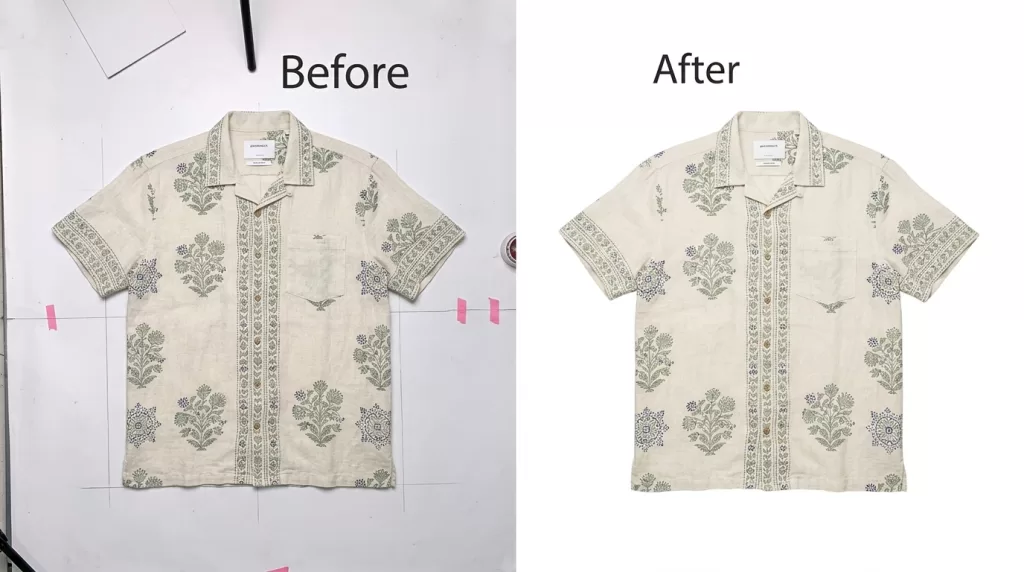
Flat lay photography captures the garment from directly overhead while it lies flat on a surface. The camera sits on a tripod arm or overhead rig pointing straight down. The result is a two-dimensional composition.
Flat lay is the fastest, cheapest apparel format in commercial photography. A trained stylist shoots 40–60 garments per hour. Post-production stays light. Social platforms love the format because it grids beautifully in Instagram feeds and Pinterest boards. The catch: flat lay hides how the garment actually looks on a body.
Who uses flat lay at scale: Etsy sellers, DTC social-first brands, sustainable fashion micro-brands, and any store where speed and cost dominate the calculus.
What Is On-Model Photography?
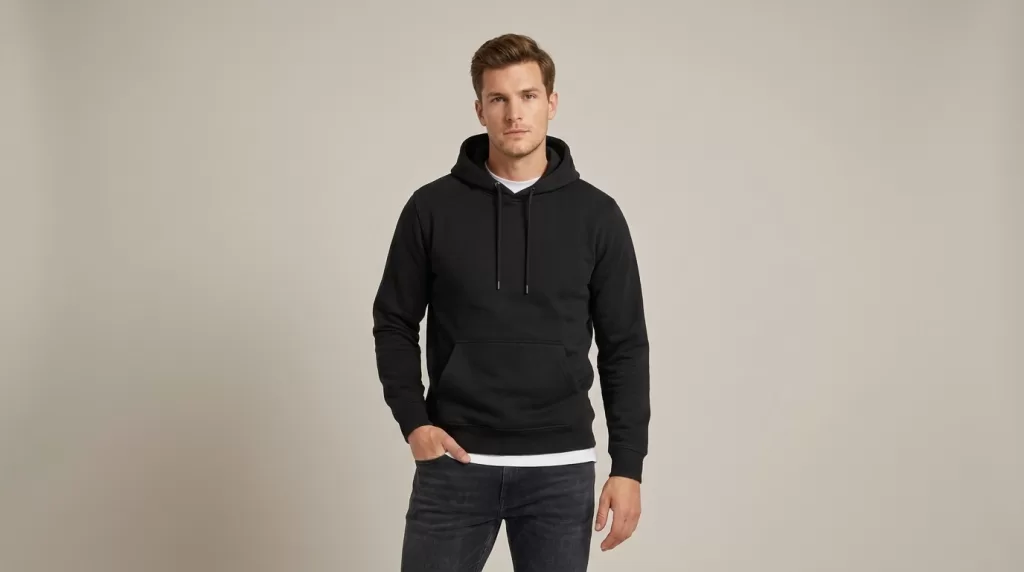
On-model photography places a real human model in the frame wearing the garment. Studio on-model images sit against a clean backdrop. Lifestyle on-model images move into an environment — a rooftop, a café, a street — to build story and mood.
On-model is the format shoppers trust most because it answers the two questions no cutout can: “How does this look on a human being?” and “How would it look on me?”
Who uses on-model at scale: Farfetch, Net-a-Porter, ASOS, Zalando, and every luxury or premium fashion brand where fit and lifestyle context justify the price tag.
How Each Format Communicates Fit
Fit is the single biggest driver of apparel returns. Each format answers different fit questions.
- Flat lay answers: What does the fabric look like? What is the pattern? What accessories or props does it style with? It does not answer: How does it sit on a body? Where does it break? How does the hem move?
- Ghost mannequin answers: What is the true silhouette? How do the shoulders sit? Where does the waist land? What does the neckline construction look like from the inside? It does not answer: How does it look on a real person of my size?
- On-model answers: How does this look worn? Does it flatter my body type? How does the fabric move when I walk? It struggles to answer: What are the exact fine construction details?
Every apparel brand needs to answer as many of these questions as possible on the PDP. That is why the combined strategy consistently beats the choose one strategy.
Head-to-Head: Cost, Speed, and Production Reality
Here is what each format costs and produces in 2026, based on published rate cards and studio benchmarks across the US, EU, and Asia.
| Metric | Flat Lay | Ghost Mannequin | On-Model (Studio) | On-Model (Lifestyle) |
|---|---|---|---|---|
| Shoot cost per image | $5–$25 | $15–$50 | $50–$200 | $150–$500+ |
| Editing cost per image | $0.30–$1.50 | $0.79–$8.00 | $1–$10 | $2–$25 |
| Production speed | 40–60/hr | 8–15/hr | 4–8/hr | 2–4/hr |
| Model fees | None | None | $200–$800/day | $500–$5,000/day |
| Location cost | None | None | Studio only | Location + permits |
| Post-production complexity | Light | Heavy (neck joint) | Moderate | Heavy (retouching) |
| Best for | Basics, accessories | Structured tailoring | Fit-critical apparel | Brand storytelling |
The single largest cost driver in apparel photography is the model day rate — followed by location fees, hair-and-makeup, and styling. That is why most catalog brands ration on-model to hero shots and rely on ghost mannequin or flat lay for the bulk of the SKU catalog.
Which Format Actually Converts Better?
Three consistent findings show up across industry data.
Finding 1 — Ghost mannequin outperforms flat lay on PDPs for structured garments. Industry reports suggest 3D ghost mannequin imagery lifts add-to-cart rates by roughly 22% over flat lay for textured or tailored garments. The reason is direct: shoppers can see how the garment holds shape.
Finding 2 — On-model beats both formats when fit uncertainty is the biggest purchase barrier. ASOS runs multi-model catwalk videos on nearly every product page for the same reason: their internal data shows fit demonstration reduces returns.
Finding 3 — Baymard Institute research from its ecommerce CRO study shows 56% of shoppers begin exploring product images the moment they land on a listing, and only 25% of e-commerce sites provide sufficient imagery for a proper evaluation. Image quality is what shoppers evaluate first — before copy, price, or reviews.
Combined, these findings tell a clear story: photography choice is not a taste question. It moves both add-to-cart rates and refund rates in measurable ways.
Want to boost your online sales with better product photography?
High-quality images increase conversions by up to 40%. Let us help you get there. See our editing services
Format-by-Format Pros and Cons
Flat Lay — Pros and Cons
Pros
- Cheapest and fastest format in production.
- Consistent look across large catalogs.
- Strong for texture, pattern, and prints.
- Native fit for Instagram grids and Pinterest boards.
- No model or mannequin logistics.
Cons
- Hides drape, shape, and true silhouette.
- Fails on structured garments — blazers look boxy, dresses look flat.
- Not accepted as the main image on Amazon fashion listings for most apparel categories.
- Requires meticulous steaming to look premium.
- Weak conversion on high-consideration purchases like tailoring.
Ghost Mannequin — Pros and Cons
Pros
- Shows true 3D shape, shoulder line, and drape.
- Reveals interior details — collar linings, cuffs, hems, labels.
- Marketplace-compliant on Shopify, Etsy, Walmart, and secondary Amazon slots.
- Consistent, catalog-ready look at scale.
- Roughly half the cost of a full on-model shoot for the same volume.
Cons
- Requires advanced post-production (neck, sleeve, and bottom joints).
- Higher upfront cost than flat lay.
- Struggles with sheer, translucent, or ultra-lightweight fabrics.
- No emotional or lifestyle context.
- Editing quality varies widely between studios.
On-Model — Pros and Cons
Pros
- Highest emotional pull and brand story potential.
- Answers “how will this look on me?” better than any alternative.
- Reduces returns caused by fit and expectation gaps.
- Versatile across ads, PDPs, lookbooks, and social channels.
- Supports diversity, inclusivity, and premium positioning.
Cons
- Most expensive format by a wide margin.
- Slowest production speed at scale.
- Introduces variables: expressions, poses, fit variance.
- Requires model casting, styling, hair, and makeup logistics.
- Difficult to keep visually consistent across seasons.
Want your images to look professionally edited, not over-processed?
Achieve natural, high-end perfection with our skilled Photo Retouching Service
Which Format Wins by Garment Type?
Different garments demand different formats. Applying the wrong style to a garment category costs conversions and drives returns.
| Garment Type | Best Format | Why |
|---|---|---|
| T-shirts, casual tops, knits | Flat lay | Predictable fit; shape rarely matters |
| Hoodies, sweatshirts | Flat lay + Ghost mannequin | Flat lay for social, ghost for PDP |
| Blazers, tailored jackets | Ghost mannequin | Shoulder shape and lapel roll must show |
| Structured dresses | Ghost mannequin or On-model | Drape defines the value |
| Flowing / wrap dresses | On-model | Movement is the selling point |
| Sheer or lightweight fabrics | On-model | Translucency needs body context |
| Denim / jeans | Ghost mannequin + On-model | Fit is everything for jeans |
| Activewear | On-model | Movement and stretch matter |
| Underwear / lingerie | Ghost mannequin | Modesty and fit clarity |
| Swimwear | On-model | Fit and body context are essential |
| Outerwear (coats, parkas) | Ghost mannequin | Weight and structure show best |
| Bridal and occasionwear | On-model | Emotional stakes are highest |
| Kidswear | Flat lay + On-model | Flat for detail, model for scale |
| Accessories (scarves, hats) | Flat lay | Detail is the whole story |
The rule of thumb: the more structure or fit variance the garment has, the further right on this table you should go.
Which Format Wins by Fabric Type?
Fabric behaviour changes the calculus. Two identical dress silhouettes shot in different fabrics can need different formats.
- Cotton, jersey, wool blends — flat lay or ghost mannequin both work. Fabric holds shape enough for either.
- Silk, satin, chiffon — on-model wins. These fabrics need body movement to show properly; flat lay makes them look like puddles of fabric.
- Denim — ghost mannequin is the gold standard. It reveals rise, break, and true leg silhouette without a model.
- Cashmere, fine knits — ghost mannequin works, but overhead flat lay is popular because it shows the weave texture clearly.
- Leather, structured outerwear — ghost mannequin only. Flat lay collapses the sculpture; on-model can hide construction details.
- Sheer, lace, mesh, tulle — on-model is often the only option. Ghost mannequin can work for lingerie sets but requires expert edge editing.
- Technical performance fabrics — on-model demonstrates stretch, sweat management, and movement that no static shot can convey.
Removing wrinkles is the second-biggest post-production cost on any of these fabrics. If you shoot flat lay or ghost mannequin, our guide on how to remove clothing wrinkles in Photoshop can save your editors hours per shoot.
Which Format Wins by Customer Segment?
- Womenswear — the highest fit-uncertainty category. On-model plus ghost mannequin outperforms flat-lay-only in almost every A/B test that reaches significance.
- Menswear — tailoring benefits from ghost mannequin (shoulder, lapel, break). Casualwear (tees, hoodies) is fine on flat lay for secondary shots.
- Kidswear — flat lay dominates because parents look for print, colour, and detail. Add one on-model shot per style for scale.
- Plus-size and inclusive sizing — on-model is non-negotiable. Shoppers need to see the garment on a body type that reflects theirs.
- Modest fashion and religious apparel — ghost mannequin is often preferred over on-model for brand-fit reasons.
- Bridal, occasion, and luxury — always on-model, always in premium studio lighting.
The 4-Image Apparel PDP Formula
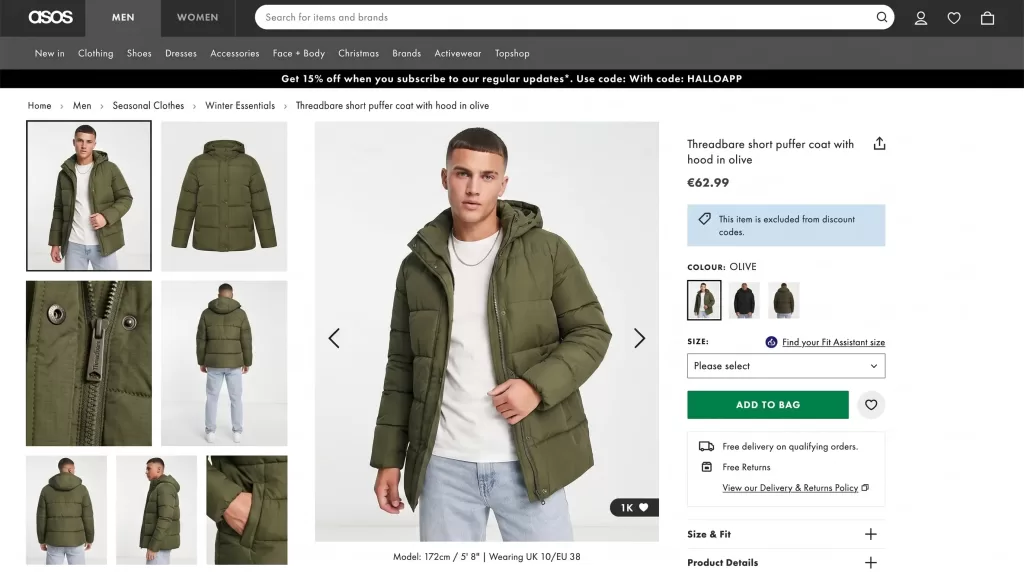
The strongest fashion PDPs follow a repeatable 4-image core, then layer extras. This is an original framework based on analysing how ASOS, Zara, Everlane, and Uniqlo structure their product pages.
- Image 1 — The Hero. On-model front view, showing the garment in context with clear fit. This is the main image on the PDP.
- Image 2 — The Silhouette. Ghost mannequin front view against a clean white or neutral background. This is what the shopper zooms into.
- Image 3 — The Detail. Flat lay macro or close-up on fabric, hardware, or stitching. This closes construction-quality doubts.
- Image 4 — The Movement. On-model side or back view, or a short 3-second walking clip. This answers “how does it move on a body?”
Add 3–4 more images for angles, size comparisons, and lifestyle context — the sweet spot is 7–10 images per PDP for apparel, which industry testing consistently identifies as the conversion peak.
Our ecommerce photo editing guide walks through how to prepare and process this mixed asset set at scale.
Marketplace Requirements: What Each Platform Actually Allows
Not every format works as a main image on every marketplace. Break the rules and listings get suppressed or hidden from search.
Amazon Fashion. The Amazon clothing image guidelines require the main image for most men’s and women’s apparel to be photographed on a live human model. Exceptions apply to children’s and baby undergarments, leotards, swimwear, and similar form-fitting items — those can appear on a mannequin. All main images need a pure white background at RGB 255,255,255, the product filling at least 85% of the frame, and a minimum of 500 pixels on the longest side (1,000+ pixels for zoom to activate).
Zalando. Requires a front-crop model view as the primary image for apparel, kids, lingerie, and shoes. Packshots (which include ghost mannequin) are also accepted as additional views. Article limit is up to 9 images per product.
Shopify. No format restriction — the merchant chooses. Shopify recommends 2,048 × 2,048 px square product images and supports WebP for faster load speeds.
Etsy. No format rule. Etsy recommends ≥ 2,000 px on the shortest side. Up to 10 photos plus 1 video per listing.
Walmart Marketplace. 2,000 × 2,000 px recommended, seamless white background, four or more images per listing. Ghost mannequin and on-model are both accepted.
Meta Shops and TikTok Shop. Both accept all three formats. Vertical framing (4:5 or 9:16) outperforms square on these mobile-first platforms.
Return Rates: The Data Nobody Talks About Enough
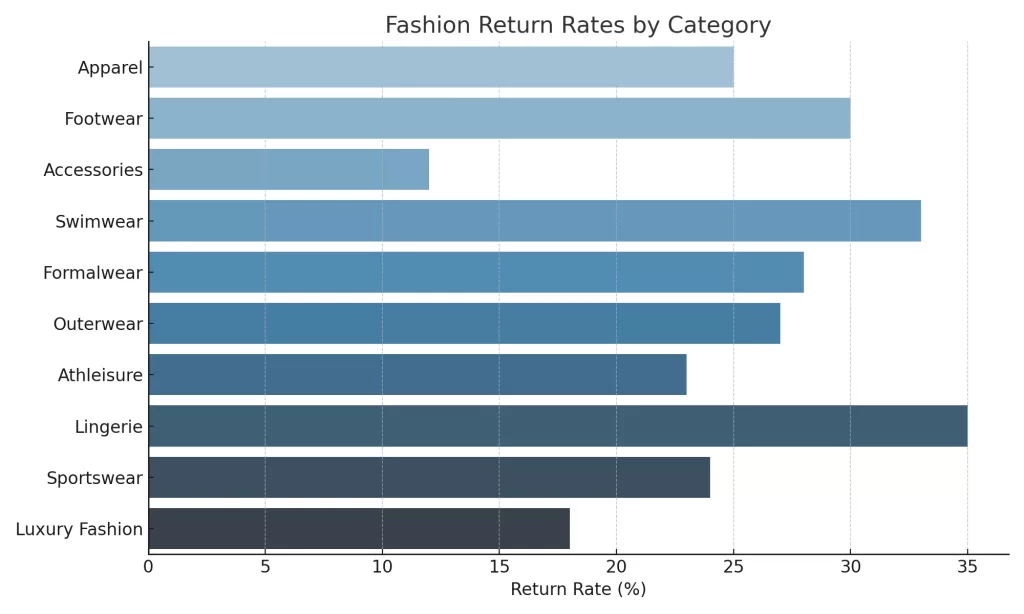
Apparel returns run at 20% to 40% across most fashion segments — the highest of any e-commerce category. Two data points explain why photography style matters more here than in almost any other product vertical.
- Roughly 34% of consumers returned items in the last year because product images were misleading, per Akeneo’s 2025 Consumer Returns Report.
- Wrong size, colour, or fit is consistently the top return reason across every major marketplace.
Ghost mannequin and on-model both attack this problem. Flat lay does not — a flat photograph of a wrap dress hides exactly the drape and cinch that determines whether it will look right on the buyer’s body.
The math becomes brutal at scale: a 5% reduction in returns on a $10M apparel business puts $500K straight into margin. That is more than the entire annual photography budget of most mid-market brands.
Want your product photos to look effortlessly professional?
Let us handle the tricky edges with our reliable Image Masking Service
How to Choose the Right Format for Your Business
The decision comes down to four inputs: catalog size, product category, target margin, and platform mix. Use this decision tree.
Step 1 — Where do most of your sales come from?
- Amazon Fashion → on-model required for most apparel main images.
- Shopify DTC → free to choose; ghost mannequin recommended for structured items.
- Etsy → flat lay works fine for handmade and casual pieces.
- Zalando or premium marketplaces → on-model mandatory for the front crop.
Step 2 — What garments make up 80% of your revenue?
- Structured (jackets, dresses, denim, outerwear) → ghost mannequin as PDP default.
- Soft (tees, knits, casual accessories) → flat lay is enough.
- Emotional (bridal, occasion, activewear, swimwear) → on-model required.
Step 3 — What is your realistic annual photography budget?
- Under $5,000 → flat lay only, with ghost mannequin outsourced for hero products.
- $5,000–$25,000 → flat lay plus ghost mannequin for the full catalog.
- $25,000+ → full mix, with on-model lifestyle for top-tier SKUs.
Step 4 — How large is your catalog?
- Under 100 SKUs → invest in on-model for every product.
- 100–1,000 SKUs → ghost mannequin as default, on-model on hero pieces only.
- 1,000+ SKUs → mix ghost mannequin and flat lay for the bulk, on-model for campaigns only.
The Photography Brief Template That Prevents Wasted Shoots
Whether you shoot in-house or outsource to a studio, a written brief before every shoot cuts wasted time by an order of magnitude. Steal this template.
- Brand vibe — one sentence describing the aesthetic (e.g., “Scandinavian minimalist, cool light, muted tones”).
- Reference images — 3–5 competitor or aspirational shots that represent the target look.
- Shot list per SKU — main + 3 alternates + 1 detail, with format specified for each (ghost mannequin / flat lay / on-model).
- Background specs — exact hex codes (#FFFFFF for Amazon-compliant white, or your brand’s neutral).
- Framing rules — aspect ratio, product-to-frame percentage, margin above and below the garment.
- Model brief (on-model shoots) — height range, size range, pose sheet, hair, makeup notes.
- Styling brief — layering rules, accessory usage, footwear.
- File delivery specs — dimensions, file format, colour profile (sRGB for web), max file size.
- File naming convention — for example,
SKU12345_main.jpg,SKU12345_ghost_front.jpg. - Turnaround SLA and revision policy.
Clear briefs typically cut revision rounds by more than half.
Struggling with inconsistent cutouts from automated software?
Switch to 100% manual, expert Clipping Path for guaranteed perfection.
Format-Specific Mistakes That Kill Apparel Photo ROI
Every format has its own failure modes. Fixing these lifts quality overnight.
Flat lay mistakes
- Using flat lay as the Amazon main image on non-exempt apparel — the listing gets suppressed.
- Over-styling with props — buyers cannot separate the garment from the noise.
- Uneven overhead lighting — creates soft shadows on one side of the frame.
- Failing to steam every garment — wrinkles ruin the premium look and inflate post-production cost.
- Inconsistent background colour across a shoot — kills catalog cohesion.
Ghost mannequin mistakes
- Skipping neck-joint reconstruction — the collar interior looks unfinished and cheap.
- Using the wrong mannequin size for the sample — the garment looks stretched or baggy.
- Not shooting the interior detail shot — impossible to reconstruct the neckline in post.
- Weak edge cleaning around dark fabrics — leaves visible mannequin outlines.
- Missing the required shadow creation step — the garment floats in space and looks fake.
On-model mistakes
- Mixing model heights and body types across a single collection without disclosing it — inflates fit-related returns.
- Using outdoor lifestyle shots as the only imagery — glare, wind, and shadow hide fit details.
- Inconsistent skin retouching across models — signals amateurism.
- Ignoring diversity — hurts brand perception and can suppress traffic on discovery platforms.
- Over-processed skin — looks plastic and destroys trust.
The Rise of AI Ghost Mannequin — Should You Care in 2026?
AI ghost mannequin tools have compressed the traditional cost curve. Where manual ghost mannequin editing ran $3–$8 per image at high-end studios, AI-assisted services now start below $1 per image. The trade-off: AI still struggles on textured fabrics, complex tailoring, sheer materials, and lookbook-grade brand consistency.
The winning workflow in 2026 for most brands looks like this:
- AI-first pass on standard catalog items.
- Human editors on hero images, complex garments, and brand-critical assets.
- Manual quality control on every AI output before it hits the site.
Industry adoption data supports the blend. Reports show roughly 57% of online retailers use ghost mannequin photography alongside flat lay, while around 95% still use model photography somewhere in the mix — proof that no single format wins alone.
A/B Testing Your Photography Formats
The only way to know for certain which format wins for your products is to test. Two frameworks work well.
Framework A — Same product, different main image. Rotate the same SKU through flat lay, ghost mannequin, and on-model as the main image over 30-day windows on Shopify. Track add-to-cart rate, conversion rate, and return rate for each version.
Framework B — Category-level split. Group products by category (jackets, dresses, tees) and assign different default formats to each. After 90 days, compare category-level revenue per SKU and return rates.
Amazon’s split-testing tool (Manage Your Experiments) allows A/B testing of main images at the SKU level for brand-registered sellers. Shopify supports this natively through apps like Intelligems, Dexter, or Convert.
The finding almost every brand reports: the winning format varies by category, which is exactly why the combined strategy above beats any one-format-fits-all approach.
Real Example: A 300-SKU Dress Brand’s Format Mix
Consider a mid-market direct-to-consumer dress brand shooting a spring collection of 300 SKUs. Here is an illustrative optimized production plan built on 2026 rate cards.
| Deliverable | Format | Volume | Rate | Estimated Cost |
|---|---|---|---|---|
| Main PDP image | Ghost mannequin | 300 | ~$15/image | ~$4,500 |
| Alternate angles | Ghost mannequin | 900 | ~$12/image | ~$10,800 |
| Detail close-ups | Flat lay macro | 600 | ~$5/image | ~$3,000 |
| Hero on-model shots | On-model studio | 60 (top 20 SKUs × 3 each) | ~$100/image | ~$6,000 |
| Lifestyle campaign | On-model lifestyle | 40 | ~$200/image | ~$8,000 |
| Total | — | 1,900 images | — | ~$32,300 |
That mix delivers 6–7 images per SKU across the catalog, spikes 12+ images on hero products, and stays within a realistic mid-market seasonal budget. Attempting to shoot all 300 SKUs on-model would push the same budget above $80,000 — with no measurable conversion lift on lower-tier SKUs. Getting the accurate colour balance across such a mix requires a strict color grading discipline so every image reads as the same brand.
Seasonal and Campaign Format Switching
Photography format is not static across a year. High-performing brands switch emphasis by season and campaign type.
- New collection launches — lead with on-model to build story and emotion, then swap main images to ghost mannequin once the campaign ends.
- Peak sale periods (Black Friday, EOSS) — ghost mannequin dominates because shoppers convert on fit clarity, not aspiration.
- Evergreen basics restocks — flat lay is enough; save the on-model budget for what needs it.
- Influencer and social campaigns — flat lay grid content plus on-model lifestyle reels; ghost mannequin rarely appears on social.
- Holiday gifting — on-model wins because gifting relies on emotional storytelling, not fit.
Rotating the mix by calendar quarter keeps the catalog visually fresh without doubling the photography budget.
Production Tips That Save Money on Every Shoot
- Steam every garment before it enters the frame. Wrinkles are the single largest driver of retouching cost.
- Use consistent lighting setups across a full shoot to avoid batch colour mismatches.
- Shoot in RAW on a colour-calibrated monitor.
- Match camera height per garment category — tops from chest height, bottoms from waist height, shoes from floor height.
- Build a written style guide covering background hex, cropping ratio, negative space, shadow style, and file dimensions. If you rely on white backgrounds, our white background breakdown covers the exact lighting setup.
- Pre-tag every image at shoot time — SKU, angle, format — so post-production runs without confusion.
- Deliver a shot-list checklist to the on-set producer for every SKU.
Studios that skip preparation spend up to 40% more on retouching because deep wrinkles alter garment shape and are almost impossible to fix digitally without distorting the silhouette.
FAQ — People Also Ask
Which converts better: ghost mannequin, flat lay, or on-model photography?
On-model tends to convert best when fit is the biggest question, ghost mannequin wins on structured garments where shape and drape sell, and flat lay works best for soft basics and social media. The strongest catalogs combine all three across the shopper journey.
Is ghost mannequin photography worth the extra cost over flat lay?
Yes for structured items — jackets, blazers, dresses, denim, outerwear — where industry data suggests ghost mannequin lifts add-to-cart rates by roughly 22% over flat lay. For soft basics like tees and casual knits, flat lay remains cost-efficient.
Does Amazon require on-model photography for apparel?
Amazon requires the main image for most men’s and women’s clothing categories to show the garment on a live human model. Exceptions apply to children’s and baby undergarments, leotards, swimwear, and similar form-fitting items — those can appear on a mannequin.
Does Zalando require on-model images?
Yes. Zalando requires a front-crop model view as the primary image for apparel, kids, lingerie, and shoes. Packshots — including ghost mannequin — are accepted as additional views within the same listing.
How much does ghost mannequin editing cost per image in 2026?
Manual ghost mannequin editing runs $0.79–$8.00 per image depending on complexity and studio tier. AI-assisted services start around $0.19–$1.00 per image but need quality control on complex garments.
Which apparel photography format has the lowest cost per image?
Flat lay is the lowest-cost format, running $5–$25 per image including basic editing. Ghost mannequin sits in the middle, and on-model is the highest-cost format because of model, studio, hair, makeup, and styling fees.
How many product images should a fashion PDP have?
Between 7 and 10 images consistently outperforms both shorter and longer galleries in fashion e-commerce testing. That typically includes one main shot, three alternate angles, two detail close-ups, one or two lifestyle images, and one size or comparison graphic.
Which format works best for silk, chiffon, or sheer fabrics?
On-model wins for silk, chiffon, satin, and sheer fabrics because these materials only reveal their drape and movement on a body. Ghost mannequin can work for lingerie sets but requires expert edge editing.
Which format works best for denim and jeans?
Ghost mannequin is the gold standard for denim on PDPs because it shows the rise, break, and true leg silhouette without a model. Add one on-model image to demonstrate fit on a body.
Can AI-generated model photography replace on-model shoots in 2026?
AI on-model imagery is improving fast but still struggles with brand consistency, realistic fit, and complex fabrics. Most brands use it for early assortment testing and channel-specific variations rather than for hero campaigns.
Final Thoughts
Ghost mannequin, flat lay, and on-model photography are not competitors. They are complementary tools that solve different jobs across the same customer journey.
Flat lay wins the top of the funnel and the social scroll. Ghost mannequin wins the product detail page and the marketplace listing. On-model wins the emotional moment and closes the sale.
Brands that recognise this — and build a production workflow that assigns the right format to the right garment on the right touchpoint — outperform brands that pick one format and force it everywhere. The 22% add-to-cart lift on structured garments, the 5% return reduction on well-shot apparel, the 30–40% conversion improvement on hero pages — all of it comes from format-fit, not format-purity.
Ready to transform your raw photos into professional assets?
Get a custom, no-obligation quote tailored to your specific volume and needs. Explore Clipping Expert Asia