


4×6 vs 5×7 Photo Size Which One Should You Choose?
February 12, 2026
Change the Color of an Object in Photoshop: Your Complete Step-by-Step Guide
February 13, 2026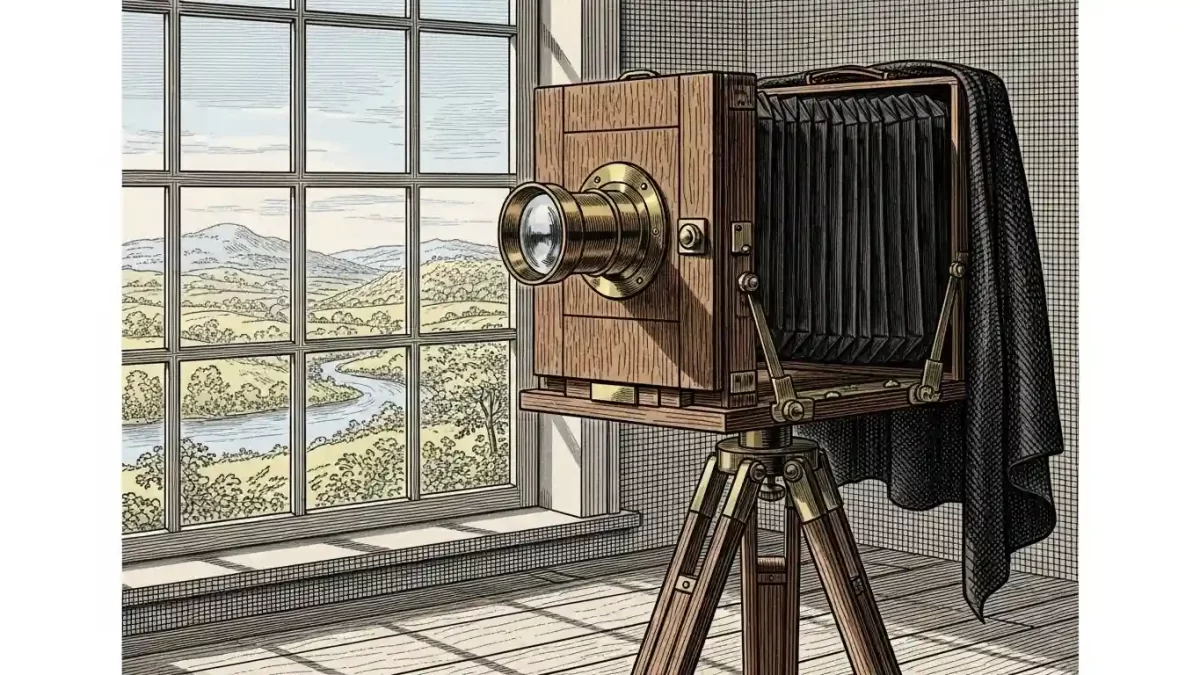
Cameras have revolutionized the way we document life, turning ephemeral moments into enduring records that shape our memories and histories. People frequently search for answers about the origins of this transformative tool, curious about its humble beginnings and rapid advancements. The first camera emerged from a blend of ancient optical discoveries and 19th-century chemical experiments, forever changing art, science, and everyday communication. Inventors overcame immense challenges to create devices that capture light and preserve images, leading to the billions of photos shared worldwide today. This article uncovers the timeline, spotlighting pivotal figures and breakthroughs that propelled photography from shadowy projections to high-tech digital marvels.
- Ancient Beginnings: How the Camera Obscura Sparked Optical Innovation
- Pioneering Permanent Captures: Joseph Nicéphore Niépce's Groundbreaking Heliography
- Refining the Art: Louis Daguerre's Daguerreotype and Rival Techniques
- Bringing Photography to the Masses: George Eastman's Kodak Revolution
- Entering the Digital Age: Prototypes, Sensors, and Smartphone Dominance
- Motion in Focus: The Parallel Rise of Video Cameras
- Shaping Worlds: Cameras' Deep Influence on Society and Culture
- Looking Ahead: Emerging Trends and Future Camera Innovations
- Frequently Asked Questions
Ancient Beginnings: How the Camera Obscura Sparked Optical Innovation
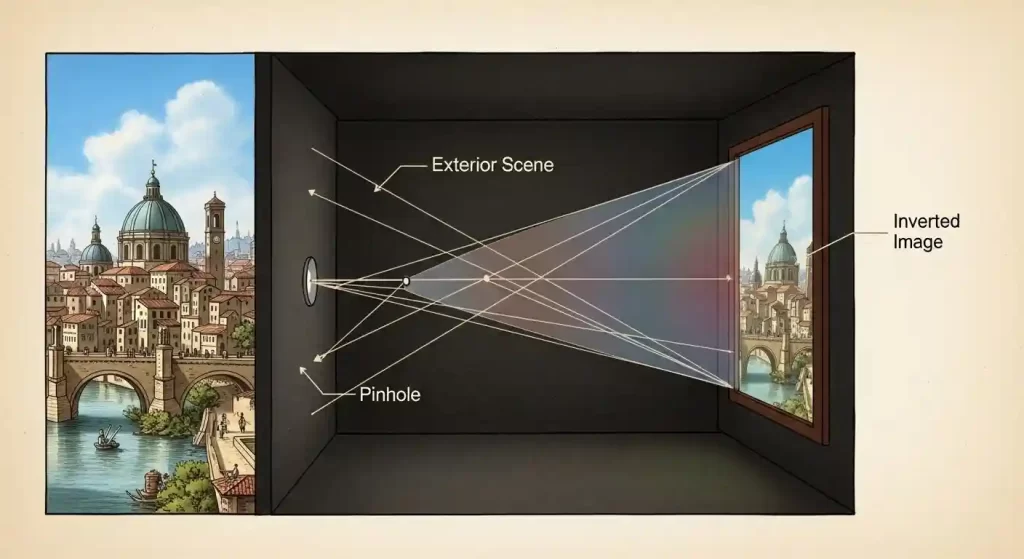
Ancient scholars first noticed the magic of light projection, setting the foundation for all future cameras. Chinese philosopher Mozi in the 5th century BCE described how rays of light through a tiny opening form an upside-down image on a wall. Aristotle in Greece echoed this around the 4th century BCE, using the effect to safely view solar eclipses without staring at the sun. These observations evolved into the camera obscura, a simple darkened chamber that projected external scenes inward.
Ibn al-Haytham, the Arab polymath known as Alhazen, took this further in the 11th century. His experiments detailed in the Book of Optics explained light’s straight-line travel and image formation, influencing Renaissance artists profoundly. Leonardo da Vinci adopted portable camera obscura setups—boxes or tents with lenses—to sketch with lifelike accuracy, capturing depth and proportion in his masterpieces. Craftsmen refined these tools by the 16th century, adding mirrors to correct the inversion and make them more practical for outdoor use.
Artists and scientists alike marveled at how this device mimicked the human eye, yet it couldn’t preserve what it showed. Painters traced projections onto canvases, blending technology with creativity. This era ignited questions about fixing those fleeting images chemically, bridging philosophy and invention. Without these early insights, modern photography might have taken centuries longer to develop.
Dive deeper into these optical roots with this comprehensive guide to the camera obscura’s history.
Pioneering Permanent Captures: Joseph Nicéphore Niépce’s Groundbreaking Heliography
Inventors in the early 1800s turned their attention to making projected images last. Joseph Nicéphore Niépce, a determined French experimenter, led the charge. Starting in 1816, he coated paper with silver chloride inside a basic box device, producing faint images that vanished in light. Undeterred, he switched to bitumen on pewter plates, a substance that hardened under sunlight.
Niépce’s efforts culminated in 1826 with “View from the Window at Le Gras,” the earliest surviving photograph. He exposed the plate for roughly eight hours in his adapted camera obscura, yielding a subtle depiction of his estate’s rooftops and trees. This heliography process, named for its sun-based drawing, proved that light could etch permanent records. Niépce’s simple wooden camera with a lens marked the true birth of practical photography, answering when the first camera was invented with a tangible device.
Despite long exposures limiting it to still scenes, Niépce’s innovation inspired widespread experimentation. He collaborated briefly with others, sharing his findings through letters that emphasized persistence. His background in engraving informed his approach, merging mechanical and chemical arts. This breakthrough shifted photography from theory to reality, opening doors for refinements that would soon follow.
Refining the Art: Louis Daguerre’s Daguerreotype and Rival Techniques
Louis Daguerre built directly on Niépce’s work after their short partnership ended with Niépce’s passing in 1833. Daguerre unveiled his daguerreotype in 1839, using iodine-sensitized silver-plated copper sheets exposed briefly and developed with mercury vapor. This slashed times to mere minutes, enabling sharp portraits that captured human expressions vividly.
France’s government bought the patent and released it freely, fueling a boom in photography studios across continents. People flocked to have their likenesses immortalized on these gleaming, unique plates, which resembled mirrors. Daguerre, once a stage designer, infused artistry into the medium, creating images that contemporaries hailed for their lifelike quality. However, the hazardous chemicals demanded caution, and the inability to duplicate easily posed limitations.
Meanwhile, William Henry Fox Talbot in England introduced the calotype in 1841. His paper-based negatives allowed unlimited positive prints, ideal for books and sharing. This negative-positive method contrasted daguerreotypes’ singularity, fostering reproduction in media. Frederick Scott Archer’s 1851 wet collodion process merged the best of both: glass plates for detail and quick exposures, revolutionizing field work during events like the Crimean War.
These competing advancements accelerated progress, making cameras more versatile and photography a viable profession.
Explore Daguerre’s enduring influence through this in-depth essay on early photographic processes.
Bringing Photography to the Masses: George Eastman’s Kodak Revolution
George Eastman simplified everything in 1888 with the Kodak camera, a compact box preloaded with roll film for 100 shots. Users pointed and clicked, then shipped the whole unit back for professional developing. His catchy phrase, “You press the button, we do the rest,” stripped away complexity, inviting amateurs to join in.
Eastman’s flexible celluloid film replaced cumbersome glass, enabling portable designs and candid snaps of daily life. The affordable Brownie model in 1900, priced at a dollar, targeted families and kids, exploding popularity. Kodak processed millions of rolls yearly by the early 1900s, building an industry around convenience. Photographers captured unposed moments, from picnics to milestones, democratizing visual storytelling.
Eastman’s company pioneered color with Kodachrome in 1935, adding vibrancy to images. Compact 35mm cameras like Leica’s in the 1920s complemented this, allowing discreet street shots. Instant options from Polaroid in 1948 delivered prints in minutes, perfect for spontaneous fun. These steps made cameras everyday essentials, fueling cultural shifts in how people preserved experiences.
- Standout Kodak features that changed the game:
- Roll film for multiple exposures without reloading
- Factory processing to eliminate home darkrooms
- Affordable pricing that broadened access
Entering the Digital Age: Prototypes, Sensors, and Smartphone Dominance
Steven Sasson at Kodak sparked the digital shift in 1975 with a prototype that stored low-res images on tape. This hefty gadget previewed a filmless future, where sensors turned light into data instantly. Consumer models arrived in the 1990s, like Apple’s QuickTake, offering color and deletions to cut waste.
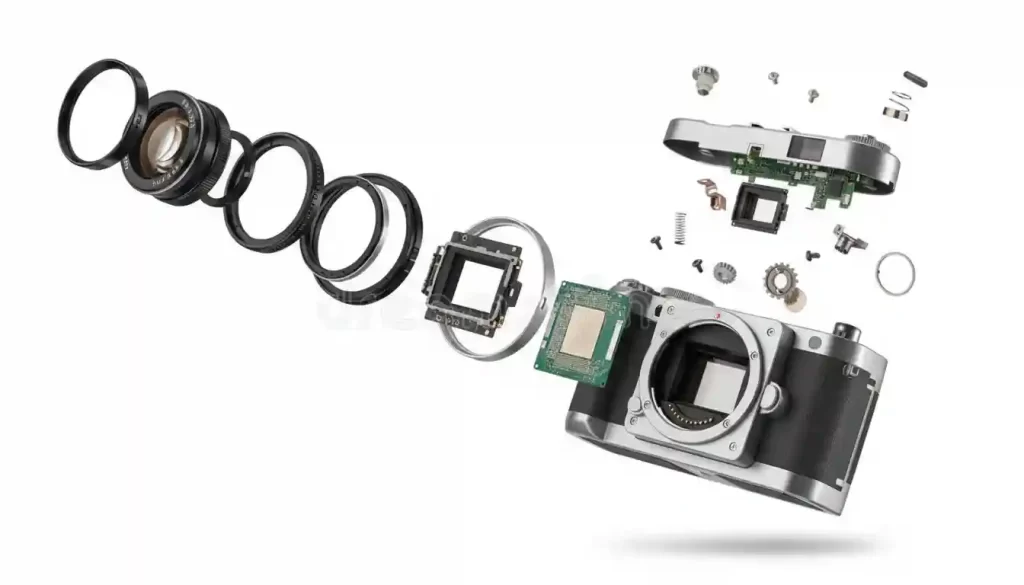
DSLRs from Nikon and Canon in the 2000s brought pro-level quality, with mirrors showing exact views. Charge-coupled devices improved fidelity, while software like HDR enhanced tricky lighting. Smartphones sealed the deal; Sharp’s 2000 model started it, but the iPhone’s 2007 integration made high-megapixel cameras pocket-sized powerhouses.
Today, AI in phones auto-adjusts for perfect shots, stacking exposures for clarity, often complemented by photo retouching for e-commerce and professional use. Drones and GoPros add adventure angles, while mirrorless systems from Sony provide compact versatility. Digital tech minimizes environmental harm from chemicals, letting creators experiment freely.
For a closer look at this transformation, read this timeline of digital camera milestones.
Motion in Focus: The Parallel Rise of Video Cameras
Still photography’s sibling, video capture, developed hand-in-hand. Thomas Edison’s team created the Kinetograph in 1891, using perforated film to record short moving sequences for viewers. The Lumière brothers’ 1895 Cinématographe combined filming, printing, and projecting, screening real-life clips that captivated crowds.
Electronic pioneers like John Logie Baird in the 1920s scanned images for television, while Vladimir Zworykin advanced tubes in the 1930s for broadcasts. Camcorders hit homes in the 1980s via Sony’s formats, shrinking devices for family videos. Digital video surged in the 1990s, evolving to 4K resolutions today.
Smartphones now blend stills and motion seamlessly, with influencers using them for high-quality content. This evolution enriched storytelling, from Hollywood epics to viral clips.
Shaping Worlds: Cameras’ Deep Influence on Society and Culture
Cameras alter perceptions, powering journalism that exposes truths—like Dorothea Lange’s Dust Bowl portraits spurring aid. They fuel art movements, freeing painters for abstraction while photographers like Ansel Adams exalt nature. In commerce, crisp images boost sales, especially with clipping path refining visuals for online shops.
Socially, they connect generations through albums and social media shares on platforms like Instagram. Videography democratizes entertainment, enabling YouTube creators to reach millions. Yet, surveillance raises privacy issues, demanding ethical balances.
Cameras advance science too, imaging distant planets or microscopic cells. They document activism, amplifying voices in protests worldwide. This tool’s journey reflects our urge to hold onto the intangible, making personal stories universally relatable.
Gain perspectives on this cultural force from the competitor’s insightful post: When Was the First Camera Invented? The Evolution of Photography.
Looking Ahead: Emerging Trends and Future Camera Innovations
AI now refines shots in real-time, detecting subjects for optimal settings. Computational techniques merge frames for stunning low-light results, while 360-degree views immerse in VR. Drones map in 3D for practical uses like rescue operations.
Sustainability guides designs, using greener materials. Quantum tech could ultra-sensitize sensors, aiding fields like medicine. Wearables and smart homes integrate seamless capture, though privacy safeguards grow crucial. Cameras will keep evolving, enhancing how we interact with reality.
- Promising trends on the horizon:
- Augmented reality overlays for interactive experiences
- Eco-conscious sensors reducing electronic waste
- Neural links for intuitive, hands-free shooting
Frequently Asked Questions
When was the first camera invented?
Joseph Nicéphore Niépce developed the first practical camera around 1816, but his 1826 heliography process produced the oldest surviving permanent photograph.
Who played key roles in early camera inventions?
Niépce pioneered permanent images in 1826, while Louis Daguerre refined it with the 1839 daguerreotype, and William Henry Fox Talbot introduced reproducible negatives in 1841.
How did the camera obscura influence modern cameras?
This ancient device projected images through a pinhole since the 4th century BCE, inspiring inventors to add chemical processes for capturing and preserving those projections.
What made George Eastman’s Kodak revolutionary?
Eastman’s 1888 camera introduced roll film and simple processing, making photography easy and affordable for amateurs, shifting it from studios to everyday use.
When did digital cameras emerge?
Steven Sasson built the first digital prototype in 1975 at Kodak, with consumer models gaining popularity in the 1990s and smartphones accelerating adoption from 2000 onward.
How have cameras impacted society?
They document history through journalism, inspire art movements, boost e-commerce with quality visuals, and connect people via social media, while posing privacy challenges.
What future advancements might cameras see?
AI-driven enhancements, sustainable designs, and integrations like augmented reality could make capturing and editing more intuitive and environmentally friendly.
How are modern cameras and editing used in e-commerce photography?
Today, high-quality digital cameras capture product images, often enhanced with post-production services like background removal and ghost mannequin effects to remove distractions and present apparel in realistic 3D form, improving buyer confidence and sales.