

Best Graphic Design Software for Beginners in 2026
February 1, 2026
Portrait Photography Explained: Types & Examples
February 2, 2026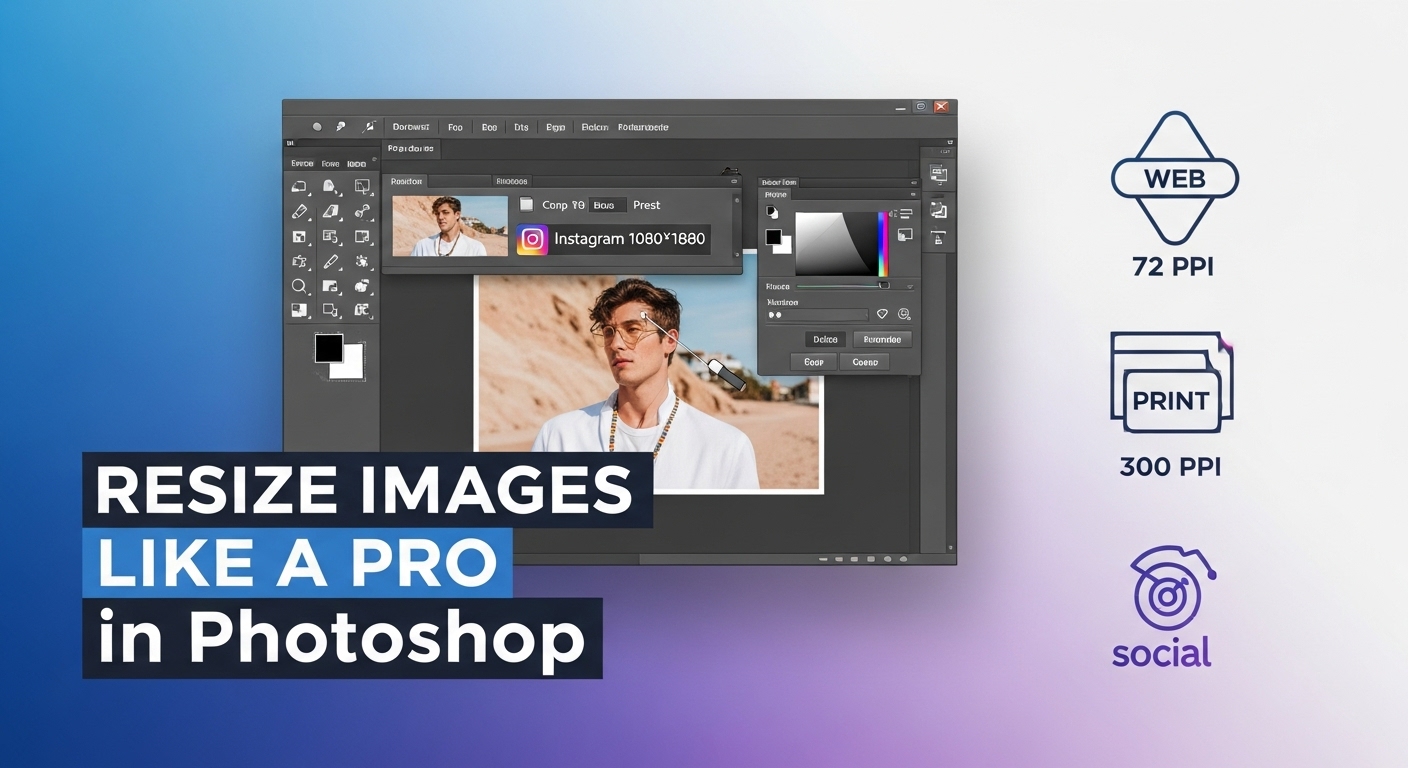
You need the perfect image size for your website, social media post, or print project, but you want sharp details and no pixelation. Photoshop gives you precise control over every resize, so you deliver professional results every time. Follow this guide and resize images confidently in minutes.
- Why Proper Resizing Matters Before You Start
- Understand Key Concepts: Pixels, Resolution, and File Size
- Prepare Your Image the Smart Way
- Method 1: Resize Precisely with Image Size Dialog (Most Popular)
- Method 2: Quick Visual Resize with Free Transform
- Method 3: Resize and Crop in One Step with the Crop Tool
- Method 4: Change Canvas Size Without Touching the Image
- Resize for Specific Uses: Web, Social Media, and Print
- Expert Tips to Keep Maximum Quality Every Time
- Batch Resize Multiple Images in Seconds
- Avoid These Common Resizing Mistakes
- Advanced Techniques for Professional Results
- Conclusion
- FAQs
Why Proper Resizing Matters Before You Start
Resizing changes pixel count, resolution, or both. Get it wrong and you end up with blurry edges or huge file sizes that slow down your site. Do it right and your images load fast, print crisp, and look stunning on every screen.
Photoshop offers multiple methods so you pick the one that matches your goal, whether you shrink a hero image for your homepage or enlarge a product shot for a catalog.
Understand Key Concepts: Pixels, Resolution, and File Size
Pixels make up your image. Width × height gives total pixels. Resolution (PPI/DPI) tells how many pixels fit in one inch on screen or paper.
- Web and social media → 72 PPI works perfectly
- High-quality print → 300 PPI or higher delivers sharp results
File size depends on pixel count and compression. Reduce pixels wisely and you keep quality while shrinking file size dramatically.
Prepare Your Image the Smart Way
Always work on a copy. Go to File > Save As and name it “filename_resized.psd”. This protects your original.
Convert the background layer to a Smart Object first if you plan multiple resizes. Right-click the layer → Convert to Smart Object. Smart Objects let you resize non-destructively and keep full quality even after repeated scaling.
Method 1: Resize Precisely with Image Size Dialog (Most Popular)
Open your image, then choose Image > Image Size (Ctrl/Cmd + Alt + I).
The dialog shows current dimensions and resolution. Keep the chain icon linked to lock aspect ratio, Photoshop adjusts the other dimension automatically so your image never stretches.
Enter new values:
- Type desired width or height in pixels, inches, or percent
- Set resolution (72 for web, 300 for print)
- Tick Resample and choose the best method:
- Preserve Details 2.0 → best for enlarging (uses AI to add realistic detail)
- Bicubic Sharper → ideal for reducing size (keeps edges crisp)
- Automatic → Photoshop picks the smartest option for most photos
Preview changes at 100% zoom inside the dialog. Click OK and you finish in seconds.
Pro tip: Hold Shift while dragging in the preview to zoom in and check critical areas like eyes or text.
Method 2: Quick Visual Resize with Free Transform
Select the layer, press Ctrl/Cmd + T to activate Free Transform.
Drag corner handles to scale. Hold Shift to lock proportions. Hold Alt/Option to scale from the center.
For pixel-perfect control, type exact percentages in the options bar at the top.
Press Enter when you feel happy. This method works great for quick adjustments or when you resize a layer inside a larger composition.
Method 3: Resize and Crop in One Step with the Crop Tool
Press C to activate the Crop tool.
Drag the handles or type exact width, height, and resolution in the options bar. Photoshop shows the aspect ratio and PPI live.
Choose a preset (Instagram post, Facebook cover, A4 print) from the ratio dropdown to hit platform sizes instantly.
Commit the crop with the checkmark or Enter. The Crop tool automatically resamples, so you get the exact dimensions and resolution you need.
Method 4: Change Canvas Size Without Touching the Image
Sometimes you need more space around your photo. Go to Image > Canvas Size.
Enter new width and height, choose an anchor point (center, top-left, etc.), and pick a canvas extension color. This method expands the workspace without touching a single pixel of your subject.
Resize for Specific Uses: Web, Social Media, and Print
For websites and blogs
Target 72 PPI and longest side between 1200–2500 pixels. This keeps load times under 2 seconds while looking sharp on retina screens.
For social media
- Instagram square post: 1080 × 1080 px
- Instagram story: 1080 × 1920 px
- Facebook cover: 820 × 312 px
- LinkedIn post: 1200 × 627 px
Use the Crop tool presets or Export As to hit these exact sizes.
For print
Set 300 PPI minimum. Calculate required pixels: inches × 300. A 8×10 inch photo needs 2400 × 3000 pixels.
Expert Tips to Keep Maximum Quality Every Time
Work with Smart Objects whenever possible. They store the original pixels so you can scale up and down repeatedly without degradation.
For extreme enlargements, try Filter > Neural Filters > Super Zoom. This AI tool analyzes and adds detail far better than traditional upscaling.
After resizing down, add a touch of Unsharp Mask or Smart Sharpen to restore edge crispness.
Always save as PSD first, then export your final version as JPEG (web) or TIFF (print).
Batch Resize Multiple Images in Seconds
Go to File > Scripts > Image Processor.
Select your folder, choose file type (JPEG), set max width/height, and run. Adobe Photoshop processes hundreds of images automatically while preserving quality.
Avoid These Common Resizing Mistakes
Never resize by dragging in the main window without Free Transform, Photoshop interpolates poorly and you lose quality fast.
Uncheck Resample only when you want to change print size without changing pixels (useful for print prep).
Avoid Nearest Neighbor resampling on photos, it creates blocky results. Reserve it for pixel art.
Advanced Techniques for Professional Results
Use Content-Aware Scale (Edit > Content-Aware Scale) when you must change proportions but want to protect important areas like faces or products.
Convert to Smart Object before Free Transform, then apply multiple transforms, quality stays perfect.
Explore Camera Raw’s Super Resolution for RAW files: open in Camera Raw, right-click, choose Enhance, and watch it double resolution with AI.
Conclusion
You now master every major way to resize an image in Photoshop. Choose Image Size for precision, Free Transform for speed, Crop tool for exact platform specs, and Smart Objects plus AI tools for best quality.
Practice on a few test images today and you will resize confidently forever. Your websites will load faster, your prints will look razor-sharp, and your social posts will stand out.
Ready for professional photo editing or bulk image optimization? Visit Clipping Expert Asia for expert clipping, resizing, and enhancement services that save you hours.
FAQs
1. What is the best resolution for web images in Photoshop?
72 PPI is standard. Combine with 1200–2500 pixels on the longest side for fast loading and crisp display on all devices.
2. How do I resize an image without losing quality in Photoshop?
Convert to Smart Object first, use Preserve Details 2.0 for enlargement or Bicubic Sharper for reduction, and avoid repeated resizing on raster layers.
3. Can I resize a layer without affecting the whole image?
Yes. Select only that layer, press Ctrl/Cmd + T, and transform. Convert to Smart Object first for non-destructive scaling.
4. What’s the difference between Image Size and Canvas Size?
Image Size changes the actual photo pixels. Canvas Size only expands or reduces the workspace around the image.
5. How do I resize for Instagram in Photoshop?
Use the Crop tool, select 1:1 ratio for posts or 9:16 for stories, set 1080 px width, and export as JPEG at 80% quality.
6. Why does my image look blurry after resizing?
You probably used the wrong resampling method or resized a raster layer multiple times. Switch to Preserve Details 2.0 and work with Smart Objects.
7. Is there a way to batch resize photos in Photoshop?
Yes. File > Scripts > Image Processor lets you resize an entire folder to exact dimensions in one click.
8. Should I resize before or after editing?
Edit at full resolution first, then resize and export at the end. This preserves maximum quality through your entire workflow.