


Outsource Image Editing Services: Save Time & Boost Visual Quality
October 27, 2025
How to Choose the Best Backgrounds for Headshots
December 5, 2025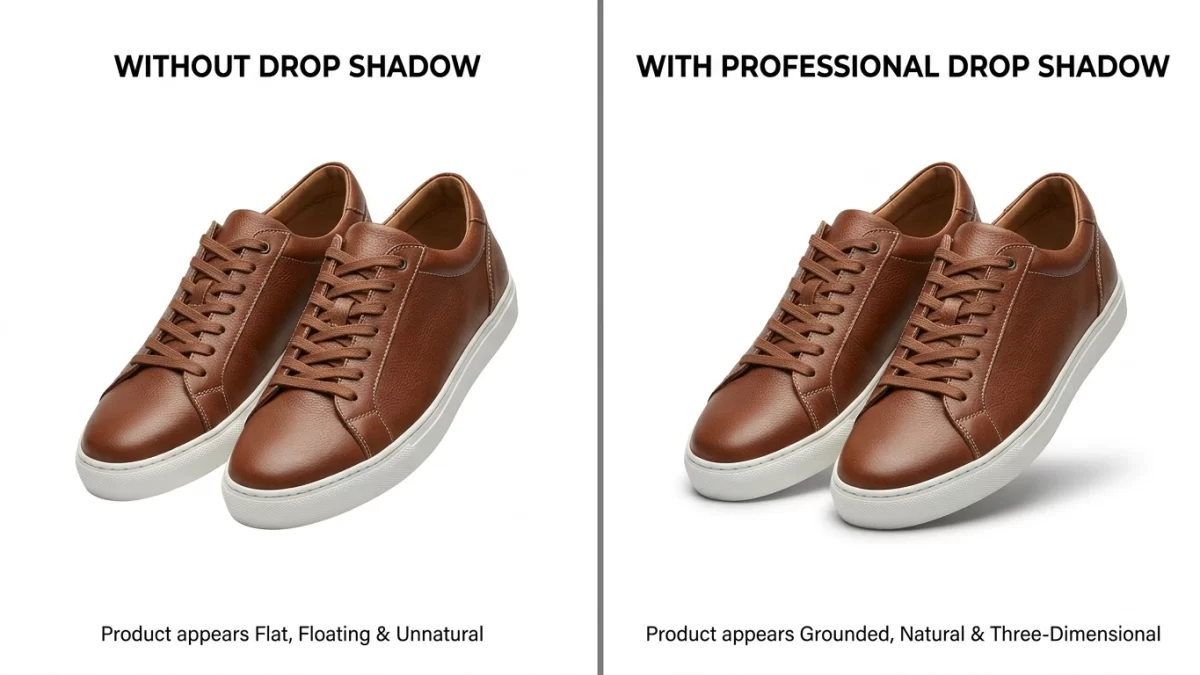
In the competitive world of online retail, product photos must do far more than simply display an item. They need to create a tangible sense of realism that helps shoppers feel confident in their purchase decisions. After removing a product’s background, images often look flat and unnatural—they appear to float in space without any connection to a surface. Professional shadow creation solves this problem by adding realistic shadows that anchor the product, giving it depth, dimension, and a polished, professional finish.
Research consistently shows that high-quality product imagery drives sales. According to Baymard Institute, 22% of online returns happen because the product looks different from what the photos showed. A well-executed product shadow effect makes items look more tangible and three-dimensional, helping customers visualize the product clearly before buying. For online stores targeting discerning markets like the USA, this added realism significantly impacts customer perception and trust, leading to better engagement and higher sales. Investing in professional photo retouching to add shadows transforms a simple cutout into a believable product presentation that drives revenue.
- 1. Adds Depth and Dimension to Products
- 2. Creates a Professional and Consistent Look
- 3. Enhances Product Realism and Authenticity
- 4. Establishes Clear Visual Context for Products
- 5. Focuses Customer Attention Directly on the Product
- 6. Increases Perceived Product Value and Price Positioning
- 7. Improves Conversion Rates and Reduces Costly Returns
- Frequently Asked Questions (FAQs)
1. Adds Depth and Dimension to Products
After background removal, a product image can appear flat and two-dimensional. It lacks the visual cues that tell our brains it is a solid object with weight and substance. Professional shadow creation reintroduces these essential cues.
How Shadows Create Tangible Product Depth
By adding a soft drop shadow or a realistic natural shadow, editors give the product visible weight and dimension. This simple addition makes the item “pop” off the page, creating a convincing 3D effect that immediately captures attention.
Key benefits of adding depth through shadows:
- Creates visual weight that makes products feel solid and real
- Helps the customer’s eye understand the product’s shape and form
- Particularly essential for furniture, apparel, electronics, and footwear where form drives purchase decisions
- Transforms basic product shots into high-impact visuals that stop the scroll
The Psychology of Depth Perception in Online Shopping
Our brains rely on shadows to interpret the shape, size, and position of objects in space. Without them, we struggle to perceive depth accurately. In e-commerce product photography, applying this psychological principle makes a dramatic difference. A correctly placed shadow tells the viewer the product is resting on a solid surface, grounding it in reality and moving it from an abstract image to a concrete item.
Online shoppers cannot physically touch or hold your products. Your images must bridge this sensory gap. A three-dimensional appearance helps create a more tangible product representation, and when customers can imagine owning and using the item, they are far more likely to complete a purchase.
2. Creates a Professional and Consistent Look
Consistency serves as the hallmark of a professional brand. When every product in your online store shares a similar, high-quality aesthetic, you create a polished and cohesive shopping experience that customers trust.
Building Brand Identity Through Shadow Consistency
Professional shadow creation proves instrumental in achieving this visual harmony. By applying a uniform product shadow effect across all your images, you establish a consistent brand aesthetic that customers recognize instantly.
How shadows reinforce your brand identity:
- A soft, subtle natural shadow suits minimalist, high-end brands
- A defined drop shadow works well for brands selling bold, modern products
- Consistent shadow styles help customers recognize your products on crowded marketplace platforms
- A dedicated photo retouching team signals that you are a serious and reliable business
Amazon’s marketplace guidelines require a pure white background (RGB 255,255,255) for main images but explicitly allow “minimal shadows around the product.” Applying a consistent product shadow effect helps your products look professional and uniform within these competitive environments. This standardization makes your product line appear organized and well-managed, enhancing perceived quality and credibility as a seller. This professional edge leads to higher click-through rates and better sales performance across major platforms.
3. Enhances Product Realism and Authenticity
The primary goal of professional shadow creation is making product photos look genuinely realistic. In any real-world setting, every object casts a shadow. Images without shadows look fake and manipulated, instantly eroding customer trust.
Natural Shadow vs. Drop Shadow: Key Differences
Expert shadow editors carefully craft effects that replicate the way light behaves in reality. Understanding the distinction between shadow types helps you choose the right approach for each product.
| Shadow Type | Key Characteristic | Best Use Case |
|---|---|---|
| Natural Shadow | Follows object’s shape, varies in intensity, mimics actual light source | High-end fashion, jewelry, footwear, products needing visual authenticity |
| Drop Shadow | Uniformly blurred and offset, creates subtle “floating” effect | Basic e-commerce, clean product cutouts, neutral backgrounds |
| Reflection Shadow | Mirror-like effect beneath product, creates glossy or reflective surface look | Electronics, cosmetics, luxury goods, premium branding |
Creating a natural shadow requires highly skilled editing. Expert editors consider the direction and intensity of the light source, the shape of the object, and the surface it rests upon. A natural shadow is often softer and less defined as it moves further from the product, with realistic gradient and opacity. Mastering these subtleties separates professional image editing from amateur work and builds the authenticity that customers demand. Learn more about realistic shadow techniques on Shopify’s blog.
4. Establishes Clear Visual Context for Products
A shadow does more than add depth—it provides essential visual context. It helps the viewer understand the product’s relationship to its environment, even when that environment is simply a plain white background.
Why Context Matters in E-Commerce Product Photography
A shadow anchors the product, telling customers that the object has mass and interacts with a surface. Without this context, the product feels disconnected and abstract. Professional shadow creation services expertly add this missing piece of the visual puzzle, creating a product shadow effect that logically fits the product’s shape and assumed lighting.
What context helps customers understand instantly:
- The product’s approximate size and scale
- Whether the item is heavy or light in weight
- How the product would look in a real-world setting
- The spatial orientation and positioning of the item
Context helps customers answer subconscious questions without conscious effort. It reduces the cognitive load on shoppers—they do not have to work as hard to understand what they are looking at. High-quality imagery increases conversion and decreases the likelihood of negative reviews or returns by helping customers make informed purchase decisions. This smoother, more intuitive viewing experience leads to longer engagement times on your product pages and higher purchase confidence.
5. Focuses Customer Attention Directly on the Product
While it may seem counterintuitive, adding a shadow helps focus more attention on the product itself. A shadow frames the product and creates subtle contrast that draws the eye toward the item.
How Shadows Guide the Viewer’s Eye Through Visual Hierarchy
This effect proves especially powerful on plain white backgrounds, where a product without a shadow can sometimes blend in or appear washed out. A well-executed product shadow effect adds visual interest without creating distraction. Unlike a busy background, a shadow is a natural element that the brain expects to see. Its presence makes the entire composition feel balanced and complete, allowing the product to remain the undisputed hero of the image.
The psychological impact of shadow-based visual anchoring:
- Shadows act as subtle visual anchors that ground the product at the bottom of the image frame
- The contrast between product, shadow, and background creates a clear visual hierarchy
- This structure makes images easier to scan and comprehend in fast-paced online shopping environments
Eliminating the “Floating” Effect Once and For All
One of the biggest problems with simple background removal is the “floating” effect, where the product appears weightlessly suspended in a white void. This unnatural look can be jarring for viewers and instantly damages credibility. Shadow creation completely eliminates this issue. By adding a natural shadow or drop shadow, the product becomes instantly grounded, appearing to sit firmly on a surface. This simple addition transforms a poorly executed cutout into an intentional, professional image that inspires confidence.
6. Increases Perceived Product Value and Price Positioning
The overall quality of your product presentation directly impacts its perceived value. Professional, polished images with realistic details suggest a high-quality product worthy of a premium price.
The Direct Link Between Image Quality and Price Perception
Professional shadow creation plays a key role in this professional presentation. The addition of a subtle, realistic shadow elevates the entire image, making the product look more premium and desirable. This enhanced perceived value allows you to position your brand at a higher price point and compete on quality and style, not just on price.
Key data on image quality and customer behavior:
- Professional-quality photos yield approximately 33% higher conversion rates compared to low-quality images (Niel Patel)
- Adding realistic shadows to product images can increase click-through rates by an estimated 15–20%
- Products with shadows in ad frames increase consumer willingness to pay, according to visual marketing studies
Luxury brands consistently feature flawless photography with perfect lighting, composition, and post-production. A realistic product shadow effect is a consistent feature of this high-end aesthetic. When customers see this level of detail and quality, they associate it with a premium product and become more willing to pay higher prices because the presentation builds confidence in the item’s worth.
Using Reflection Shadows for a Premium Feel
A reflection shadow proves particularly effective for creating a premium feel. This technique requires a high level of skill to execute realistically—the reflection must be distorted correctly based on the product’s shape, and its opacity must fade naturally. Reflection shadows add a sophisticated, modern look that works beautifully for electronics, jewelry, cosmetics, and glassware. When done correctly, this effect adds a “wow” factor to your product images, making them look sleek and luxurious to appeal to high-end consumers.
7. Improves Conversion Rates and Reduces Costly Returns
Ultimately, the goal of improving product photos is increasing sales and protecting profitability. Professional shadow creation contributes to this goal through multiple channels: adding realism, depth, and professionalism builds customer trust, while providing context and focusing attention helps customers better understand the product.
How Better Images Drive Higher Conversion Rates
The path from product view to purchase is a journey of building trust, and every detail matters. A realistic shadow is a small but significant detail that adds to a photo’s credibility. Multiple credible photos build a trustworthy product page, and a trustworthy page converts visitors into customers.
The financial impact of professional product imagery:
- Optimized images can increase conversion rates by 30–40% across e-commerce listings
- Better images improve overall user experience, making browsing more enjoyable and informative
- Positive user experience directly correlates with higher conversion rates and customer loyalty
Setting Realistic Expectations to Lower Return Rates
Realistic images help set accurate customer expectations and directly reduce costly returns. When a product looks tangible and three-dimensional online, customers form an accurate impression of what they will receive.
Critical return rate statistics every e-commerce seller should know:
- Baymard Institute finds that 22% of online returns occur because the product looks different from the advertised photos
- The average e-commerce return rate hovers around 17%, climbing to 25% for apparel
- Size and fit alone account for 67% of fashion returns, but poor visual realism also plays a major role
A flat, floating image provides an abstract representation that often disappoints customers upon delivery. A grounded image with depth and shadow feels like a real object, giving customers an accurate impression of the product’s physical presence. When the product arrives, it matches the mental model the customer formed, leading to greater satisfaction, fewer returns, and stronger long-term brand loyalty.
Frequently Asked Questions (FAQs)
1. What is a shadow creation service?
Professional shadow creation is a specialized photo editing service that adds realistic shadows to product images after background removal, making products look three-dimensional, natural, and properly grounded in their environment.
2. What is the difference between a drop shadow and a natural shadow?
A drop shadow places a soft, gray shadow behind an object to create a subtle “floating” effect. A natural shadow mimics how a product would actually cast a shadow on the surface beneath it, following the object’s shape, light direction, and perspective for maximum realism.
3. Why are shadows so important for e-commerce product photos?
Shadows add essential depth, dimension, and realism to product images. They make products look more tangible and professional, build customer trust, increase perceived value, and significantly improve conversion rates while reducing returns.
4. What is a reflection shadow and when should I use it?
A reflection shadow creates a mirror-like reflection beneath a product, simulating placement on a glossy or reflective surface. Use this technique for electronics, jewelry, cosmetics, glassware, and any product where you want a sleek, premium, high-end aesthetic.
5. Do Amazon and other marketplaces allow shadows in product images?
Yes. Amazon requires a pure white background for main images but explicitly allows “minimal shadows around the product.” Well-executed shadows are encouraged because they improve image quality and customer experience without violating marketplace guidelines.
6. How do shadows help reduce product returns?
Shadows help set accurate customer expectations by making products look tangible and three-dimensional online. When customers see realistic shadows, they form accurate mental models of the product’s physical presence. This alignment between online presentation and delivered product significantly reduces “item not as described” returns.
7. Can I add shadows myself, or should I hire a professional service?
While basic shadow effects can be added using Photoshop or AI tools like Photoroom, professional shadow creation requires advanced skills in light source analysis, perspective transformation, and opacity blending to achieve truly natural results. Professional services deliver consistent, high-quality shadows that scale across large product catalogs.
8. What types of products benefit most from shadow creation?
All e-commerce products benefit from professional shadows, but furniture, apparel, electronics, footwear, jewelry, cosmetics, home goods, and luxury items see the most dramatic improvements. Any product where form, shape, and visual authenticity influence purchase decisions requires professional shadow creation for optimal results.