

DJI Osmo Pocket 4 Review 2026: Specs, Features & Verdict
May 21, 2026
Nikon D4S Review: Specs, Pros, Cons & Honest Verdict
May 25, 2026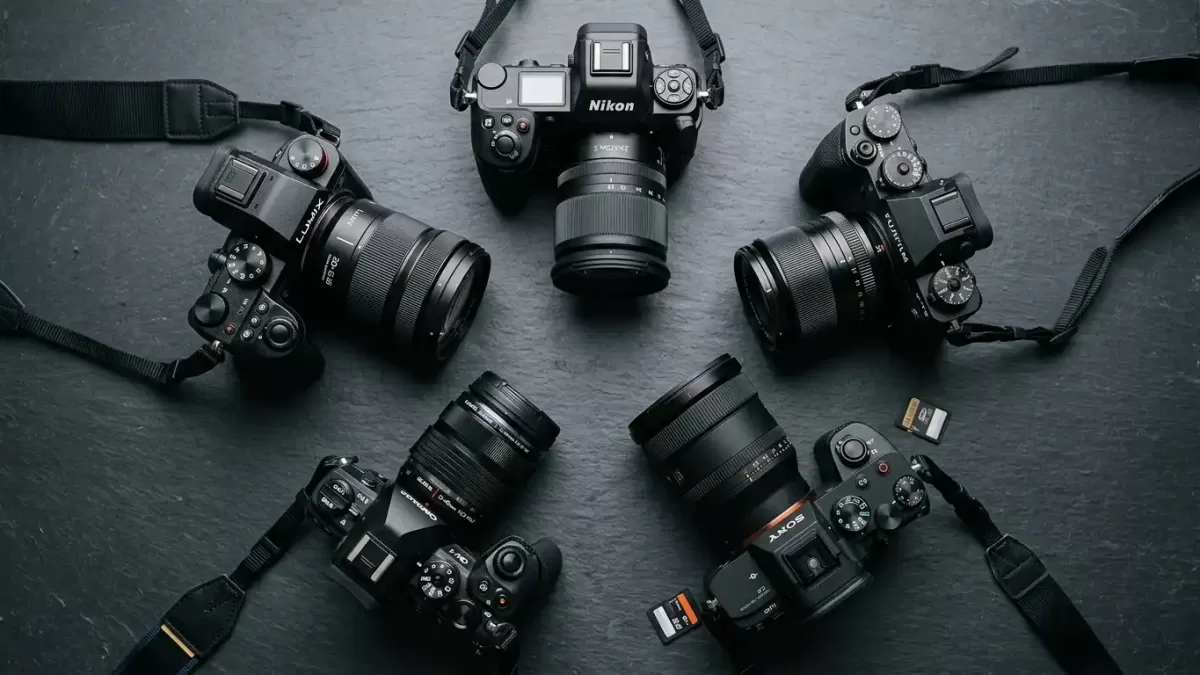
Let’s face it: buying a new camera in 2026 feels overwhelming. Manufacturers release stacked sensors, AI-driven autofocus, and insane burst rates faster than most of us can learn to use them. You do not need the most expensive model. You need the right tool for your specific vision.
After testing over a dozen flagship and mid-range bodies in real-world conditions (from rainy Scottish highlands to studio shoots), I have cut through the marketing noise. This guide focuses on value, performance, and handling. Whether you shoot weddings, wildlife, or street photography, you will find your perfect match here.
Why trust this guide? I update these recommendations based on actual field use not spec sheets. Every camera here delivers professional-grade image quality.
Ready to sell your high-res images online? Flawless product presentation starts with a clean background. Let our experts handle the tedious work so you can focus on shooting. Check our professional background removal service
- What Defines the Best Camera in 2026?
- 1. Nikon Z8 – Best Camera for Photography in 2026 (Overall)
- 2. Fujifilm X-T5 – Best Travel & Everyday Camera
- 3. Sony A7V / A7IV – Best Autofocus & Wedding Work
- 4. OM System OM-1 Mark II – Best Wildlife & Action Camera
- 5. Panasonic S5II – Best Hybrid Video/Photo Camera
- 6. Fujifilm GFX100S II – Best Landscape & Studio Camera
- 7. Nikon Zf – Best Retro Styling & Fun Factor
- Technical Deep Dive: Lenses, Storage, and Post-Processing
- How to Choose Based on Your Experience Level
- Frequently Asked Questions (FAQ)
- Final Verdict: The Only Camera You Actually Need
What Defines the Best Camera in 2026?
Before we rank specific models, you need to understand three key shifts in camera technology this year.
First, AI processing chips now drive autofocus and noise reduction. Cameras like the Nikon Z8 and Sony A7V use deep learning to track eyeballs, animals, and even vehicles with creepy accuracy.
Second, stacked CMOS sensors have gone mainstream. They eliminate rolling shutter in electronic mode, letting you shoot silent bursts at 20fps or higher without distortion.
Third, computational photography has reached dedicated cameras. Features like Handheld High-Res Mode (OM System) and built-in ND filters (Panasonic) now reduce your gear bag weight significantly.
Quick Decision Matrix (2026)
| If you shoot… | Buy this… | Skip this… |
|---|---|---|
| Travel & Street | Fujifilm X-T5 | Nikon Z8 (too heavy) |
| Wildlife & Sports | OM System OM-1 Mark II | Sony A7IV (slow burst) |
| Studio & Landscapes | Fujifilm GFX100S II | Any APS-C body |
| Hybrid Video/Photo | Panasonic S5II | Nikon Zf (poor video AF) |
| Weddings & Events | Sony A7V / A7IV | OM-1 II (low light noise) |
1. Nikon Z8 – Best Camera for Photography in 2026 (Overall)
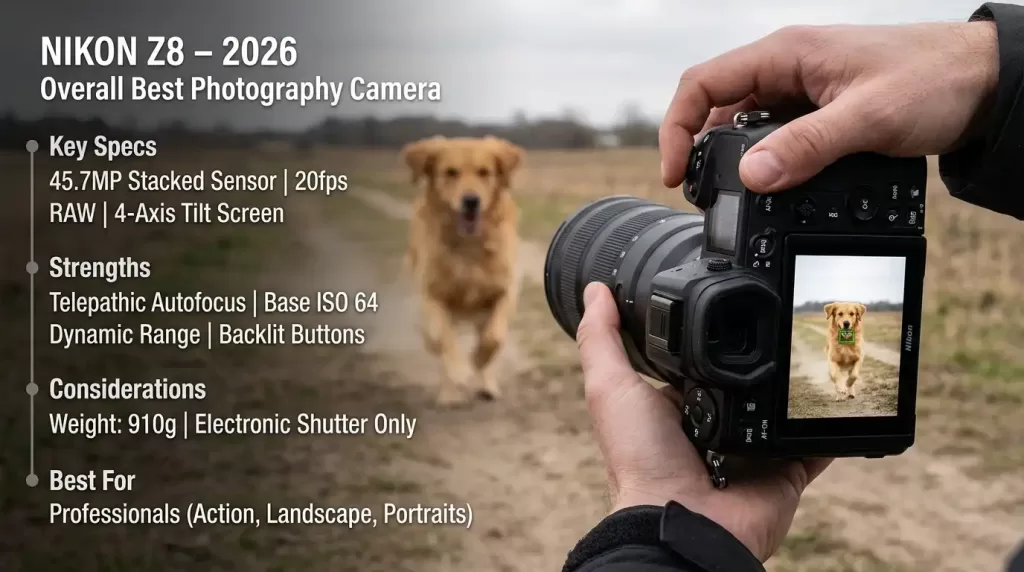
Nikon took the flagship Z9 and squeezed it into a smaller body. The result is the Z8, a 45.7MP stacked-sensor monster that does everything correctly. If you can only buy one camera for the next five years, make it this one.
Why it wins: The autofocus feels telepathic. I tracked a running dog directly toward the lens at 20fps RAW. Every single frame stayed sharp. The base ISO of 64 delivers medium-format-like dynamic range. You recover shadows without noise, and highlights roll off smoothly like film.
The body handles like a dream. Large, backlit buttons and a deep grip make long shoots painless. The 3.2″ 4-axis tilt screen works perfectly for both landscape and portrait orientation.
Only real downside: It weighs 910g. Your backpack will feel it. Also, the lack of a mechanical shutter means you might see banding under weird LED lights (rare, but possible).
Best for: Professionals who shoot a mix of landscape, action, and portrait work.
Want that “expensive look” for your portraits? Great lighting and composition deserve perfect skin. Our beauty retouching service adds the final polish while keeping texture natural. See how we refine portraits →
2. Fujifilm X-T5 – Best Travel & Everyday Camera
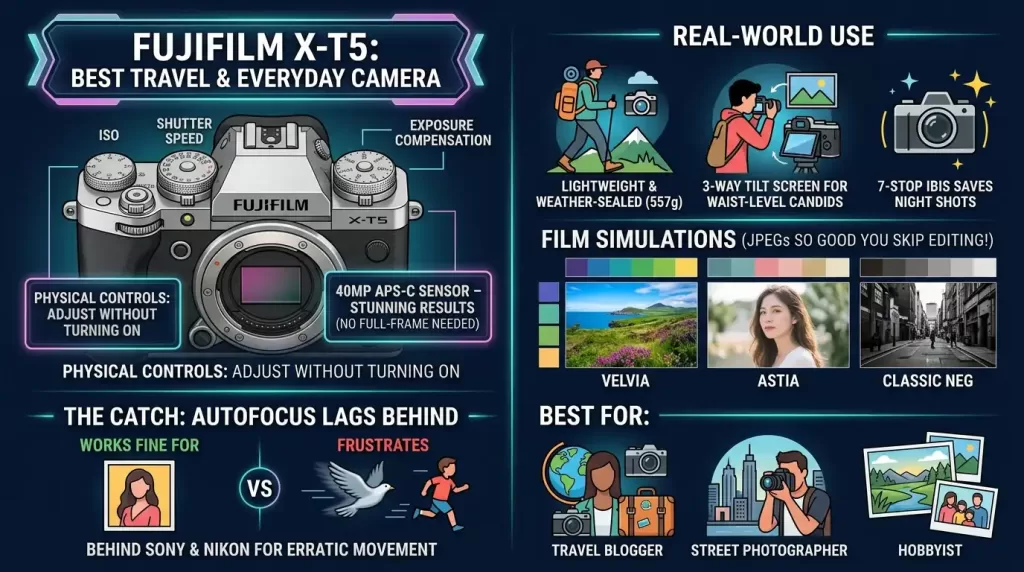
The X-T5 proves you do not need full-frame for stunning results. Fujifilm packed a 40MP APS-C sensor into a lightweight, weather-sealed body. The real magic lives in the dials. ISO, shutter speed, and exposure compensation all have physical controls. You adjust them without turning the camera on.
Real-world use: I took this hiking for a week. The 557g weight (with battery) barely registered in my bag. The 3-way tilt screen allowed waist-level candids, and the 7-stop IBIS saved my night shots in dim mountain huts.
Fujifilm’s film simulations (Velvia, Astia, Classic Neg) produce JPEGs so good you skip editing entirely. For travel, that speed matters.
The catch: Autofocus lags behind Sony and Nikon. It works fine for posed portraits and slow movement, but erratic kids or birds in flight will frustrate you.
Best for: Travel bloggers, street photographers, and hobbyists who enjoy the shooting process itself.
3. Sony A7V / A7IV – Best Autofocus & Wedding Work
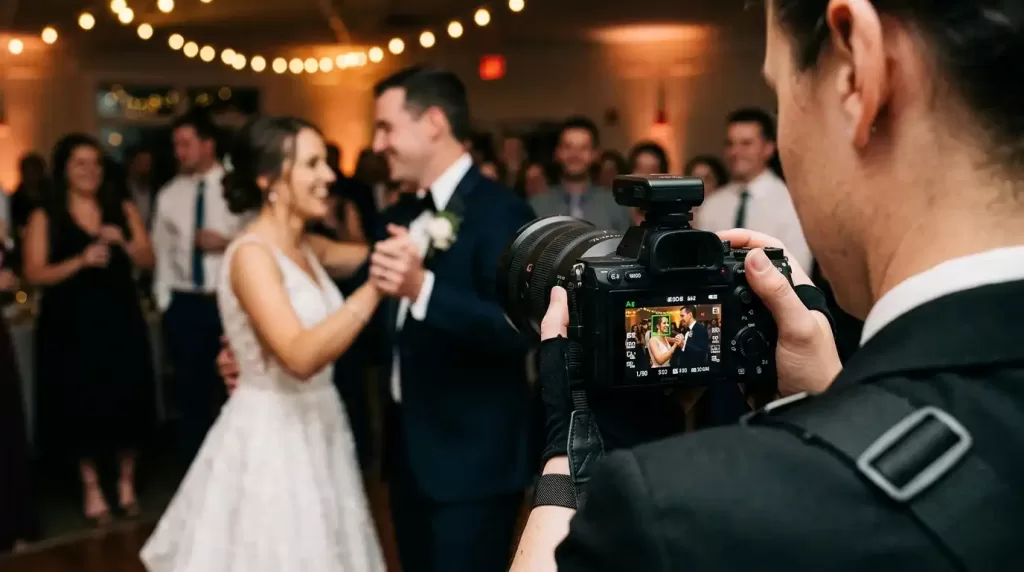
Sony continues to dominate the autofocus game. The new A7V (and the still-excellent A7IV) uses AI to recognize human poses, eyes, and even if a subject turns away. It never loses lock.
For wedding photographers: This reliability changes your workflow. You focus on composition and emotion. The camera handles tracking. The 33MP sensor gives you crop room for second angles. Dual card slots and endless lens options (Sony, Sigma, Tamron) make it a safe investment.
But the grip: After six hours, the ergonomics dig into my hand. The menu system, while improved, still feels like a spreadsheet. Also, the IBIS gives only 3-4 stops of stabilization—weak compared to OM System or Nikon.
Best for: Event pros, portrait artists, and anyone who needs “it just works” autofocus.
Selling products online? A floating shadow or ghost mannequin effect instantly boosts perceived value. We create clean, editable visuals that convert browsers into buyers. Explore our shadow and ghost mannequin services
4. OM System OM-1 Mark II – Best Wildlife & Action Camera
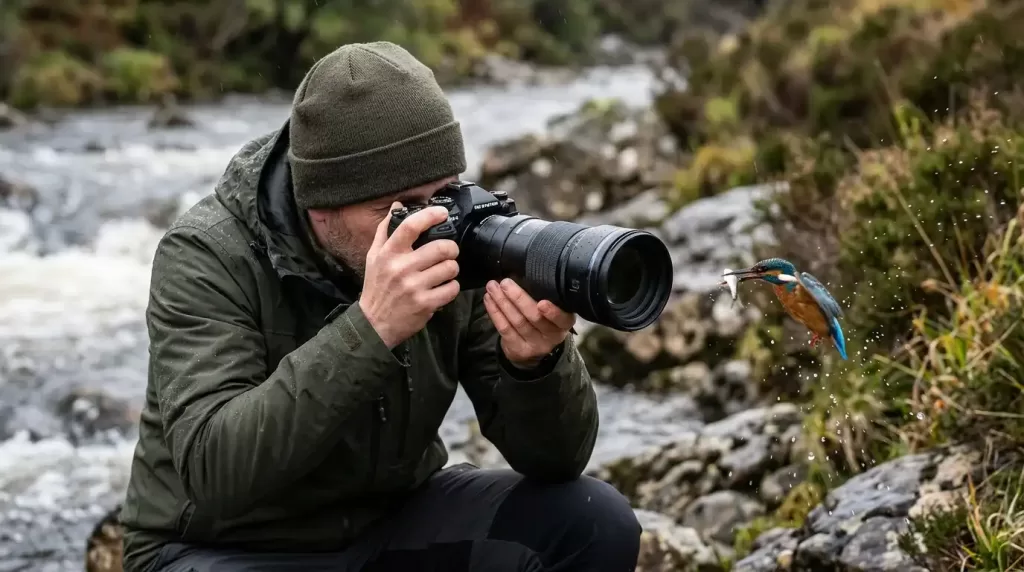
Do not ignore Micro Four Thirds in 2026. The OM-1 Mark II proves that sensor size isn’t everything. The 20MP stacked sensor reads out so fast you get 50fps RAW bursts with full AF. The pre-capture feature records frames before you fully press the shutter.
A game-changer for birds: I photographed kingfishers diving. The camera saved 15 frames from before I reacted. No other system offers this for the price.
The build quality is absurd. This camera survived Scottish monsoon rain and Icelandic snow. The 8.5-stop IBIS lets you shoot 2-second handheld exposures. You leave your tripod at home.
The trade-off: High ISO past 6400 gets noisy. You trade low-light purity for reach and portability. Pair it with the 300mm f/4 Pro lens for a lightweight wildlife kit.
Best for: Birders, sports shooters, and adventure travelers in harsh environments.
5. Panasonic S5II – Best Hybrid Video/Photo Camera
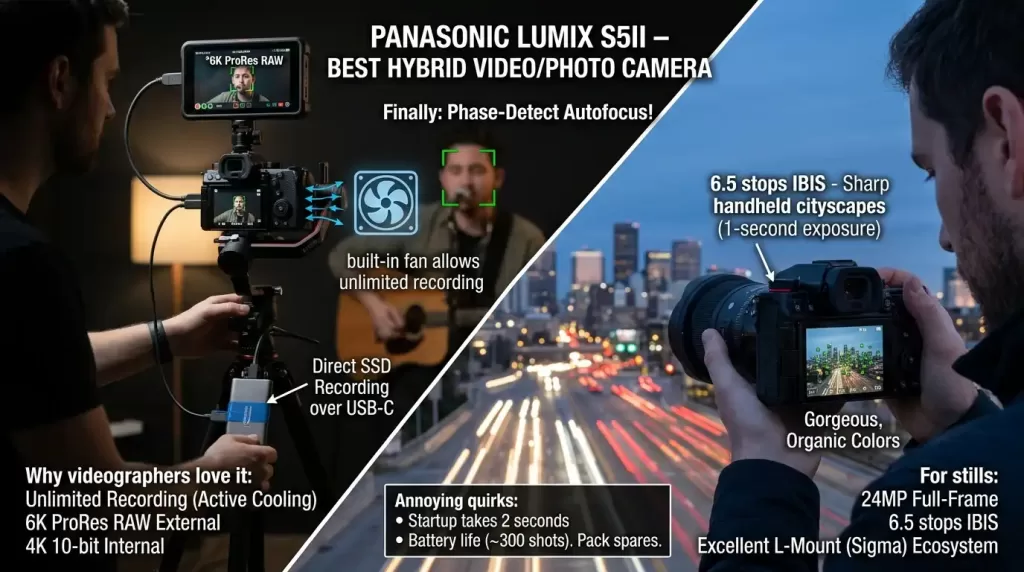
Panasonic finally added phase-detect autofocus. The S5II now competes directly with Sony and Canon. The 24MP full-frame sensor produces gorgeous, organic colors straight out of camera.
Why videographers love it: The built-in fan allows unlimited recording. You shoot 6K ProRes RAW externally or 4K 10-bit internally for hours. The active cooling means no overheating shutdowns. Direct SSD recording over USB-C saves you money on expensive CFexpress cards.
For stills, the IBIS hits 6.5 stops. I shot sharp cityscapes at 1-second handheld. The lens ecosystem (L-mount) now includes Sigma’s excellent f/1.4 primes at reasonable prices.
Annoying quirks: Startup takes 2 seconds (feels like forever). Battery life barely reaches 300 shots. Pack spares.
Best for: Content creators, indie filmmakers, and photographers who need one camera for both disciplines.
Shooting through glass or complex hair? Standard clipping paths fail on fine details. Our image masking service handles wispy hair, transparent objects, and soft edges with pixel-level precision. Get accurate masks for tricky subjects
6. Fujifilm GFX100S II – Best Landscape & Studio Camera
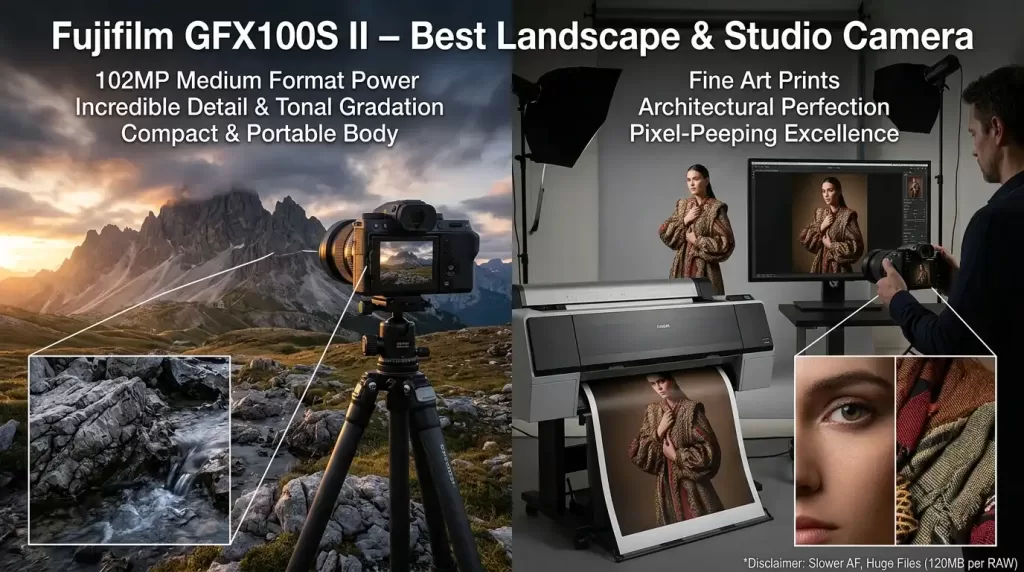
Medium format used to cost $10,000 and weigh as much as a cinderblock. The GFX100S II changes that. You get a 102MP sensor in a body only slightly larger than a full-frame DSLR.
The image quality: At base ISO, you see texture in clouds and fabric that smaller sensors compress into mush. The tonal gradations feel analog. If you print large (24″x36″ or bigger), you need this camera.
Autofocus runs slowly compared to the Z8, but landscapes don’t move. The lens lineup (GF lenses) costs serious money, but each one resolves 100MP perfectly.
Who shouldn’t buy this: Street photographers or anyone who needs speed. The file sizes (120MB per RAW) eat storage and slow down Lightroom.
Best for: Fine art printers, architectural photographers, and pixel-peeping perfectionists.
7. Nikon Zf – Best Retro Styling & Fun Factor
The Zf hides modern Nikon technology inside a 1980s film-camera body. You get the same EXPEED 7 processor as the Z8, but wrapped in brass dials and leatherette.
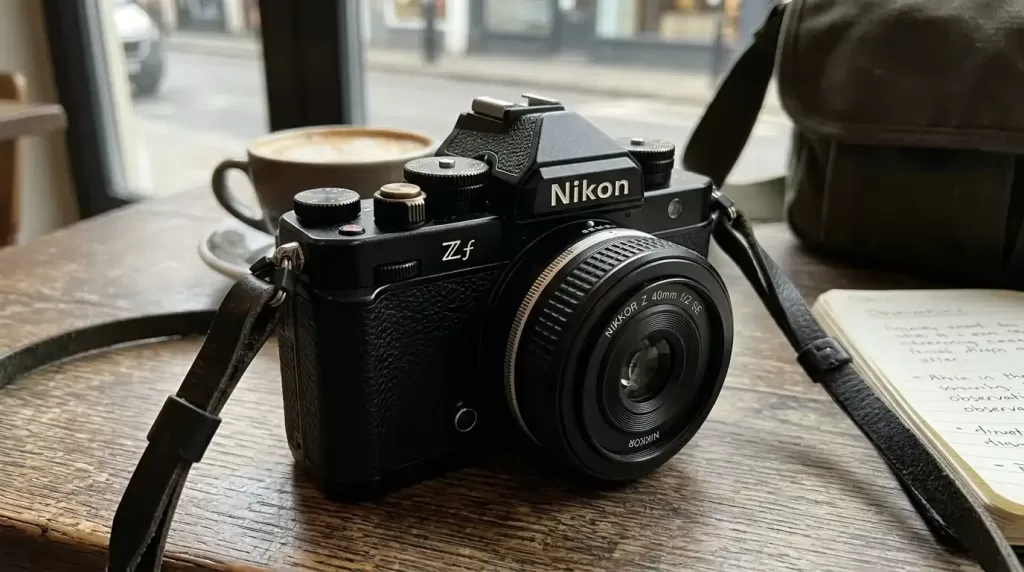
The experience changes how you shoot: Physical dials force you to slow down. You set exposure consciously. The 24MP sensor still produces rich colors and deep blacks. When paired with the compact 40mm f/2 SE lens, this outfit fits in a small messenger bag.
Comfort issues: Without an add-on grip, the flat body hurts your hand after an hour. The microSD slot (for backup) feels cheap. Also, the fully articulating screen works for video but annoys stills shooters.
Best for: Collectors, street photographers, and anyone who wants to fall back in love with photography.
Need perfectly isolated products with natural shadows? A raw clipping path creates a clean outline for any background. Our expert pathing ensures zero pixel loss or jagged edges. Order precise clipping path services online
Technical Deep Dive: Lenses, Storage, and Post-Processing
Buying an expensive camera body means nothing without good glass. Allocate 50% of your budget to lenses. A 10-year-old camera with a pro lens beats a new body with a kit lens every time.
Lens recommendations by genre:
- Portraits: 85mm f/1.4 or 135mm f/1.8 (full-frame)
- Travel: 24-105mm f/4 zoom + 35mm f/1.4 prime
- Wildlife: 150-600mm zoom or 300mm f/4 prime
- Landscapes: 16-35mm f/2.8 + 24-70mm f/2.8
Storage planning matters. High-resolution cameras (45MP+) fill cards fast. Shooting uncompressed RAW on a 45MP camera uses about 60MB per file. A 128GB card holds roughly 2,000 images. For video, 4K 10-bit eats 5GB per 10 minutes.
Pro tip: Always carry two extra cards and a portable SSD. Card failure happens when you least expect it.
Need to calculate your storage for a trip? Understanding how many photos fit on your card prevents mid-shoot panic. Check this detailed guide on how many photos a 256GB card can hold
How to Choose Based on Your Experience Level
Beginners: Do not buy a flagship camera. The learning curve ruins your enjoyment. Start with a used Fujifilm X-T30 II or Sony A6400. Use the money saved for a photography workshop.
Enthusiasts: You want the Fujifilm X-T5 or Nikon Z6III. These hit the sweet spot of quality, features, and price. They offer room to grow without overwhelming you.
Semi-pros: The Sony A7IV or Panasonic S5II serve you well for client work. Dual card slots and reliable AF matter for paid gigs.
Full-time pros: Invest in the Nikon Z8 system or Fujifilm GFX. Your income depends on reliability and image quality. Buy once, cry once.
Your final image deserves more than straight-out-of-camera colors. From color grading to frequency separation, our comprehensive photo retouching brings your artistic vision to life. Let us retouch your best shots professionally
Frequently Asked Questions (FAQ)
1. Is 2026 a good year to buy a camera, or should I wait?
Buy now. The major sensor technology advances (stacked CMOS, AI processors) have matured. Any camera released in the last 18 months will serve you well for 5+ years. Waiting only delays your practice.
2. Do I really need full-frame for professional work?
No. The Fujifilm X-T5 (APS-C) and OM-1 (MFT) both produce professional, printable images. Clients care about composition and lighting—not sensor size. Full-frame helps in very low light or for extremely shallow depth of field.
3. Which camera has the most affordable lens ecosystem?
Micro Four Thirds (OM System, Panasonic) offers the best cheap lenses. You find excellent used lenses for $100-300. Fujifilm X-mount comes second. Full-frame L-mount (Panasonic/Sigma) offers good value. Sony E-mount has huge variety but pro glass stays expensive.
4. How important is IBIS (in-body image stabilization)?
Critical for handheld shooters. IBIS adds 2-5 stops of stability. You shoot sharp images at 1/10th second instead of 1/125th. For video, it smooths out walking shots. Only skip IBIS if you always use a tripod.
5. Should I buy a camera with an AA filter in 2026?
No. Most modern cameras omit the anti-aliasing filter. You get sharper images. The risk of moiré patterns is very low with today’s high-resolution sensors.
6. What is the best entry-level full-frame camera right now?
The Canon EOS R8 or the original Panasonic S5 (used). Both offer great image quality for under $1,500. You miss some pro features but gain fantastic low-light performance.
7. How many shutter actuations count as “high mileage”?
For mechanical shutters: Under 50,000 is low, 100-150k is moderate, 200k+ is high risk. Electronic shutters (most 2024-2026 cameras) last virtually forever. Buy electronic-shutter cameras used without worry.
8. Does the Nikon Z8 really outperform the Sony A1 for half the price?
For stills, yes. The Z8 matches or beats the A1 in dynamic range, ergonomics, and AF tracking. The A1 wins only if you need 30fps RAW or specific Sony glass. Most photographers should buy the Z8.
Final Verdict: The Only Camera You Actually Need
Stop obsessing over gear specs. The best camera for photography in 2026 is the one you carry every day. If the Fujifilm X-T5 makes you want to walk outside and shoot, buy it. If the Nikon Z8 feels like a tank in your hands and inspires confidence, stretch your budget.
For most readers, my clear recommendation is the Nikon Z8. It does everything well. You grow into it for years. Pair it with the 24-120mm f/4 S lens, and you cover 90% of real-world photography.
Your next step: Rent your top two choices for a weekend. Shoot the same scenes. Edit the files. One camera will feel like home. That feeling matters more than any spec sheet.
Ready to showcase your 2026 camera’s full potential? Even the best camera produces raw files that need final polish. Let our expert photo retouching service handle color correction, skin smoothing, and complex masking. Get 20% off your first retouching order here
Got questions about a specific model? Drop them in the comments below. I respond to every reader personally. Happy shooting, and see you out there with your new camera in 2026.